

LAHAINA, Maui, Hawaii–Credit union volunteers gathered here were given an update on regulatory priorities in the coming year, what a new Congress might mean, and whether there will be more oversight of climate change-related policies—and further cautioned that if the board is “sitting and hoping” the current interest rate environment will change, hope is not a strategy.
Sharing their thoughts and participating in the panel discussion were NCUA Board Member Rodney Hood and NASCUS CEO Brian Knight. The conversation at Rochdale’s Volunteer Leadership Institute meeting was moderated by Carol Marx, president and CEO of the Hawaii Credit Union League.
Here is a look at what was discussed:
Marx: With a new year here, what’s your assessment of how the credit union industry is doing in this environment, and what trends, challenges and opportunities are you seeing?
Hood: Credit unions as evidenced by call report third quarter data have strong signs. Credit unions have grown by 5.5 million members since the onset of pandemic. Assets have grown exponentially to $2.15 trillion, about a 10% increase. The one number that I am really most proud of is that our loans now exceed $1.9 trillion. You’re helping people get mortgages and Main Street businesses get access to capital, and nowhere was that more evident than in the 310,000 PPP loans credit unions made. And it’s been prudent lending, as evidenced by our low charge-off ratios.
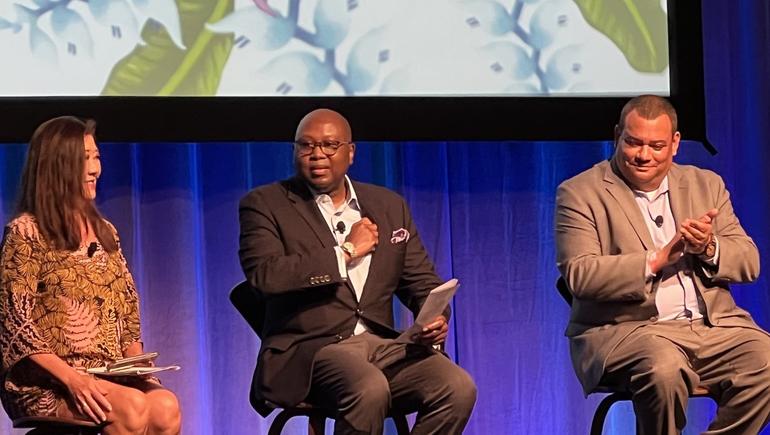
From left, Carol Marx, Rodney Hood & Brian Knight at VLI meeting.
Another sign that makes me bullish about the future is the strong net worth within credit unions of 10.59% collectively (among FICUs). Credit unions have a lot of capital that can be deployed for the headwinds that may be about to come.
We also have a very strong insurance fund. I can’t say there won’t ever be a premium assessment, but I don’t see this on the horizon.
As for trends, one of the things we are looking at is interest rate risk given the velocity of increases we are seeing from the Federal Reserve. Many of you have had to look at duration risk and you’ve had to look at the pricing of loans. We are looking at interest rate risk on a case by case basis. If you are just sitting and hoping that this interest rate environment will change, hope is not a strategy. You need to make sure you are showing your examiners you know what you’re doing with interest rate risk mitigation.
We are going to be providing new guidance around liquidity pressures. And we also need to be mindful of CECL implementation. I thought CECL was a solution in search of a problem. While I could not get CUs exempted from CECL, we were able to give credit unions a three-year window to implement. Examiners are going to be looking at how you are implementing CECL.
Marx: Much of the conversation has been focused on post-pandemic risks. What potential risks keep you up at night
Knight: From the state perspective, other than the issues Rodney raised, some of the things NASCUS is talking about start with cybersecurity. That’s a huge one, especially with remote employees. Our defensive perimeter for cybersecurity is expanding. It’s not just enough to lock down the organization, you have to be concerned about employees’ houses.
We’re all swimming upstream; social engineering is still the primary way bad actors get into institutions. We tell people not to click on links, not to click on links, and what do we do? We send out links.
There is also the competition for talent. We hear from our members that the available workforce seems to have dissipated. So where do we find the workforce of the future in regulatory agencies and at credit unions?
The final challenge is to look at credit unions as a whole. Where do credit unions fit in with fintechs? We need to think about, do we have the best foundational structure?
Hood: There truly is a war for talent. We have 50 open positions at NCUA and we have to be aggressive. We are having to search diligently for employees.
Knight: And particularly for examiners. We can’t find examiners.
Hood: I try to welcome all new examiners. From the time we welcome them until you see them on the job there is two years of training.
Marx: What can we expect from the 118th Congress?
Hood: One of the things I know after two stints in government is not to answer that question directly. But whether it is the 117th or 118th Congress I want to continue to work with whomever is in Congress on reducing your regulatory burden. There are going to be a lot of new committee chairs. Patrick Henry from my home state of North Carolina will be new chair of the House Financial Services committee and he cares passionately. I look forward to working with him. There is an opportunity for us to continue to tell our stories.
Knight: Rep. McHenry has shown a willingness to work across the aisle. I think with digital assets and cryptocurrency there is a recognition of perhaps a need for new rules. One question is who will regulate it and where it fits in the federal regime. We do have quite a few states that already regulate crypto. In the Senate, I think they are still going to focus on oversight policy, discussion of regulatory agencies and whether they are exceeding their statutory mandates, preservation of some of the powers of the CFPB, addressing climate change oversight.
Hood. I agree. There is a major turf war in Washington over oversight of cryptocurrency. Washington at some point is going to have to decide what is best for digital assets. I don’t see the people creating those assets waiting for Washington.
Knight: One other piece to watch is what happens with safe harbor for cannabis. It is not so clear cut as Republicans view it one way, Democrats another. It is often a personal view and it will be interesting to watch and see which party is willing to give a little bit.
Hood: I have been one of the few federal regulators who has been outspoken on the need for legalizing cannabis banking. I hear about people working at these legitimate businesses and they are denied loans for working at a dispensary. This is on my agenda as one of those underserved communities. These businesses have been vastly neglected.
Climate change is something I get asked about a lot. Yes, I believe it is important to tell credit unions to do their part, but do you need Washington to tell you how to mitigate risk in things you have been living with. I don’t see any rulemaking from NCUA on this.
Marx: What about the discussion from Washington on junk fees?
Knight: It’s a difficult issue. Several things have been conflated. There is the idea are any of these fees appropriate, or is it about appropriate disclosures? There are a lot of nuanced issues and unfortunately it has devolved into junk fees and thumbs up, thumbs down. If you are saying that kind of income is always inappropriate, then what kind of fees are appropriate? Offering products and services to consumers comes with a cost. Are we going to get back to no free share draft accounts? You can’t see a teller? The cost has to be recouped. It’s a complicated issue.
Hood: Saying fees are bad, make them go away, is a very disingenuous argument. More financial literacy is needed and it does come down to disclosures. I have seen some egregious abuse from Main Street (institutions) and for you to be thrown into that bucket is very disheartening. I have not seen any data showing credit unions have been acting in ways harmful to members.