EL SEGUNDO, Calif.–There is a unique opportunity available to U.S. employers to address the American retirement crisis and to redefine how they measure the success of their retirement plans, according to Financial Finesse.
With the majority of employees facing delayed retirement or worse, not being able to retire at all, Financial Finesse said it has developed a six-step retirement preparedness model that it is urging employers to adopt in order to address the crisis that could significantly impact their workforce. This model changes the paradigm from participation in company-sponsored retirement plans to preparation for all aspects of retirement, according to the company.
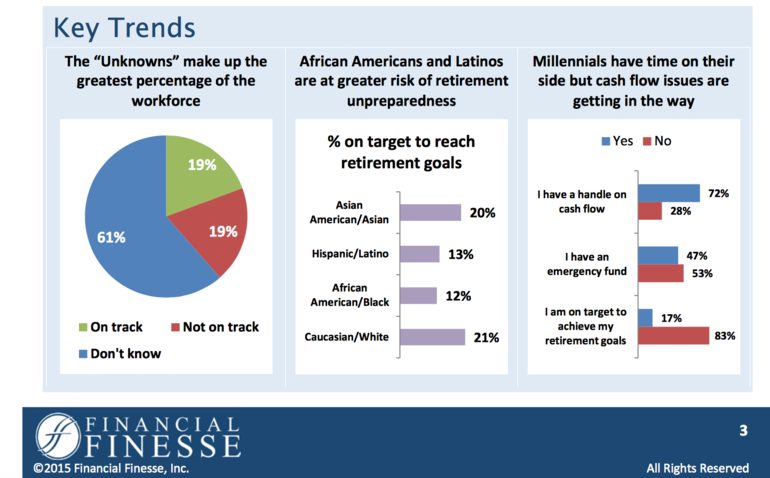
“Many employers have adopted automatic features, such as automatic enrollment and contribution rate escalators,” note Financial Finesse. “This has boosted retirement plan participation, but employees still aren’t saving enough. Even with 88% of employees participating in their employers’ 401(k) plans, they are overall, still massively underprepared for retirement, with only 19% of employees surveyed on track to reach their retirement goals. The percentage of underprepared employees drops even lower for certain demographics—with African Americans, Latinos and women at highest risk for not achieving a comfortable retirement.”
Among those employees who reported not being on track for retirement, Financial Finesse reported that a deeper analysis shows a lack of proactive retirement planning. Seventy-six percent of those that are not on track have not used a retirement calculator to run a projection—a first step in knowing how much they need to save. Additionally, only 47% have taken an investment risk tolerance assessment and only 31% rebalance their investment portfolio.
Greg Ward, the firm’s Think Tank director, said employees who are not prepared for retirement fall into three main groups:
- The unknowns – employees who are completely unprepared and overwhelmed. These employees don’t know if they are saving enough to retire comfortably and don’t have the resources, or don’t know where to begin.
- The underfunded – employees who have taken some initial steps to plan for retirement, such as running a retirement projection; they realize they are not saving enough for retirement but can’t or aren’t likely to due to other competing priorities.
- The underconfident – late career employees who from a financial standpoint, could retire comfortably but are uncertain about economic and market instability and need to be coached through the transition into retirement.
Financial Finesse said its Retirement Preparedness Model is designed to address the needs of all three groups, using principles of behavioral finance that have been proven to dramatically improve savings rates as well as investment behavior. The model starts with prompting every single employee to run a retirement estimate so that they see where they stand, and then sets employees up for success through automatically enrolling them into the plan at a high savings rate, and escalating that rate annually in small increments. Lastly, it provides benefits education and financial wellness programs to employees, which alone have been shown to increase retirement preparedness by 77%.
“This model is the future,” said Ward. “For years, all of us in the retirement industry have come at the problem from different angles thinking that there’s some sort of magic bullet that would change everything for participants. The reality is that a holistic approach is far more successful. Tools alone can’t resolve the problem; employees have to fundamentally change their behavior and that requires a very strong support system.”