

WASHINGTON—How does members’ economic instability affect credit union growth? How would ChatGPT answer that question? And how big an issue is liquidity going to be for all CUs? Four leaders from within the credit union community have offered some interesting insights on those questions and others.
During Mitchell/Stankovic’s Underground: Shattered event, the panel that tackled those issues included Jay Mossman, president/CEO with Akuvo; Mike de Vere, president/CEO with Zest AI; Tony Boutelle, president/CEO with Origence and Tom Davis, president/CEO with Trellance. The panel was moderated by Samantha Paxson, chief experience officer with Co-op Solutions.
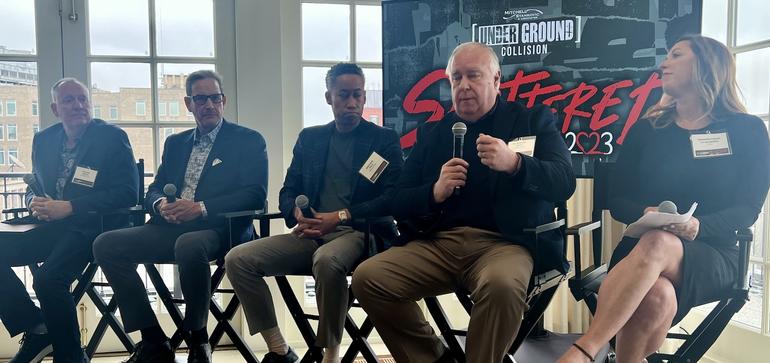
Here's a look at what was discussed:
Paxson: How do you think about economic instability and how does that impact the growth model for credit unions?
Mossman: The company we have really focuses on when things go wrong in life for members, when they don’t make those payments. It’s also an opportunity for you to absolutely make them a member for life.
One of the reasons I got back into this model was to turn (the approach to collections) upside down. I think many are still doing it the old way; you build the queues and make phone calls. You’re not accounting for the change in their behavior. Are you looking at the behavior of your employees? Which employees are doing the best job in solving those issues?
Not all delinquent members are bad members. Delinquency is an opportunity to engage the member. It’s an opportunity to make members, members for life. We’re starting to take a look at the collections side to look at data for members and employees to find better ways to resolve.
Three Points Worth Attention
de Vere: The good news is members still need your help. Eight out of 10 members think you are more suited than banks to help them when times get tough.
I want to touch on three points:
- Smart: You have to have more data. You have to have better insights into your members. With better data you can make decisions in a lot better way.
- Inclusive. Being more inclusive is where we can do better. Twenty percent of all Americans are difficult to score and make decisions on. When times are difficult, financial institutions shrink that credit box and make it easier on themselves. What happens? We leave a lot of people out, one in five. Over last few years we have talked a lot about DEI. It’s a good thing to do, and we are trying to figure out how to do it better. If you have more data and better technology you automatically make more of your members part of the game.
- More Efficient. Seventy-four percent of your members expect instant response time. It’s a big deal. If they don’t get it they go other places. We have to figure out how to be more efficient. Right now, credit unions are about 30 minutes or more in decisions. We have to get that faster, we have to be instantaneous. We have to be efficient.
Three Issues of Concern That Begin With ‘L’
Tony Boutelle: I’d like to talk about three things: liquidity, liquidity and liquidity.
I would say that from a member perspective, when it comes to buying cars right now they are under a lot of economic pressure. Obviously, there are so many things that went good for them in the sense that
COVID gave them a lot of money to spend. They were buying cars like crazy last year. That has slowed down a lot due to affordability issues; there are more cars out there at the dealerships.
During COVID used car prices went up 50% from 2019. Prices are still up there. They're starting to come down as more new cars come into the marketplace, but our average loan balance right now for new cars on our platforms is just under $36,000; it's the highest it's ever been. Affordability is a huge issue for members.
I know you guys feel sorry for the dealers, but they're making a lot of money right now, they are going to make good money this year. Economists have calculated the dealers in 2022 made more money than they ever have; in 2022, their gross profit margins were $55 billion. This year it’s expected to be in the $28-billion $35-billion range for gross profits this year.
But dealerships are hurting in a way right now in that they definitely don't have the kind of transactions they had last year. From a credit union perspective, I would just say that last year was our best year ever and I think some of your best years ever as far as making loans. The challenge that we have in a rising interest rate environment is generally we didn't raise rates fast enough, so you didn't attract money or we didn't raise rates fast enough and you made a lot of loans. We did $78 billion of loans last year on our platform, $56 billion was the year before.
What to Expect in 2023
Now we're into this world of 2023 where last year we were funding $6.5 billion dollars on average a month. In January we did about $4.2 billion, and it's going to go down even more in February.
So, that is the main topic. I guess that I would say going into ’23, in order to do better we have to have money to lend out because I think the big issue today is the loans you can make today at the new rates are at probably the best profit margins you've ever made. It's now how do we get the money to do that and, again, liquidity is an issue. I think it is about managing the balance sheets more aggressively in this interest rate environments. Interest rates are double what they were last year. We probably should have moved rates up a lot faster. Now, it's how do we find liquidity to help members get a loan.
Now, we are looking at doing some more securitizations.
What ChatGPT is Doing Already
Davis: I’m sure everyone has heard of ChatGPT. In November of 2022, the company had a $29 billion valuation. It’s an open AI platform and you can have a conversation with an AI bot and they will tell you anything and everything you want to know about your life.
I asked ChatGPT, ‘What is the impact of economic instability on members of credit unions?’ I'm just going to read a little bit of a summary because the conversation between me and this cloud-based thing lasted for quite some time.
Here we go: ‘Economic instability can have a significant impact on members of credit union. Credit unions are financial institutions that are owned and operated by their members and they are typically not-for-profit organizations. As such credit unions are often more focused on providing affordable financial services and products to their members rather than generating profits for shareholders…When economic instability occurs credit unions may face challenges related to loan defaults, declining in investment, increased regulatory scrutiny. This can impact the financial health of the credit union and, in turn, affect the services and products they are able to offer….’
Wow, it knows us.