

WASHINGTON–There is a steady, ongoing “war on trust” taking place in the United States, and it’s taking a toll on credit unions, according to a number of people who also shared some strategies for responding.
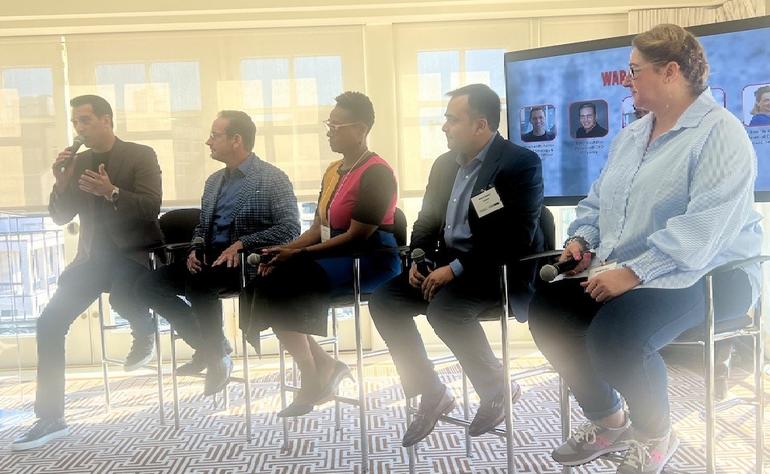
Speaking to the issue during Mitchell Stankovic’s Underground meeting here were Stephen Bohannon, chief strategy and product officer at Alkami; Tony Boutelle, president and CEO of Origence; Emma Hayes, chief culture officer with SECU; Rahul Kumar, VP and GM with Talkdesk, and Leonie Collier, head of design and innovation with Sparck/BJSS.
Bohannon served as moderator. Here is some of what was discussed:
Q: When we talk about war on trust and relationship with members, fintechs and other FIs want CU members and we have the trust. Will we keep it?
Boutelle: Trust is the basis of any relationship, and I think that is so hard to earn and so easy to lose. From a credit union perspective, we have built trust with members, but if you look at the studies now over who is most trusted, we are in middle of the pack. How many of you trust Amazon, but you’ve never had a conversation with anyone there?
I do think we really have to think about how do we build better digital trust and still build that relationship? Hopefully, you are consistent and meet people’s expectations. People need to feel you care about them.
I don’t think we have trust as much as we used to have it, because we haven’t gotten to that digital trust journey as fast as we need to.
How Trust Has Changed
Trust has changed over time. Trust and truth used to go together. Now, you have people being trusted who aren’t very truthful. It’s that term ‘truthiness’ from Stephen Colbert. You want it to be true. That’s where I think a lot of the world is going. The whole issue of trust is harder than it’s ever been.
From a credit union and financial services perspective, one, the big goal is to get better at digital trust and, two, we need to get consistent. When things happen to credit unions that are national news, like with Navy Federal (mortgage lending bias allegations), that hurts the trust of everybody.
These OD products are valuable products. But someone else has control of the narrative.
Hayes: We do have the trust, but it’s fading. We have multiple generations that have a need for financial services and as an industry, historically we have only served a few of those well. They have an affinity for our values, like Boomers and the mature. And as those generations have changed, their needs have changed, but our services have not. We’ve done a horrible job at keeping pace.
We have left the national advertising to one brand, Navy Federal, which is under the heat lamp. So, we have to figure out how to navigate that.
What One Study Found
There was a study of consumers that asked what is important to you, and the first thing was the experience they have had with that FI. We’ve done a great job of building brick and mortar and then delivering exceptional service. That’s our bread and butter. But it’s not how all members want to experience us and we are losing trust as we have not done a great job in technology. Younger generations do not want to come into a financial institution all the time. They do want the concierge service and want help and hand-holding, but they also want transparency and communication, and we are not doing as great a job as our competitors in banking when it comes to communicating.
They don’t just trust what they experience, but also what they see on social media. They believe all that.
So, how do we meet them where they are and get them to understand the value proposition?
Kumar: When I came to the U.S. my first touch with the U.S. financial system was with a credit union as a student. They were the first to give me a credit card. They gave me my first auto loan. Unfortunately, a few years ago my accounts were compromised and the conversation I had with that credit union that I had been with for a decade was frustrating. They could not reassure me it would not happen again. That’s when my relationship ended and I took my business to a fintech.
Facing Away
I agree (trust is) fading if we cannot reassure a member their finances are safe with us.
It shouldn’t be that hard. What members are looking for is simplified financial journeys and personalized advice.
The challenge we face is we make every step in the member journey hard. The first step in the journey is ‘Do you know me?’ Everybody has fun creating PINs, forgetting PINs, resetting PINS. The technology today allows us to do better. When we talk about AI, it has its own issues with trust, but if we pair the AI with data, that’s when you can achieve better results.
Collier: We are going through this fourth revolution, and what is happening is storming, forming and norming.
We’ve got all these trusted institutions but fintechs have been absolutely brilliant at building trust, and trust comes from your service. Is the service good? Is it easy? Is it enabled to allow me to do things? Is it adding value? It comes from accountability.
I'm asking you to ask yourselves what you are doing with the data. Am I telling you why I've asked you for this information? Then it comes into action, so if I have a problem, if I need your help, are you helping me, or are you putting me in a loop with a chat box where I never get the answer? All those things are moments that build and break trust.
The ‘Happy Paths’
I come from things as a human-centered designer. You need to understand the journeys you're asking your customers to take on the omnichannel journeys. If you haven't identified (pain points), how are you going to get people to trust you? They go to the pain point and they don't get help. You really need to be thinking about the journeys that you're doing. We call them happy paths. Think about their unhappy paths and start making those unhappy paths happier.
Now With Free Shipping! The CUToday.info Daily News Email Keeps Getting Better!
The biggest, best and freshest news reporting in credit unions remains free, and now has an added bonus---free shipping to your email address! That’s right. Each morning CUToday.info delivers its daily Fresh Today news update offering the latest headlines and breaking news right to your email, with the easy-to-read headlines format allowing you to click on the stories that interest you most in order to learn more. So, stop paying those bank-fee-like subscription prices from other so-called “news” publications!
If you haven’t yet signed up for the new email solution on which CUToday.info has partnered with ResponseGenius, you can do so here. Signing up requires less than one minute of your time—and it’s free!
Please note that after signing up you may need to go to your Spam/Junk folder and mark the morning headlines email as safe. CUToday.info does not provide its list of readers and emails to outside parties, and we will not be contacting you to sell you an extended warranty or sending you any links so you may cash in on an inheritance you didn’t know was coming.
And did we mention it’s free?