

WASHINGTON–Concerns over how credit unions are “spinning” their own perceptions, what “community” is really about, and why members no longer believe in the “picket fence” American Dream were all the subject of some unique observations during a panel discussion here.
The conversation came during Mitchell Stankovic’s Underground meeting here.
Panelists included Joe Franklin, VP-brand management and experiential engagement with PSCU/Co-op Solutions; Heather McKissick, president and CEO of CUES; Chung Bothwell, board chair with UNCLE CU; Patrick McElhenie, chief strategy officer with Trellance; and Marci Francisco, CXO with the Premier America Credit Union.
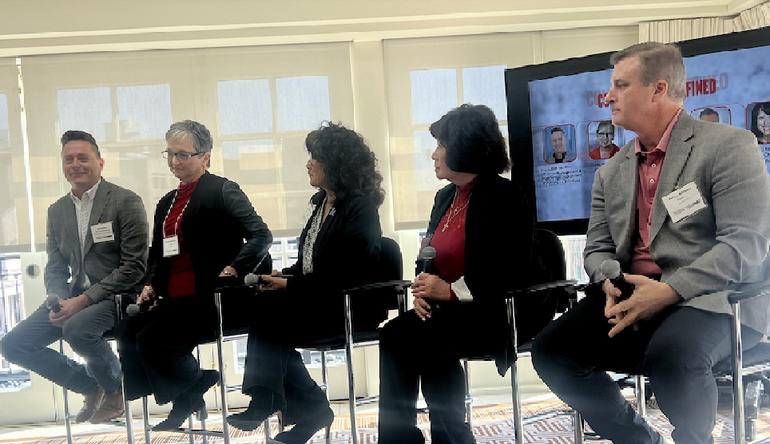
Franklin, who served as moderator, noted some of the research conducted by Co-op, Filene and EY of some 3,000 consumers found the number-one issue to winning business was trust. And when asked what defines trust, consumers said it’s all about the daily interactions.
Here is some of what was discussed on the issue of community and more.
Q: What does community mean to you?
McKissick: Community means communication. There are four primary tenets of communication: safety, value, openness and freedom.
We’ve been talking a lot about that safety means you are safe with me. Value means I see you, I know what matters to you I will act accordingly. Openness means I am transparent: you see me and you can trust me. Finally, freedom is all about choice. You can choose to engage with me or not.
These are the things that create community and they are not just communication principles or community principles, they're in leadership principles. I believe that we as an industry, as a movement, must prioritize those before we are prioritizing anything else because what I'm getting worried about is the spin that is perhaps us telling ourselves, but also others, and we are caught up in some kind of a false dichotomy between mission and margin.
That is a false construct. Everybody in this community knows that mission means margin and vice versa, and yet we continue to listen to that and I'm not quite sure I understand why.
Spinning a Myth?
I think it's really important for us when it comes to continuing to build community with one another that we pay close attention to that, because, honestly, at the end of the day what are we all trying to do is measure the impact that we are making.
We have to be mindful of our humans. But I wonder why we're spending it this way if we're spinning ourselves into a belief that somehow if we show our hearts we are then making ourselves weaker in the face of competition? That's a message that we have to be very careful about sending.
The future is calling us and we need to do a better jobs of holding each other and ourselves accountable to them.
Francisco: At Premier America we've been on a wonderful journey over the last six years. I've been with the organization for just short of five years, and we wanted to make sure that we recognized our community was changing, but there was just a lack of representation, a lack of belonging, a lack of understanding (at the credit union).
Our communities are wildly diverse. We serve a community where nearly 60% of the population is getting Pell grants, 80% of the population is multicultural, and 5% of the population is international students. We’ve got a large segment of Dreamers.
We wanted to create relationships and communities where people felt like they belonged, where they could see themselves reflected in the organization. We asked if our team members when looking at our leadership team, do they see themselves reflected there?
Not About the White Picket Fence
We can't expect that people are going to come to us for products and services. We've got great home loans, we’ve got great auto loans, but when we did consumer research as part of our brand and our community transformation, our mission is to make it easier to meet today's needs and reach tomorrow's dreams.
We know that home ownership is a pattern of changing generational wealth uplifting communities. We asked our communities what the American dream meant to them. They said a home with a white picket fence; that's my mother's American dream or my grandmother's American dream. They said ‘That can't happen today. The American Dream has become the American Hustle,’ and that was just devastating to hear that there was a lack of belief and a lack of faith.
See You on Tik Tok
So, we've gone out to our communities instead of expecting them to come to us.
We needed to change who we were to build to a community that people can trust and yes, we're on TikTok. Join us. We're a little quirky, we're a little out. There a tiny bit of product but really it's just humanizing the brand.
Community means going to where people are and creating that sense of belonging and being real and being vulnerable, admitting when you're wrong, being kind of silly so people see that that you're people, too.
McElhenie: I want you to think about data. We all have a lot of data and we can identify communities through this data, help communities through this data, but each of you have this individual data at your credit union. Are we sharing it collectively? Can we define or identify communities that we don’t even know exist.
I feel at Trellance and at the industry we can go one step further if we all share data. That’s the next step.