

LAS VEGAS–There is significant discussion within credit unions about diversity, but what does that really mean, and how does a credit union get there?
That issue, the “Realities of Diversity,” was tackled during Mitchell Stankovic’s Underground Collision here. Participating in the panel that shared their thoughts were:
- Renee Sattiewhite, president and CEO of the African American Credit Union Coalition (moderator)
- Frank Chinn, board member, Unitus Community CU
- Jorge Estaban, VP, Visa
- Seth Brickman, president/CEO, QCash Financial
Here’s a look at some of what was discussed.
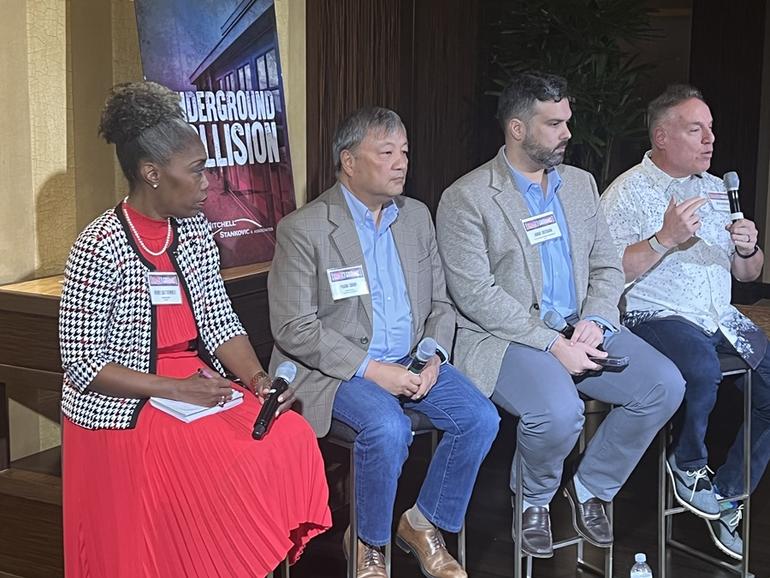
From left: Renee Sattiewhite, Frank Chinn, Jorge Estaban, and Seth Brickman
Sattiewhite: What do you do at your credit union that makes it diverse?
Chinn: We have done a number of things. Our board is progressive. We have term limits. This has been hugely controversial, but we have compensation for board members. When you are asking a younger person to give up time, to give up vacation time for a conference, you have to compensate them. It’s not a compensation where I’m driving a Tesla. It’s just an acknowledgement of the time and work a lot of board members put in.
Our nation is becoming more diverse very year. To be sure you are serving everyone in your community equitably, it is essential you are serving the diversity of your community. Diversity is not just about race. It’s about gender, age, people with disabilities. Recruit them. Value them. Use their skills to enhance your board.
Some credit unions have put a person of color on their board without proper onboarding. Those new board members can feel isolated. In many cases their service is brief and often followed by a resignation.
If you haven’t already done so, now is the time to start recruiting diverse candidates for C-suite positions. Ensuring their success leads to the success of your organization. Remember hearing the words, ‘We’re looking for someone with more experience.’ How do people get experience if no one takes the chance to provide you with more experiences?
Communities of color are often underbanked. To bring them into your organization it is important to create a trusted relationship. When a person of color comes to your credit union, consider whether they see someone who looks like and speaks like them….The same for your employees. Go beyond just translating your website. Being authentic with the groups you are trying to attract is important. Learn their culture.
Create an ecosystem that supports diversity beyond your credit union. Our mantra is people helping people. It’s not people helping some people.
White: What are you most proud of that you are doing at Visa?
Estaban: One thing I’m really proud of is, I cover the southeast region, I have 1,100 customers, and I think the thing I’m most proud of is the company has a guy named Jorge covering the Southeast. Five out of eight on our team are female. One is black and female. Two are LBGTQ. We mimic who are customers are and the country.
Brickman: Data show for the first time in five years the average financial health of Americans has gotten worse. Two out of every three Americans are financially unhealthy. Those are the Americans who are members of our credit unions. One in 10 is credit invisible. And let’s not even talk about that we have a nation full of immigrants who need to get Social Security numbers and who need help during life events. When we talk about those unhealthy Americans, it is more disproportionate to people of color and single moms.
So, if we know these things, and know 60% of Americans are living paycheck to paycheck independent of socioeconomic status, what are we as credit unions doing to support that kind of diversity in our membership base? What are we doing to go beyond the traditional credit score to meet that need and in the time frame of when they are experiencing that need? How are we making sure we have products for people who need them the most? How are we supporting people in the gig economy?
It’s great that you are offering financial counseling, but if they can’t put food on the table or buy medicine, they don’t need your financial counseling.
Sattiewhite: What I heard from the three of you was being intentional. At your shops what’s the first thing that comes to mind in being intentional?
Chinn. I think at Unitus we really try to reach out and be part of the community. We have advisory committees, we have people reaching out to us and saying you’re thinking about something from the wrong perspective. So, we ask how we can change wording to be a part of the community. We reach out to organizations, we don’t just wait for them to come to us. We have to remember that 60% of our members are in that basket of people who can’t afford a $400 emergency.
Estaban: What stands out to me in intentionality is we think about being a thought-leader and a challenger. There are a lot of ways we bring resources and scale to the forefront. My job as your partner is to challenge you when you aren’t getting it right.
Sattiewhite: Five years from now what does your organization look like? What have you solved?
Brickman: A few years ago a study said there are only 15 states in the U.S. that have more McDonalds than predatory store fronts. Five years from now I want there to be no predatory lending storefronts because credit unions are meeting their needs. When you help people when they have a need, they become more sticky to your credit union. They will tell their friends.