

LAS VEGAS–It isn’t just that the FICO model is evolving, in many cases it shouldn’t even be used as a basis for lending, according to a panel of people here.
And as CUToday.info reports separately, the FHFA has really stated that Fannie Mae and Freddie Mac will require lenders to also use VantageScore in making mortgage loan decisions.
During a session titled “Give Credit Where’s Credit’s Due: The FICO Model is Evolving. How can CUs be More Inclusive?,” four people shared their perspectives and experiences on those questions.
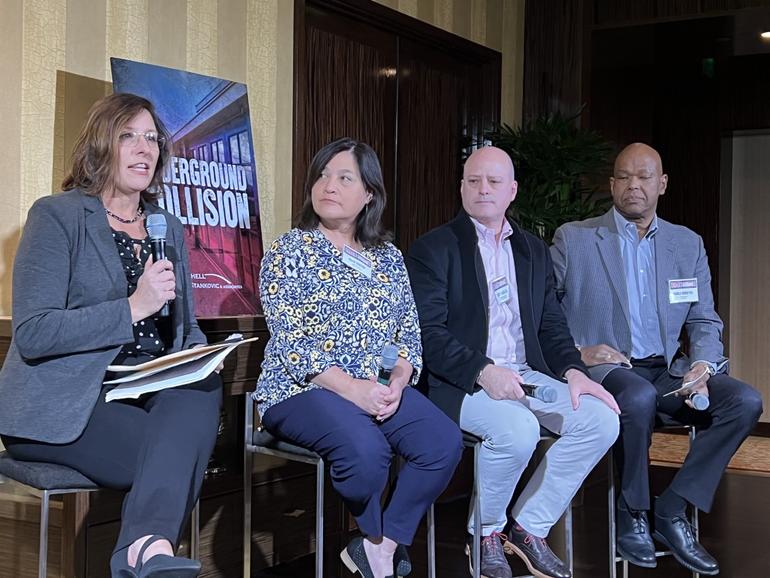
From left :Cynthia Campbell, Selfa Saugedo, Scott Lascelles, and Harold Roundtree.
Participating in the discussion were:
- Cynthia Campbell, CXO, BALANCE (moderator)
- Harold Roundtree, president/CEO, UNCLE FCU
- Selfa Saugedo, board member, Ventura County CU
- Scott Lascelles, marketing services, GDS Link, Sertech
Here is some of what was discussed by the panelists:
Campbell: We have had panelists talk about the FICO score not being unbiased. It is a big thing we hang our hat on, but it shouldn’t be the only thing we hang our hat on. How can credit unions be more inclusive?
Roundtree: For UNCLE Credit Union, we had been on FICO 3 (for a long time). It’s very important to make sure you are on the right model. We had one score and an auto dealer would have another score.
The other thing that is important for credit unions is a lot of people don’t trust financial institutions as a whole. There are a lot of people who don’t like credit. So, there is a lot of education needed for many communities about credit.
Saugedo: I will approach this from a slightly different perspective. Yes, I am a board member, but I am first and foremost a public health professional. The pandemic really exposed the inequities that exist in our communities.
In the public health setting we rushed to reach those populations most impacted, and we realized there was a need to reach people where they were and to understand their situations. You cannot treat every individual the same way. We know our prime members get better opportunities. Our subprime members are punished with higher rates. Our ability as a credit union to serve both is going to be stretched.
In public health we look at the social determinants of health. Those show us individuals are a product of their lived experiences. All impact their abilities to access services, and that goes for economic stability. Economic stability is one of the key pillars for an individual and a community to be healthy. So, we have to approach it from perspective of what am I offering my field of membership, and do I know my field of membership?
One reason many immigrant communities don’t bank is they don’t trust banks. If you don’t know the difference between a credit union and a bank, you can bet your bottom dollar the immigrant communities do not.
If we want to treat people equally, we have to treat them differently. You have to understand the communities you are serving.
Campbell: How are you inclusive?
Lascelles: With a 560 credit score, one out of five loans will go bad. So, you turn them all down. That means you are turning down four good loans.
FICO is a tool you can use for 80% of the population. FICO is built on the thickness of your credit file. If you only have 40% of the African American community who have home ownership, you won’t have a thick file. So, stop using FICO in those populations.
A common trap of new entrants in credit cards is to give $500 in credit to people and then as soon as one-third of that is used, you drop their scores.
Campbell: Do you use data to find the people who need the help?
Selfa: Data used correctly and appropriately, along with good data, will definitely reveal important information. But data, such as payment history, tends to chain people to that history and difficult moments in their lives. The problem with the FICO score is it doesn’t consider that they have matured, that they have gotten an education, that they are more grounded in their communities.
Our communities are counting on us to see them where we are. If we are discounting the credit-invisible populations, we are discounting a lot of people. We have to look at how we are helping people to get credit.
Roundtree: We have all grown up with the three C’s of credit: collateral, capacity and character. FICO was invented all those years ago and it has a heavy weighting on the character component. I think what people have to learn is like on the commercial side of the business--you have to do more storybook lending.
You have all those 700s--make that an automated decision. Don’t spend time with an underwriter on it. Get it done. Then you pick a spot, hopefully a low spot, of what you’re not going to do, to do credit-challenged lending.
With credit unions, you have to have a physical branch in these challenging communities. That’s where a lot of the activity is happening. These are people who need money, and yet you still hear, ‘Why would you go and do that?’ And if you can’t build a physical presence, then become engaged in some of the activities there.
Lascelles: A lot of credit unions focus on one-size-fits-all, one-product-fits-all underwriting. Micro loans may not occur to you. You have to look at the population, and you have to ask what will work here? Everyone is not like you.