

WASHINGTON–Members may “belong” to a credit union, but do they really have a sense of “belonging?”
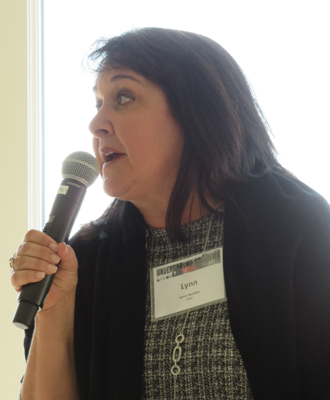
Lynn Heckler
And what about employees? Even at credit unions that talk diversity and inclusiveness, do all employees share in feeling included?
Those questions and others were explored during a session titled “Love and Belonging” during the Underground Collision event hosted by Mitchell Stankovic here.
Three people shared their views on the question during a discussion: Lynn Heckler, chief talent officer with PSCU; Linda Bodie, chief innovation officer with Element FCU; and Renee Sattiewhite, president and CEO of the African-American Credit Union Coalition.
Here’s a look at what each had to say.
Top Down, Bottom Up
Heckler said she wouldn’t be spending time on why diversity, equity and inclusion (DEI) are important.
“We know it’s a catalyst for innovation, it attracts and retains top talent, and we know it produces better business outcomes for whatever business you’re in,” she said.
Instead, Heckler opted to focus on why more people and credit unions are talking about DEI than doing anything about it. The reason: it’s hard, she said.
“We all want a diverse and inclusive workplace, but it’s not easy,” explained Heckler. “Feeling like you belong is different for each individual. There is no playbook and there are a lot of pitfalls.”
PSCU, said Heckler, has opted to approach the issue not just from the top down—which is important–but also from the bottom up.
“It starts with the C suite, but it must start from bottom up, too, so it can grow organically,” she said.
Inside PSCU there are a number of groups for various employees, including one for LGBTQ+ employees, African-American workers, younger workers, and female employees.
Heckler closed with a quote being shared by PSCU’s CEO, Chuck Fagan, in a new company video: “Inclusion happens when we use our power to intentionally bring people in instead of unintentionally keeping people out.”
‘It Spoke to Me’
Linda Bodie brought with her to the Underground Collision a book she checked out of the library in 1992 titled, “Understanding Homosexuality: Pride and Prejudice.” (She has since paid for the book.)
The book, she said, was the “Internet for us” at that time, the “us” being people who are gay.
“This book spoke to me at a time in my life when I was 24 or 25 years old. Love and belonging was not where I was,” said Bodie. She recalled the mother of her girlfriend, after learning her daughter was gay, responding by saying, “It would have been better if you had died.” For the record, the woman’s mother eventually came around and was “cool” with the both of them.
Noting a recent Internet search for credit unions serving the gay community found just a few hits, Bodie said, “Clearly we are not serving industry.
I don’t know if your staff is comfortable being out. I know in many cases they are not. I know we have our diversity training. Visibility is extremely important. If you’re not allowing people to be who they are, then stop doing the training. The training is about letting people be authentic.”
Bodie challenged credit unions to allow their employees to be their authentic selves.
“What I went through in 1992 and 1993, I guarantee people are going through now,” she said. “You need to be there for them and tell them you love them and they belong.”
Please Stand
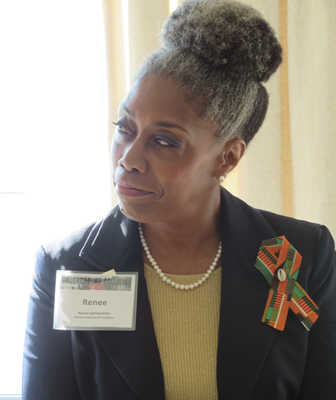
Renee Sattiewhite
The AACUC’s Sattiewhite asked her members of her audience to stand if they were African-American. Approximately a half-dozen people got to their feet.
“That’s sad. This is in a room full of friendly people who want to make a difference,” said Sattiewhite. “It’s OK that there are only a few black people in this room, because I do belong here. I was told I was welcome here. When you can have your members feel like they belong, that’s what love is. What’s your personal mantra? What are you going to do that’s going to make difference for your membership?
Sattiewhite challenged attendees to think about how they can get employees to “run through brick walls not just you but for your members. At the end of the day it’s about putting your best foot forward and making a difference. You have to be intentional. You don’t have to love everyone, but you do have to be intentional about being fair.”