

LAS VEGAS–The types of conversations many board members wait to have until the monthly meeting adjourns and everyone heads to their cars need to be brought back inside the boardroom, according to a panel discussion here that focused on what makes for boards best prepared for the next generation.
Discussing and debating what will contribute to the “Next Gen Board” were four people who shared their insights and experiences about how many boards are just “social clubs” and what can be done to breathe new life into what are often old boards.
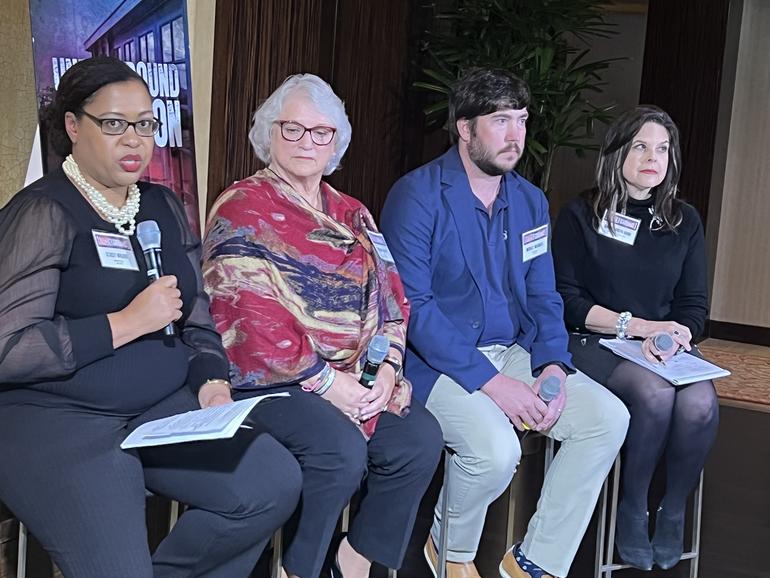
From left: Stacey Walker, Roxy Ostram, Michael Maxwell and Sarah Canepa Bang
Participating in the discussion, which took place as part of Mitchell Stankovic’s Underground Collision, were:
- Stacey Walker, chair, Xcel FCU (moderator)
- Roxy Ostram, board member, Ventura County Credit Union
- Michael Maxwell, chair, SCE FCU
- Sarah Canepa Bang, senior advisor to NCUA Board Vice Chair Kyle Hauptman
Here’s a look at what was discussed:
Walker: I’d like to ask the panelists to share why they do what they do.
Ostram: For me, it started 50 years ago when my mom was on the board and the credit union was the only institution that would lend her money as a single mom. So, I watched this through my whole life, how they helped her and how she got on the board and helped other people. I’m on the downhill side of things as far as the board is concerned and I’m happy to say that. Too often we have board members for whom board meetings become their social club, their once a month meeting with others with whom they have been on the board with forever.
Someone has to have that hard conversation with them. It’s time to make room. We have board members who say, ‘Don’t give me an iPad, I don’t want to work on an iPad. Mail me that 300-page document.’ That no longer works. We started our board modernization in 2018. It’s ever-changing. You need to be sure that as individuals you are still willing to be always evolving. You have to stay relevant. You have to continue to put the member first. And when you’re done, say thank you and move on to the next generation.
Maxwell: I serve because I get as much out as I put in. I get to learn so much. I started on the supervisory committee in 2014. In 2015, NCUA asked how old I was. I was 27. I asked does that matter? The average board member is 70 years old in our industry. They know what it was to like to bank 30 years ago. We just had a great conversation on fintechs. Do you think they understand fintechs? They don’t. So how can you expect to stay relevant as a credit union.
We are starting to do self-assessments. And maybe you don’t have space on the board for various areas of expertise. So, we are creating board advisory positions. And when someone comes off the board we can bring them in. The next generation isn’t just about being that I’m young. I’m an entrepreneur, I have a tech background. We just heard car loans are going away. So, why do I need a board member who is an expert on auto loans?
Canepa-Bang: After retiring, I served on a credit audit committee. I would not have this job today if I had not done that. I am one of the oldest people at NCUA. I have learned a lot being there. When I was in trade associations and CUSOs I had all the answers. And when I got to the credit union board I learned that I didn’t have all the answers. There are a lot of fire drills. If you have a board that is even half-aware they are worried about technology and things like that.
One piece of potential advice I have is to make sure your board really understands the difference between a credit union and a bank. I never thought I would have to say that. I have said to people at NCUA, ‘Give me five ways credit unions are different from banks, and one of them can’t be that credit unions are nicer than banks.’ And if members don’t know they’re owners, that’s not on them, that’s on us.
It is all about convenience. Convenience is in the eye of the beholder. Your field of membership is your community. What is your FOM and what is your community? One problem credit unions have with getting diversity on their boards is some people can’t get time off to attend a board meeting. The question is can we pay these people? I can’t comment on that but there has to be something in it for people if you want diversity.
Walker: What about age diversity on boards? It’s the younger volunteers who push for technology.
Ostram: One of the changes we made was we went to a consent agenda and we moved to dashboards. That helps with that board packet. (Is the dashboard light) green? We’re good. If not, bring it up at the board meeting. Our board liaison puts everything in there. It’s nice to have it all in one area. We also set up job descriptions. We went through our 1950s bylaws, which were shocking. So, we had to switch some language around.
You have to stay on top of it. Listen to your younger board members. They have great ideas and they are fun ideas.
Maxwell: I am a Millennial. We care about things. Our credit unions care about people. You can build a board off of that. You hear it’s a social club. What do they bring to the table? It doesn’t have to be young, but it can be more diverse. It will cause conflict. With different voices in a room you’re going to have tough conversations. I’ve seen it just be a ‘yes’ trap. But things are changing. You have to hold people accountable.
Audience Member: How do you ask someone to step off the board?
Maxwell: You can implement term limits, but people aren’t going to turn themselves out. You can put them in an advisory role, you can move them to a different committees.
Canepa-Bang: I want to piggyback on that. We can’t all be friends. It’s not a social club. One of the things I’m seeing and it’s hard to watch because everyone is in a social club because everyone just wanted to go along.
We had a credit union that had to be liquidated because of a fraud that had been perpetrated by someone who had been brought in as a friend of a board member and who had a rap sheet in the next state. It’s the power of one in your credit union, and you are the one. Even if you don’t want to be, you have to be. If just one person had Googled this guy they would have seen this guy was a bad guy. All one of them had to do was step up and do a background check on this guy who they were giving all this money to.
I’ve been at board meetings where, after votes are held, people are asked how to you feel about this and do you have any other thoughts about this. Everyone is asked to speak. Let’s have the conversation in the board room that’s had when everyone leaves the board meeting and then meets at their cars.