

WASHINGTON–Are credit unions really being true to their cooperative DNA? And if you believe the answer is yes, then one person here wants to know why credit unions that talk so often of being part of the solution are often missing from the process.
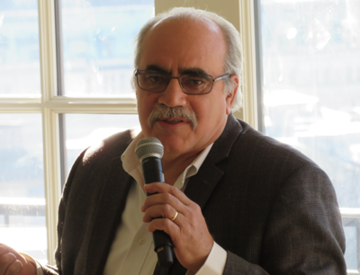
Brian Branch
During a session titled, “Physiological Needs: I’m Hurting and Does Anyone Care?” three people shared their takes on that question during one of the fast-moving discussion groups at the Underground Collision event hosted by Mitchell Stankovic.
Sharing their thoughts were Brian Branch, president of the World Council of Credit Unions; Pablo DeFilippi, SVP-membership and networking engagement with Inclusiv, and Monica Belz, president/CEO of Kauai Government Employees CU, whose efforts to help members recover from flooding on the island included the use of jet skis and who was profiled here.
Here’s a look at what each of the three had to say.
‘Yes, We Care’
Looking at credit unions in a bigger context, Brian Branch, president/CEO of the World Council of Credit Unions, shared how he had once been asked whether credit unions were more or less likely to work with underserved and unserved markets as they grew larger? Branch replied that he believes the answer is both.
For example, he cited a credit union in Ecuador that began serving the rural poor even though conventional wisdom held they didn’t have money to save and it was too expensive to serve the market. But that market proved to be quite robust and has driven growth, and the CU and others are using it as a model in central America.
But there’s a flip side, too, acknowledged Branch.
“Credit unions are driven by their members. It’s only natural as members become more affluent and the credit union becomes more affluent that the demands and what services members are looking for are going to change,” he said. “That’s why we see both patterns.”
Branch said where credit unions are especially effective at serving those who are “hurt” is after natural disasters when communities turn to their CUs for solutions.
“The question was who’s hurting and does anyone care? Yes, we care,” he said. “Credit unions are driven by their members, driven by their communities. And that’s one of the most powerful things in working with credit unions around the world.”
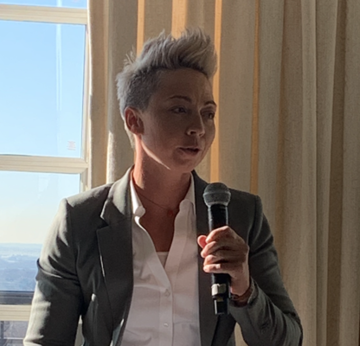
Monica Belz
‘We Can Do Better’
Inclusiv’s DeFilippi began by asking his audience some questions, including whether they know how many Americans live paycheck to paycheck, how many live in households that are unbanked or underbanked, and how many Latino households there are. It’s a number that exceeds 130 million in total, according to DeFilippi.
“We have come a long way and still have a long way to go,” he said. “Today we look at people who bring $50 to our credit union and we don’t welcome them. We deny them the very reason we exist.”
And yet those individuals don’t just “deserve” CU services, providing those services is good for the CU, too, he said.
“We are an amazing mechanism for creating wealth in communities,” DeFilippi said. “This is not an either/or question. We can do this and we can do better. When we talk payments, we have so many people who do not have access to them. We should not be scared of these changes, we should be embracing them.”
DeFilippi said it’s an issue that comes to his mind each time he reads about another credit union merger.
“They merge and yet we have so many people who are unbanked. We have small credit unions not growing even with these opportunities out there. I want to challenge you to see this,” he said.
Meanwhile, looking to Puerto Rico, where Inclusiv and credit unions have done considerable work in the wake of Hurricane Maria, DeFilippi added, “One thing I love about Puerto Rico is the credit unions there are the centers of the community. They aren’t just a financial institution, they are part of the fabric of the community. You have the municipality, the church, and the credit union. When you are at that level of integration with the community, there is no payment system that will replace you.”
Asking Tough Questions
Kauai Government Employees CU’s Belz has only been in credit unions two years, with her business background in entrepreneurship and global business.
“I didn’t quite understand what a financial cooperative was and I started asking questions. And I’m still asking questions,” Belz said. “The questions I was asking about credit unions were, ‘What is this, why is it important, why not a bank?’”
Belz said she came to understand that at the time in the earliest 20th century when credit unions were taking root in the United States the system was broken.
“These social innovators came along and built a new system to meet the needs of the community. I was blown away that I landed in an industry founded by social entrepreneurs,” said Belz. “I was hooked and said I was in for life.”
But Belz said she continues to have questions, including whether all of the technological developments are really filtering down into communities in ways that make them better.
What she has found, she said, is the benefits are “heavily concentrated and getting worse. The top 10% of people control 90% of the wealth on our planet. More people are moving down Maslow’s Hierarchy of Needs than moving up. That’s not OK. That’s not acceptable as a human being. If these financial cooperatives were born to be a part of the solution, where are they?”
Belz noted that every year at her credit union and across the industry there is much focus on how loans and assets are up. But another number isn’t.
‘They Call That Stasis’
“And then I looked at (credit union) marketshare and said, ‘They call that stasis.’ Our industry is stagnant. What the hell is going on? We go to these meetings and here about all these growth triumphs, but are we really doing these things that are supposed to be in our DNA?”
Seeking to provoke her audience to rethink some things, Belz suggested “We are not the leaders we think we are. Amidst all the hard work we’re doing, the way we’re approaching this and doing this isn’t working. We have to turn the whole thing upside down on its head. We need to radically think differently. And if we don’t we’ll just continue to be in stasis and let big tech and big banks grow their marketshare.”