

LAS VEGAS–Your credit union likely has data that indicates a member is in some type of trouble. Financial trouble, certainly, but what if it’s due to gambling? Or, perhaps they are involved as a victim of domestic violence. What is the credit union’s real responsibility? It’s a moral dilemma, agreed a panel of people with different perspectives who spoke to credit unions here and tried to offer some direction while sharing their experiences.
Addressing the issue of “Human and Digital Intersectionality” during a discussion that was part of Mitchell Stankovic’s Underground Collision here were:
- Mai Linh Hoaung, VP-strategy, marketing Collins Community CU (moderator)
- Raj Bandaru, CIO, Kinecta FCU
- Stephen Bohanon, founder and CSSO, Alkami
- Todd Lane, president/CEO, CalCoast CU
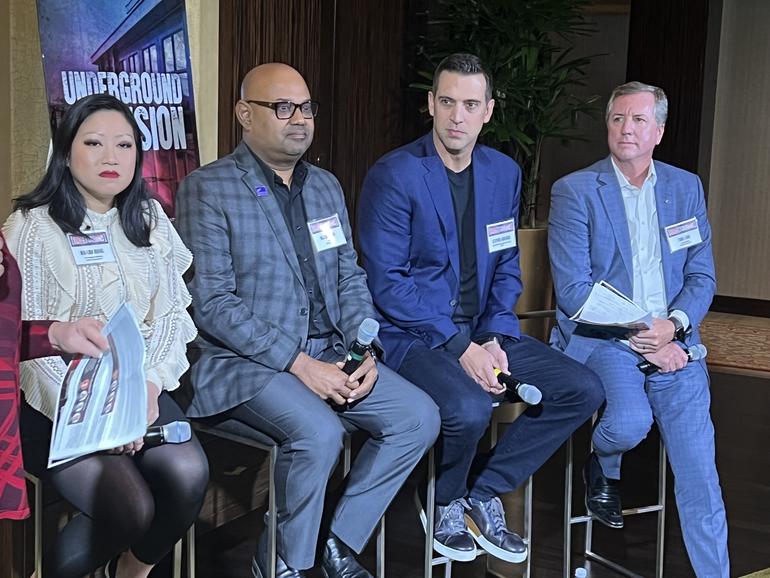
From left, Mai Linh Hoaung, Raj Bandaru, Stephen Bohanon, and Todd Lane
Here’s a look at what they had to say about the issue and some of what was debated:
Hoaung: More people are talking about mental health since COVID. But where the taboo piece is the action. Have we done anything about it? Not really. There is still not enough being done. We have 330 million Americans. More than 43 million Americans suffer through a mental issue annually. They are also three times more likely to be in debt. What does that mean for our future as a society? Not good. Let’s say 20 million credit union members suffer a mental health issue annually. That’s a lot of people we are serving that we may not be doing anything for. What is our responsibility?
Bandaru: Let’s try to tackle it by what’s in our control versus what is not. As a financial institution, you have data and the data tells a story. Based on transaction history you can nail it to the point where you know exactly what a person is interested in, what they do in their daily lives, their behaviors. But as an institution you only have a sliver of all the information.
Sometimes it gets fuzzy and you don’t have the full picture. As a consumer you are transacting across multiple FIs and retail institutions. So, I might have some data that says he or she is suffering from a mental health issue or distress, but how do you piece all of that together to paint the picture? That’s where you need more of a governing entity that has access to the information from multiple sources, hopefully in real time, to make it an actionable decision. The danger is in making a decision based on that sliver of information you have. Sometimes you might be right, sometimes you might be wrong.
Bohannon: Alkami just bought a company called Segment and it’s just spooky what you can know about a person. Let’s just assume we do have a complete picture. Then the question is, do you do anything? Do you have a responsibility to do anything? If you drink too much, the bartender has a responsibility to stop you. Here in Vegas, if you are gambling too much, they will stop you. So, in the vice industry there is a certain responsibility that when I notice something that could be destructive to a person’s personal life, they are going to hit pause. So, what responsibility do we have in our industry? We can see your income and what percentage of your income you’re spending on things. But the first question is, should we even weigh in?
Lane: I will take a little bit of a different twist. My bottom line is I do think we have a little bit of responsibility. I’m going to talk about economic abuse and financial coercion related to victims of domestic violence, human trafficking, and those who grew up in the foster care system. I’m not an expert, but I am married to a wonderful lady who works in this space in assisting women and children fleeing domestic violence. There is a financial component here. The stories are tragic.
It’s not a moral dilemma—it’s a moral imperative that we get involved. These things lead to a poor credit history, financial vulnerability, and often forces them into bankruptcy. The long-term consequences are huge.
I believe credit unions should play a role in the identification—whether it’s through data or in the branches or call center—and prevention and recovery of victims of human trafficking, domestic violence and those who grow up on foster care. I find it ironic we have to do elder abuse training annually, but we are not required to do any training on domestic violence.
Legislation in this area has been opposed, and guess who has opposed it? We have. Banks have. We don’t want responsibilities in this space.
At CalCoast in San Diego, we are a border town and we see a lot of human trafficking. Domestic violence is growing as is the financial coercion that goes with it. Absent legislation, we have decided to get involved and our role has been a couple of different things. We are doing financial education for those who have fled domestic violence and human trafficking. We have partnered with not-for-profits. And we also done something unique, we have helped to provide transportation by working with our third party auto buying service (New Cars, Inc.) to get them reasonable transportation at cost.
Hoaung: I live part of the year in Singapore. When we talk about data everyone talks about privacy But as marketers we love the data. So, Americans are very guarded with their privacy. In Singapore, you pretty much give up your right to privacy. It’s very safe. So far can we take this thing when we talk about privacy?
Bandaru: To me, data privacy is critical. My daughter, maybe not so much. Now it’s a three-legged stool. How do you take the data you have and the intelligence you glean out of that data, maintain data privacy, maintain the separation so you are not making a bad decision, and you report at least some of that data to some agency? You then expect the governing body to act on it. As a credit union, I am at least doing my part by reporting the issue. Hopefully, we get better at providing that data in real time.
Lane: In the Great Recession every credit union had members feeling financial stress. With members asking for loan modifications, we were going through their checking accounts to figure out how to do a loan modification that was appropriate. We didn’t invite them into the discussion until later when we had a resolution. I don’t see the difference here.
Bohannon: Playing devil’s advocate, the difference is here they aren’t asking and you are sticking your nose in.
Lane: I agree, but the alternative is we simply lob it over into collections. I don’t know what the answer is, but I think it’s a moral imperative.
Bandaru: The danger lies in misinterpreting the data. You have to be able to paint a full picture.