

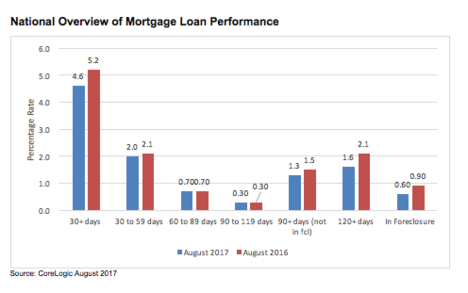
IRVINE, Calif.—As of August 2017, the 0.6% foreclosure inventory rate, which measures the share of mortgages in some stage of the foreclosure process, was at its lowest point for any month of August since 2006, when it was 0.5%, according to CoreLogic.
Meanwhile, CoreLogic said its monthly Loan Performance Insights Report, which shows that, nationally, 4.6% of mortgages were in some stage of delinquency (30 days or more past due including those in foreclosure) in August 2017. This represents a 0.6 percentage point year-over-year decline in the overall delinquency rate compared with August 2016 when it was 5.2% the company said.
Measuring early stage delinquency rates is important for analyzing the health of the mortgage market, said CoreLogic. The company said to monitor mortgage performance comprehensively, it examines all stages of delinquency as well as transition rates, which indicate the percentage of mortgages moving from one stage of delinquency to the next.
The rate for early stage delinquencies, defined as 30-59 days past due, was 2% in August 2017, down slightly from 2.1% in August 2016. The share of mortgages that were 60-89 days past due in August 2017 was 0.7%, unchanged from August 2016. The serious delinquency rate (90 days or more past due) declined 0.5 percentage points year over year from 2.4% in August 2016 to 1.9% in August 2017.
The 1.9% serious delinquency rate in June, July and August of this year marks the lowest level for any month since October 2007 when it was also 1.9%, and is also the lowest for the month of August since 2007, when the serious delinquency rate was 1.7%, the company said.
Alaska was the only state to experience a year-over-year increase in its serious delinquency rate in August 2017.
“The effect of the drop in crude oil prices since 2014 has taken a toll on mortgage loan performance in some markets,” said Dr. Frank Nothaft, chief economist for CoreLogic, in a statement. “Crude oil prices this August were less than half their level three years ago. This has led to oil-related layoffs and an increase in loan delinquency rates in states like Alaska and in oil-centric metro areas like Houston.”
Since early stage delinquencies can be volatile, CoreLogic noted it also analyzes transition rates. The share of mortgages that transitioned from current to 30-days past due was 0.9% in August 2017, unchanged from August 2016. By comparison, in January 2007 just before the start of the financial crisis, the current-to-30-day transition rate was 1.2% and it peaked in November 2008 at 2%.
“Serious delinquency and foreclosure rates are at their lowest levels in more than a decade, signaling the final stages of recovery in the U.S. housing market,” said Frank Martell, president and CEO of CoreLogic, in a statement. “As the construction and mortgage industries move forward, there needs to be not only a ramp up in homebuilding, but also a focus on maintaining prudent underwriting practices to avoid repeating past mistakes.”