

WASHINGTON—Backed by strong consumer spending, the U.S. economy continued its recent streak of solid growth during the third quarter, the latest data from the U.S. Bureau of Economic Analysis show.
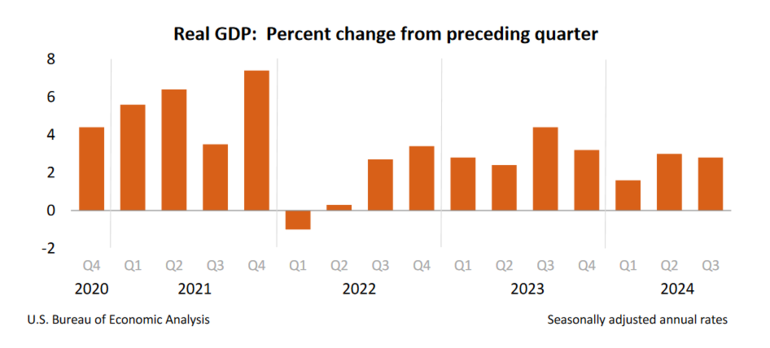
Real gross domestic product (GDP) increased at an annual rate of 2.8% in the third quarter of 2024, according to the advance estimate released by BEA. In the second quarter, real GDP increased 3.0%.
The increase in real GDP primarily reflected increases in consumer spending, exports, and federal government spending. Imports, which are a subtraction in the calculation of GDP, increased, BEA said.
The increase in consumer spending reflected increases in both goods and services. Within goods, the leading contributors were other nondurable goods (led by prescription drugs) and motor vehicles and parts. Within services, the leading contributors were health care (led by outpatient services) as well as food services and accommodations. The increase in exports primarily reflected an increase in goods (led by capital goods, excluding automotive). The increase in federal government spending was led by defense spending. The increase in imports primarily reflected an increase in goods (led by capital goods, excluding automotive), BEA said.
Compared to the second quarter, the deceleration in real GDP in the third quarter primarily reflected a downturn in private inventory investment and a larger decrease in residential fixed investment. These movements were partly offset by accelerations in exports, consumer spending, and federal government spending. Imports accelerated, BEA added.
Current-dollar GDP increased 4.7% at an annual rate, or $333.2 billion, in the third quarter to a level of $29.35 trillion. In the second quarter, GDP increased 5.6%, or $392.6 billion. The price index for gross domestic purchases increased 1.8% in the third quarter, compared with an increase of 2.4% in the second quarter. The personal consumption expenditures (PCE) price index increased 1.5%, compared with an increase of 2.5%. Excluding food and energy prices, the PCE price index increased 2.2%, compared with an increase of 2.8%.
Personal Income
Current-dollar personal income increased $221.3 billion in the third quarter, compared with an increase of $315.7 billion in the second quarter. The increase primarily reflected an increase in compensation, BEA said.
Disposable personal income increased $166.0 billion, or 3.1%, in the third quarter, compared with an increase of $260.4 billion, or 5.0%, in the second quarter. Real disposable personal income increased 1.6%, compared with an increase of 2.4%. Personal saving was $1.04 trillion in the third quarter, compared with $1.13 trillion in the second quarter. The personal saving rate—personal saving as a percentage of disposable personal income—was 4.8% in the third quarter, compared with 5.2% in the second quarter.