

MADISON–Credit unions have been offered a primer in what drives economies and inflation and what is motivating the Federal Reserve.
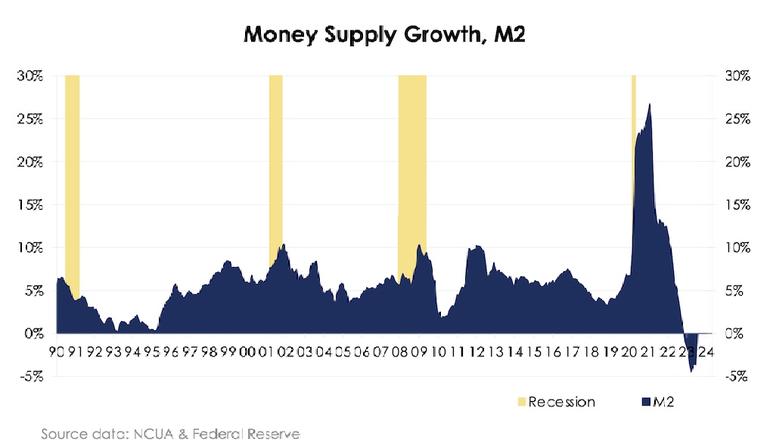
In a new analysis released by TruStage’s chief economist, Steve Rick, in conjunction with the company September Trends Report, it’s noted that for the first time since 1948 the U.S. money supply is declining. In fact, it’s down more than $1 trillion since its high-water mark of $21.906 trillion set back in April 2022, according to Rick.
In the report, Rick first explains economists define money as the sum of currency, checking accounts, savings accounts, money market deposit accounts, certificates of deposits and money market mutual funds.
“So, a drop in ‘money’ is really a contraction in bank and credit union deposits,” wrote Rick. “This 5% reduction in the money supply/deposits is having a major liquidity impact on banks and credit unions.”
‘No Coincidence’
Rick said it’s “no coincidence” the high-water mark for credit union savings-per-member was also set back in April 2022, when it reached $14,133, and has also declined 5% to $13,479 today.
“The average credit union member has therefore withdrawn $654 from their credit union deposit accounts between April 2022 and July 2023,” Rick stated.
Rick further explained the drop in the money supply is due to the Federal Reserve’s policy of “quantitative tightening” (QT), which is designed to drain excess liquidity from the banking system in its efforts to bring inflation down to its 2% target.
“If inflation is caused by ‘too many dollars chasing too few goods,’ then reducing the amount of money should help bring inflation down to the Fed’s target in the next 18 months,” Rick shared.
A Historic Peak
He noted assets on the Fed’s balance sheet reached an historic peak of $8.96 trillion in April 2022 (36% of GDP). Since then, the Fed has reduced its assets by $757 billion by not reinvesting all its maturing Treasury and mortgage-backed securities.
“Expect the Federal Reserve to continue its balance sheet ‘normalization’ and therefore lower the U.S. money supply and bank and credit union deposits through the first half of 2024,” Rick forecast.
Just Because It’s Autumn Doesn’t Mean Falling for Schemes to Overcharge You for CU Industry News. Instead, Try This Crisp Offer
The biggest, best and freshest news reporting in credit unions remains free! Each morning CUToday.info delivers its daily Fresh Today news update offering the latest headlines and breaking news right to your email, with the easy-to-read headlines format allowing you to click on the stories that interest you most in order to learn more. So stop paying those bank-fee-like subscription prices from other so-called “news”” publications!
If you haven’t yet signed up for the new email solution on which CUToday.info has partnered with ResponseGenius, you can do so here. Signing up requires less than one minute of your time—and it’s free!
Please note that after signing up you may need to go to your Spam/Junk folder and mark the morning headlines email as safe. CUToday.info does not provide its list of readers and emails to outside parties, and we will not be contacting you to sell you an extended warranty or sending you any links so you may cash in on an inheritance you didn’t know was coming.
And did we mention it’s free?