

MADISON, Wis.—Credit union net interest margins are up, as is lending, albeit at a slower growth pace than last year, according to CUNA Mutual Group’s latest Trends Report.
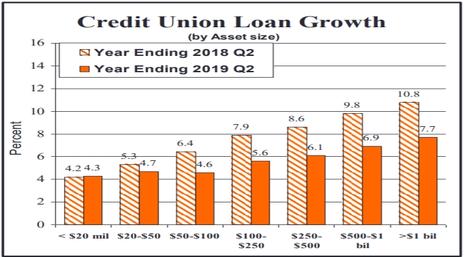
Data show this is the first year since 2013 that credit union loan growth has dipped below 7%. The Trends Report did reveal loan growth at large credit unions has slowed more than growth at smaller shops.
Membership growth has also slowed.
CU net interest margins rose to 3.21% in the second quarter, up from 3.12% during the first quarter and 3.09% in the second quarter of 2018.
“The recent flattening and inversion of the Treasury yield curve will weigh on net interest margins over the next year as funding costs rise faster than asset yields. We expect the Federal Reserve to follow the bond market and lower the fed funds interest rate 50 basis points over the next few months,” stated CUNA Mutual Group, including the recent rate cut in that forecast.
Here’s how credit unions performed by category:
Lending
Credit union loan balances rose 0.6% in July, below the 0.8% pace reported in July 2018. Loan balances are up 2.8% year-to-date, around half the 5.5% pace set last year. July’s seasonal factors usually add 0.32 percentage points to the underlying trend growth rate, the report stated.
“In the year ending in the second quarter of 2018, total credit union loan balances rose 6.6% according to NCUA call report data. This is the first year since 2013 that credit union loan growth fell below 7%,” CUNA Mutual Group stated. “The credit union movement’s loan-to-asset ratio now stands at 71.2%, below the 71.4% reported in July 2018, indicating the credit cycle has passed its apex and will move down over the next few years.”
A greater share of loans on credit union balance sheets along with rising interest rates increased the yield-on-asset ratio to 4.01% in the second quarter, up 29 basis points when compared to the second quarter last year. Larger credit unions reported a bigger slowdown in loan growth during the last year when compared against smaller credit unions. This reduced the big loan growth rate disparity between large and small credit unions in 2018, the report found.
Credit Union Consumer Installment Credit (CUCIC)
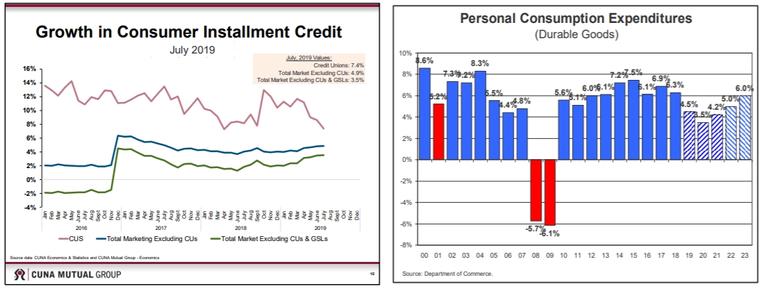
Credit union consumer installment credit loan balances (auto, credit card and other unsecured loans) rose 0.4% in July, below the 1.6% pace set in July 2018. During the last 12 months, credit union consumer installment credit grew 7.4%, significantly above the total market excluding credit unions of 4.9%.
“We are forecasting consumers expenditures on durable goods – autos, appliances, furniture – to increase only 4.5% in 2019 and then decelerate to 3.5% in 2020, as households will have exhausted their pent-up demand built up during the Great Recession and its aftermath,” CUNA Mutual Group said.

Vehicle Loans
Credit union used-auto loan balances rose 0.5% in July 2019, below the 0.9% pace set in July 2018. Currently, used-auto loan balances are rising at a “remarkably low” 2.4% seasonally-adjusted annualized growth rate, which is down from the 8.5% pace reported one year ago. The slowdown is due to the 130 basis point increase in used-auto interest rates during the last three years and the elimination of any remaining pent up demand for autos that was built up during and immediately after the Great Recession of 2008-2009.
“Auto sales are expected to remain above their natural sales rate due to the strong labor market, lower interest rates and high levels of consumer confidence. On a negative note, wealth effect impacts will not support auto sales going forward as it did during the golden years of 2015-2018. Volatile stock prices and slowing growth in home valuations will keep sales below 17 million units for the next few years,” CUNA Mutual Group said.
Real Estate Secured Lending – First Mortgages and Other Real Estate
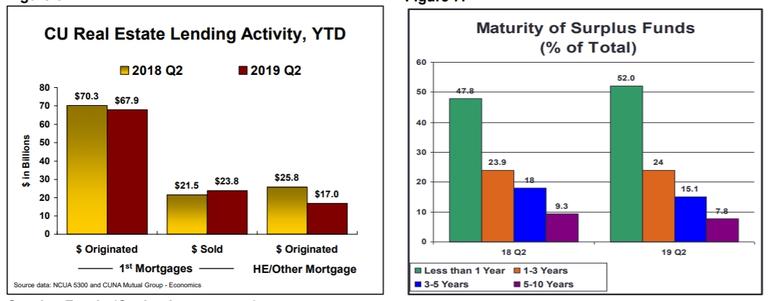
Credit unions originated $67.9 billion first mortgage loans in the first half of 2019, a 3.4% decrease below the $70.3 billion in originations in the first half of 2018. Credit unions then proceeded to sell off 35% of those originations into the secondary market, a lower percentage than the 30.6% in 2018, according to the Trends Report data.
“The stage is set for a rebound in mortgage originations in the second half of 2019 due to the significant drop in mortgage interest rates. We expect both purchase mortgage and refinance mortgage activity to increase,” the report is forecasting.
Credit unions originated only $17 billion of home equity and second mortgages in the first half of 2019, a 34% decrease from the same time period last year. Credit unions now hold $542.1 billion of total real estate loans (first and second mortgages) on their books, which are 5.2% of the entire mortgage market, up from 4.9% in June 2018. The contract interest rate on a 30-year fixed-rate conventional home mortgage fell to 3.62% in July, down from 3.77% in June and below the 4.53% reported in July 2018, CUNA Mutual said.
“We expect the Federal Reserve to lower short-term interest rates in the second half of 2019, which will lower the 30-year mortgage interest rate to the 3.25% to 3.50% range by the first half of 2020 and increase the refinance business at financial institutions,” CUNA Mutual Group said.
Home Prices
Home prices rose 0.5% in July from June, according to the Core Logic Home Price Index, and 3.6% year-over-year, the slowest monthly pace since the start of 2018. The decline in mortgage interest rates since the start of the year has picked up the pace of home price appreciation.
Home prices are expected to rise another 4% in 2019 and 3.5% in 2020 due to the continued tight supply of existing homes on the market. All of the fundamental drivers of housing demand remain strong and will keep home sales above the long-run average over the next two years, the report stated.
“The labor market is very tight and wage growth is beginning to accelerate, both of which are positive factors for homebuyer demand and house price appreciation. Credit union mortgage lending should increase as improving financial positions among borrowers and rising incomes justify loosening credit standards,” the company predicted.
Surplus Funds (Cash + Investments)
Credit union surplus funds fell $10.1 billion, or 2.5%, in July to reach $387.3 billion, which helped fund the runoff in savings balances of -$3 billion and the additional $6.2 billion in loans. Credit union surplus funds as a percent of assets rose to 25.2% in July, up from 24.3% in July 2018, indicating that liquidity has turned the corner and will start loosening over the next two years. During the last year, credit unions funded $62.5 billion in additional loan balances and $36 billion in additional investments with $84.3 billion of additional savings balances and $15.4 billion in additional capital.
The yield on surplus funds rose to 2.27% in the first half of 2019 compared to 1.81% during the first half of 2018. Investment yields remain significantly below the 4.88% yield on loans in the first half of 2019, which is up from the 4.6% reported in the first half of last year, CUNA Mutual said.
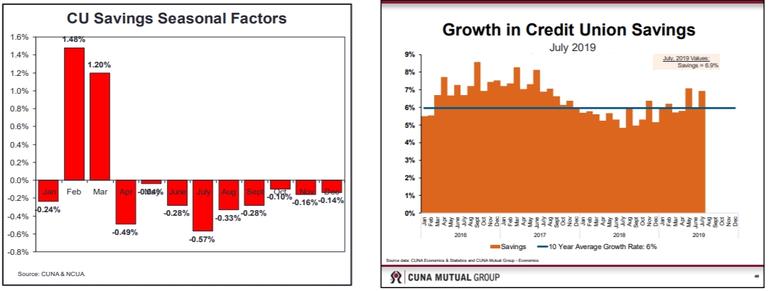
Credit unions decreased the maturity of their investment portfolio during the last year due to the Federal Reserve raising short-term interest rates nine times over the last three years. Surplus funds with a maturity of less than one year made up 52% of all surplus funds in the second quarter, above the 47.8% during June of last year, the Trends Report stated.
Savings and Assets
Credit union savings balances fell 0.2% in July, above the 1.1% decline in balances in July 2018. July is normally the weakest month of the year for savings growth due to seasonal factors such as vacation spending and auto loan down payments, CUNA Mutual’s analysis noted, adding credit union savings seasonal factors will remain as negative factors for rest of the year.
During the last 12 months, savings balances rose 6.9%, above the 10-year average of 6%, as members locked in the relatively high certificate of deposit interest rates before the Federal Reserve lowers short-term market interest rates in the second half of 2019.
“Moreover, the Federal Reserve lowering interest rates has resulted in some interest-rate sensitive members moving savings deposits from their share draft accounts and money market deposit accounts to CDs. We expect savings balances to grow 7% in 2019 and then accelerate to 9% in 2020 as members start rebuilding their savings balances after the surge in spending over the last few years and a possible economic slowdown,” the report forecasts.
Capital and Other Key Measures
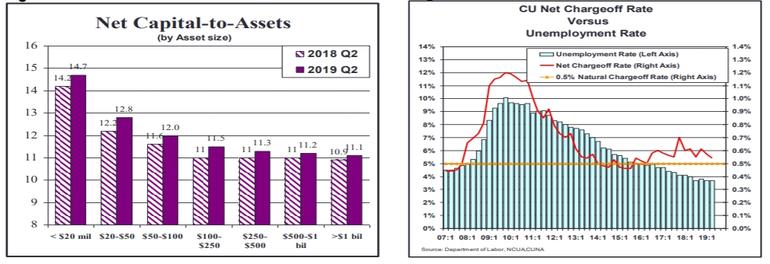
The industry’s weighted average capital-to-asset ratio rose to 11.1% in June from 10.8 for the same time period last year, according to NCUA call report data, due to capital growing faster than assets (10% vs. 6.4%). Credit unions with assets less than $100 million typically have capital-to-asset ratios above 12%, while larger credit unions have ratios below 12%, CUNA Mutual Group stated.
The credit union movement’s 10% capital growth rate over the last year, which is also known as the movement’s return-on-equity, has been trending above its long-run average of 7% lately. The credit union loan net charge-off rate fell to 0.54% in June, down from 0.61% in June 2018, according to recently released NCUA’s mid-year call report data. A ratio of 0.5% is the long-run average during an economic expansion. The charge-off rate will fall to 0.5% in the third quarter, which is historically the quarter with the lowest charge off rate of the year, due to faster loan growth over the summer months.
“We expect the charge-off rate to increase five basis points to 0.55% in the fourth quarter as loan growth slows and delinquent loans increase,” the company said.
Number of Credit Unions
As of July 2019, CUNA estimates 5,529 credit unions are in operation, down seven from June. Year-to-date, the number of credit unions fell by 74, which is less than the 94 reported in the first seven months of 2018. NCUA’s Insurance Report of Activity showed 32 mergers in the second quarter with an average asset size of $66.2 million, 12 fewer than reported in the second quarter of 2018, with an average asset size of $23.7 million.
“These smaller credit unions are finding it difficult to increase their member value proposition as fast as larger credit unions and are therefore losing members,” CUNA Mutual Group said.
Recently released mid-year NCUA call report data show 320 credit unions with assets in excess of $1 billion and 265 credit unions with assets between $500 million and $1 billion. The greater-than-$1 billion asset category represents 5.9% of all credit unions, but more than 66.4% of the credit union system’s assets and 68.4% of the loans.
The median asset size of a U.S. credit union rose to $34.8 million in mid-year, up from $32.9 million at mid-year 2018, CUNA Mutual reported.
Number of Members
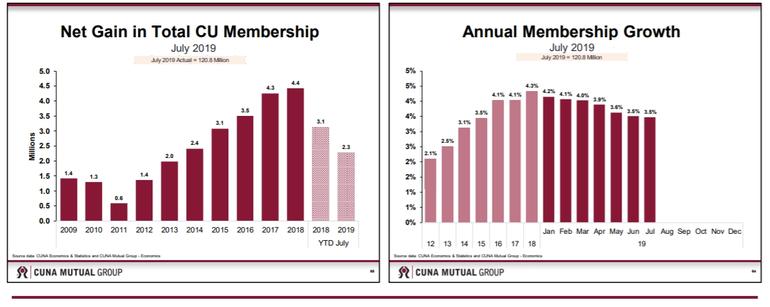
Credit union memberships grew 385,000 in July, or 0.3%, below the 406,000 new members added in July 2018. Year-to-date credit unions added 2.3 million new members, slower than the 3.1 million members added in 2018. Total credit union memberships reached 120.8 million in July, 3.5% below the 4.2% recorded last year.
“This slowdown in membership growth is due to the slowdown in loan growth and the deceleration in job creation. Approximately 159,000 new jobs were added to the U.S. economy in July, down from 178,000 in July 2018, according to the Bureau of Labor Statistics. We forecast credit union memberships to grow 3% in 2019 and 2.5% in 2020 due to annual job gains slowing to 1.2 million each year, down from the 2.5 million pace set during the last two years and less demand for consumer loans,” the report stated.