

NASHVILLE, Tenn.–When it comes to the opportunities for credit unions and AI, they are both far reaching and immediate, involve employees and members, and will require credit unions to act—"fast following” isn’t going to cut it, according to one expert.
Speaking to the Edge Conference here sponsored by Trellance and the Filene Research Institute, Dr. Lamont Black offered an overview, reviewed strategies for adopting AI, and shared advice with credit unions as they race to respond to all the ways generative AI is changing every aspect of not just their own operations, but the marketplace itself and the lives of their members.
Black, a professor of finance at DePaul University, became well known to many in credit unions for his speaking and consulting related to cryptocurrency and blockchain over the past few years. But now, in addition to that, he also is a Filene Fellow who leads its Center for the Credit Union of the Future, and artificial intelligence is a significant part of what lies ahead and of his work in the CU community.
Every credit union, he said, should be developing a strategy around AI, but that isn’t going to be enough.
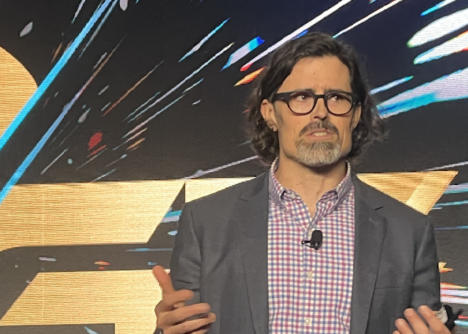
Dr. Lamont Black speaking to EDGE conference.
The Tipping Point
“I don’t think we would be here were it not for ChatGPT. That is the tipping point in this conversation,” Black told the meeting. “We are now at the point where the question is, ‘Where are we going with this?’ One concern I have with credit unions is sometimes there is this sense of who are the vendors and what should we be buying and plugging in? I want you to step back and think more broadly about what your strategy is and what to do with AI.”
It's a conversation that can’t wait, according to Black, who encouraged credit unions to develop a culture around AI, to identify an “AI champion” within the credit union or to even form a committee.
“This is not something you can bolt on,” he stressed.
Can be Polarizing
Black acknowledged the issues around generative AI can be polarizing, with some people believing it will transform the future, and others believing it will destroy it.
“That tension is healthy, but it can create a dynamic in an organization around ‘How do we even feel about this?’” he explained. “My guess is many of you have started to develop policies like what is appropriate and what is not with ChatGPT. That can be good, but it can send a message, ‘This is a new technology, be careful.’ If people are unsure and anxious about how the technology is viewed, people can be reluctant.”
Black said some credit unions have even formed internal marketing campaigns to communicate through the organization how the CU is approaching AI, as communication with any change is critical.
The Third Leg
While strategy and culture are important, Black said something else is equally critical: Experimentation.
“The reason I love the word experimentation is these are tools that just about anyone could pick up and use,” he said. “Machine language and machine learning were predecessors that were typically housed in a small group in the credit union and nobody had any idea what they were doing or how they did it. This cuts across the organization. You want to put these tools into the hands of your people so they can solve their own problems.”
In short, summed up Black, strategy comes from the top down, while experimentation flows from the bottom up.
“Technology changes the way people interface with information,” Black said. “We often use the word interface in a technical sense, like two computers, but I want you to start thinking about people interfacing with machines and even more broadly, information.
The Next Step
Black believes generative AI is the “next step” in the human-information interact.
“I would argue that the reason ChatGPT is a tipping point is it has changed our relationship to information and how we consume it,” he said. “ChatGPT has changed our relationship to the Internet.”
While artificial intelligence is often the subject of fear, Black said he remains generally positive about what it offers.
“The beauty of AI is all those technologies in the past were one direction. Generative AI is a two-way conversation,” he explained. “You can now interact with the media source. You can ask for clarification. You can dig deeper.”
The AI Opportunity for Credit Unions
The fundamental question for credit unions, according to Black, is how they can use AI in a way that is helpful to their mission. He recommends credit unions begin internally.
“AI is not here to replace you. It is a tool you can pick up and use for your purposes,” he said.
He said CUs should start with their own employees, including incorporating AI into email, meeting notes, content creation and technical development, and that includes beginning with Microsoft Copilot 365.
“Think about content creation in marketing, including image generation and marketing analytics,” he said.
Member Productivity
Generative AI also involves thinking about members in a new way, according to Black, who wants CUs to think in terms of “member productivity.”
“If you are starting to think about GenAi making the human information interface interactive, it’s going to change the way members interact with your credit union,” he said. “I want you to think about your website, your app, all the different ways you interact with them. How could this tool change the way people interact with your credit union? The reason this is so important is credit unions are information repositories. You produce nothing physical. It’s zeroes and ones and you are just moving them around. You put a face on that, but ultimately people just want to interact with your information. How do you do that? It's not as easy as you might think. We need to be thinking about how do we move this conversation forward.”
‘More Conversational’
In that regard, Black urged CUs to think about files, policies and procedures, products and services, their knowledge base and their core.
“Now (information) is sitting there and people have to actively find what they are looking for. GenAi makes it more conversational. It’s changing the interface,” he said. “When we talk about member experience, we tend to think about the digital channel and people interacting with that. The UI/UX is all changing with GenAi in a way that is making it more personal.”
Black said credit unions need to understand that all their structured and unstructured data, call center transcripts and more are going to become much more interactive with generative AI.
“Gen AI will change your employees’ relationship to your information. They are the first users. If this interface can be improved to make it more interactive so they can inquire with human language, they no longer need to be trained in software XYX, they can get what they want from your knowledge base,” he explained. “At some point people are trying to answer their own questions. You want to be able to empower them to do it. This isn’t about making people go away so you don’t have to pay people to deal with (members). This is about empowering people to do what they want to do.”
The Big Vendor Question
The big question in credit unions, according to Black, is whether to wait on a vendor to handle everything related to AI.
“One reason I want to ask this question is the answer should not be an emphatic yes,” he said. “What I don’t love about the credit union movement is some CUs view themselves as passive recipients of technology. Many have used that phrase ‘fast follower,’ but that statement is a wait and see, passive statement—'We will tag along until things fall to us from the sky.’ If you just wait on your vendors, some of you might be waiting a little too long. And if your vendor is rolling something out, saying they do AI, do you really know what they’re doing? Do you understand it? Do they?
“What I love about this technology is it so accessible,” he continued. “My goal is for vendors to become the ones who empower credit unions, not the ones that do it for them. I’m not anti-partnership. I’m anti-just-waiting-to-pay-someone.”