

WASHINGTON—Treasury Secretary Scott Bessent Wednesday shared his insights on banking regulation, discussing proposed changes to the capital buffer framework for the largest banks, deposit insurance reform, and Treasury’s expanding role in bank oversight.
Bessent made his remarks during the American Bankers Association annual Washington Summit.
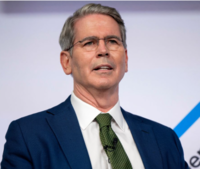
Scott Bessent
Bessent said that in the past, bank regulators have exercised vast powers on almost every aspect of daily life—but without “meaningful accountability” to the American people.
“Most glaringly, regulation through supervision has too often taken place behind a veil of secrecy that precludes scrutiny by the public and their elected officials,” he said. “President Trump is correcting this. He has tasked the Treasury Department with ensuring that the financial services regulators fulfill their statutory mandates consistent with his priorities.”
Bessent said the Treasury Department intends to play a greater role in bank regulation.
“The Financial Stability Oversight Council is one potential forum,” he said. “The President’s Working Group on Financial Markets is another option. We also regularly engage with each federal bank regulator.”
Statutory Mandate
Bessent said that foremost, regulation should derive from a clear statutory mandate.
“That includes safety and soundness, mitigating risk to financial stability, and consumer protection,” he said. “Second, regulation should be efficient. That means regulations should strike an appropriate balance between costs and benefits. Third, regulation should be fair. That means the rules of the road should be clearly stated and consistently applied across entities and across time.”
Bessent stressed that regulators themselves should be efficient.
“Fulfilling their statutory mandates does not require ever-increasing budgets and employee counts,” he told the meeting. “These commonsense principles have important practical implications. For example, striking a balance between costs and benefits requires tailoring regulatory actions to the risk profiles of different business models. In assessing the costs of a regulatory action, we should be attentive to the potential burdens arising from unintended consequences. In assessing the benefits of a regulatory action, we should remember the tremendous economic and human cost of a financial crisis.”
As regulators apply these principles, Bessent said a particular focus of his will be the impact on Main Street.
“In the past, some regulatory actions have unduly burdened community banks or erected barriers to entry. Other regulatory actions have entrenched the dominant position of the largest banks,” he said. “More generally, bank regulation has not taken effects on economic growth into account. That in turn has meant less lending, slower wage growth, more inflation, and fewer opportunities for American families.”
Main Street Matters Most
To ensure Main Street matters more in bank regulation, Bessent said he and the rest of the Treasury team will devote the necessary time and attention to the “quite technical, substantive aspects of regulatory reform.”
Bessent said that in applying commonsense principles, the Treasury Department intends to drive more tailored regulation to the community bank model.
“There might be strong cases for categorical exemptions of community banks from some regulations,” he said. “In particular, we will be taking a close look at the CFPB’s recent rules and the bank regulators’ expectations relating to internal controls. This will include, for example, third-party risk management and information security.”
Besides better tailoring of regulation, Bessent suggested the single most important reform will be to re-focus bank supervision on material financial risks.
“Regulators should keep the main thing the main thing,” he said. “Supervision has an important role in ensuring banks’ safety and soundness. But as we saw with the bank failures in spring 2023, unduly centering supervision on management and other governance matters can distract examiners and banks’ risk managers from the real risks to safety and soundness.
“The associated mission drift can lend itself to political ends, as we saw with the focus on climate risk and the debanking of disfavored industries. All of this drives up distractions and compliance costs while impeding responsible lending and risk-taking,” continued Bessent.
Bessent said the Treasury Department intends to drive a change in the culture of supervision through improvements to examination procedures, enhanced monitoring of examiners’ compliance with those procedures, and more “realistic processes” for appealing supervisory findings.
“Perhaps the most consequential step would be to define ‘unsafe and unsound’ by rule using more objective measures rooted in financial risk,” he said. “In the meantime, I have previously asked each of the bank regulators to consider removing reputational risk as a basis for supervisory criticism, and that effort is well underway.”
‘Open Question’
Bessent said a significant “open question” would be how to foster competitive parity across large and small banks and nonbank lenders.
“Modernizing regulatory capital likely would mean reduced capital requirements for mortgage loans and some other exposures that are core to the community bank model,” he said. “Giving only large banks the benefit of the reduced requirements for those exposures, as actually contemplated under the Biden Administration, would entrench their already dominant position. One possible solution would be to give each bank that is not mandatorily subject to the modernized requirements the option, in its discretion, to opt in. This is what I mean by ensuring Main Street matters more.”
Bessent said Treasury will also look at the capital buffer framework that applies to the largest banks.
“The process for sizing each large bank’s stress capital buffer, for example, should be consistent with the law and otherwise provide appropriate transparency and opportunity for comment,” he told attendees. “That is especially important here given the role that the associated stress-testing indirectly plays in the pricing and allocation of financing.”
Bessent said what he outlined Wednesday is only the beginning.
“The Treasury Department plans to revisit the other aspects of prudential regulation,” he said. “We will advocate for changes to the AML/CFT framework to truly focus on national security priorities and higher-risk areas and explicitly permit financial institutions to de-prioritize lower risks. We will work with Congress to consider reforms to deposit insurance, including potentially higher limits for business payment accounts.”
Bessent said Treasury will consider enhancements to failed bank resolution to incorporate the lessons learned from the bank failures of 2023, including efforts to reduce the FDIC’s losses in auctions of failed banks.
“We will take a close look at regulatory impediments to blockchain, stablecoins, and new payment systems,” he said. “And we will consider reforms to unleash the awesome power of the American capital markets.”