

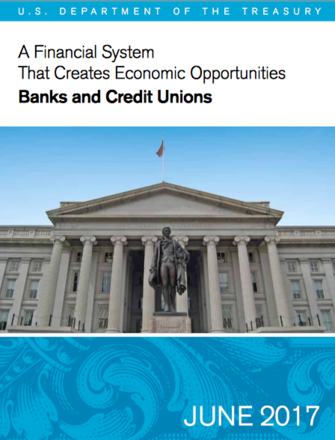
WASHINGTON–With their initial reviews now complete of the new 149-page report on its plans for banks and credit unions by the Treasury Report, additional reading reveals how the Trump Administration plans to defang the Consumer Financial Protection Bureau and reduce the reach of Dodd Frank.
As CUToday.info reported here, the Treasury report, “A Financial System That Creates Economic Opportunities: Banks and Credit Unions,” was assembled in the wake of an Executive Order from President Trump and in support of core principles the president has established, according to the Treasury Dept. Both CUNA and NAFCU had input into the report.
In the report, the Treasury Department calls for stripping the CFPB of much of its power and for giving the president the power to replace its director. It also calls for more exemptions from the Volcker rule, which bans banks from trading for their own gain, and calls for revisions to many rules to give small community banks and credit unions relief from regulatory scrutiny.
The release of the Treasury Report comes shortly after passage of the Financial CHOICE Act by the House, which includes much of the same language. But the prospects for a Senate version of CHOICE are considered long, and it is not expected to make it out of Congress. That leaves it to the Trump Administration to roll back the law on its own, and as the New York Times noted in its analysis, “the law does give the president broad authority to determine how its rules are executed.”
Treasury Secretary Steven Mnuchin said during a congressional hearing on Monday that the administration could implement many of the changes in the report on its own. The administration’s position on the CFPB, for instance, is clear in the language in the report.
“The C.F.P.B. was created to pursue an important mission, but its unaccountable structure and unduly broad regulatory powers have led to predictable regulatory abuses and excesses,” the Treasury Report states. “The C.F.P.B.’s approach to rule making and enforcement has hindered consumer access to credit, limited innovation and imposed unduly high compliance burdens, particularly on small institutions.”
The Treasury Report also addresses regulation of the mortgage market in the years following the housing crisis, saying the “increased oversight and regulation has led to an increase in compliance costs,” which limits the ability of mortgage firms to spend more money “on developing more effective mortgage servicing platforms and technology.”
The Treasury Report recommends slowing the pace of regulation among mortgage servicers, and also calls for revising what constitutes a “qualified mortgage,” which can be guaranteed by Fannie Mae and Freddie Mac, to encourage more expansive lending. The report said a loan should be able to meet the criteria “even if one particular criterion is deemed to fall outside the bounds of the existing framework.”