ALEXANDRIA, Va.–The NCUA hosted its annual briefing here on its proposed 2020-2021 budget, and transparency and prudent management of funds were key matters discussed.
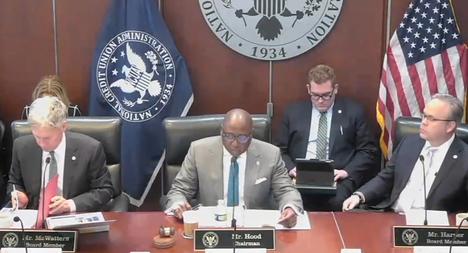
L-R: Mark McWatters, Rodney Hood, Todd Harper
Representatives of three trade groups--NAFCU, CUNA and NASCUS--offered input and feedback to NCUA’s board on where they want to see the agency take action on its budget.
In introductory remarks, Board Chairman Rodney Hood cited the transparency the agency has shown with its budget—above that of all other federal regulators. He told the hearing he believes consideration of the agency's budget is one of NCUA’s most important responsibilities.
“Our actions impact over 5,000 credit unions that serve 118 million member owners,” said Hood. “Therefore it is imperative that we must be good stewards of your money. I know the budget for 2020-2021 was a challenging one for the NCUA staff to develop and execute…We need to balance our mission, mandates and cost drivers, which impact agency finances, against the need to be fiscally responsible.”
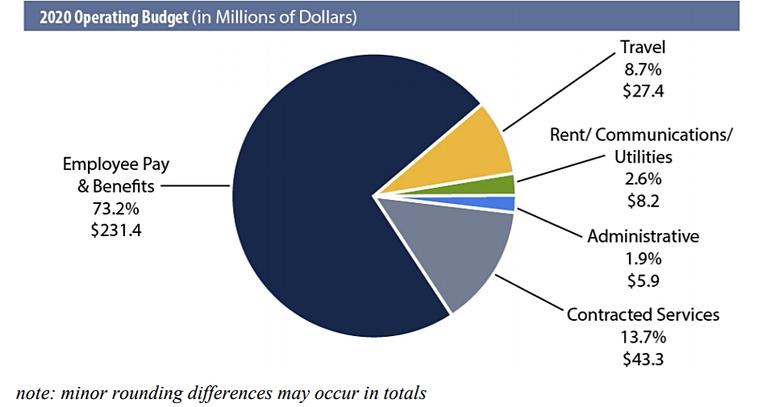
The NCUA’s 2020–2021 budget proposal represents three separate budgets: the Operating Budget, the Capital Budget, and the National Credit Union Share Insurance Fund Administrative Budget. Combined, these three budgets total $347.7 million for 2020, which is 1.1% more than the 2020 funding level approved by the NCUA board in November 2018, and 3.9% more than the comparable 2019 board-approved budget.
Budget Estimates
The budget estimates $316.2 million in spending for 2020 and $325.9 million in spending for 2021. The agency's proposed 2020 operating budget represents a 57% increase in the NCUA's budget over the past decade, trade groups reported.
NCUA stated that a significant cost driver in the 2020 budget is the increase in mandatory contributions all federal agencies must make to the Office of Personnel Management (OPM) for the Federal Employee Retirement System (FERS). Of the total 3.9% budget increase between 2019 and 2020, 1.6 percentage points of growth are directly attributable to the increased cost of FERS contributions and 2.3 percentage points of growth are the result of changes in agency operations. The 2.3% growth in agency operations also includes absorbing the equivalent of 0.8 percentage points of growth for costs avoided in the Share Insurance Fund Administrative Budget, the agency said.
“This means the actual budget increase to fund the agency’s operations is the equivalent of 1.5% growth. Personnel levels for 2020 and 2021 reflect the agency’s current staffing requirements and proposed staffing enhancements related to high-priority initiatives,” the agency said.
Prior to hearing testimony from the three witnesses, which CUToday.info is reporting separately, Board Member Todd Harper shared skepticism toward the agency’s proposed budget stating he isn’t certain how he will vote when final budget is presented to the board Dec. 12.
Vote Not Certain
Aligning with Hood, Harper said he “fully agrees” the budget is one of the board’s most important responsibilities. “While I've got to decide how I will vote go on the proposed budget, I'll be looking closely at the issues of shrinking budget ratios in the month ahead.”
Recognizing the agency can always achieve further operational and staffing efficiencies, Harper expressed concerns about “cutting too deep.”
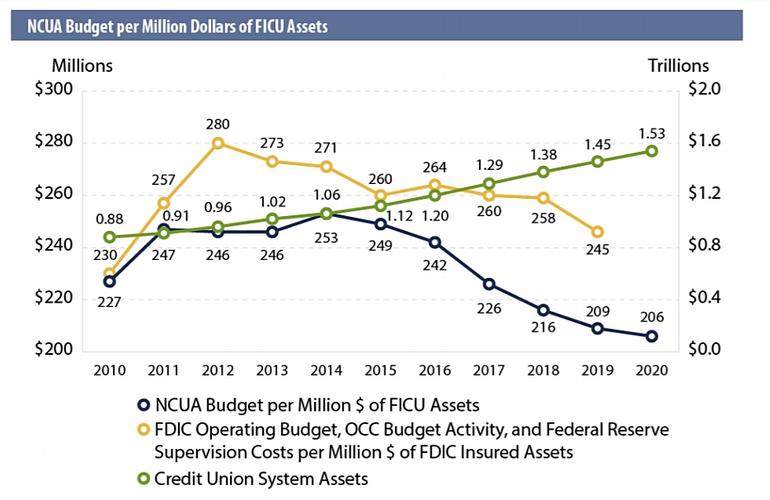
“One measure of budget efficiency is the dollars of agency budget compared to the total industry assets,” said Harper. “At the start of the century we saw a steady decline in this figure, which bottomed out in 2008 at $210 per million dollars of insured credit union assets. If we cut to the bone we can leave the agency flat-footed and ill-prepared for a financial crisis situation.”
Board Member Mark McWatters reminded NCUA is working with credit unions’ money and is mindful of that.
“This is not our agency’s money, this is not the board’s money, it’s the credit union community’s money,” said McWatters. “And we should remain respectful of that. But at the same time we have a mandate of safety and soundness to follow regarding the share insurance fund and the credit union community itself. All three of us take this obligation very seriously—so we balance carefully using your money, but we have a job to do and we will do it.”
Pointing to an aspect of the budget that often receives attention from the credit union community—staffing—CFO Rendell Jones noted the budget for employee salaries has increased by approximately 1.8% in the draft budget proposal.
“The largest share of growth in the pay and benefits categories comes from the revised assumptions by the United States office of Personnel Management for valuation of their Federal Employee Retirement charges,” noted Jones.
Jones said these costs have increased significantly for 2020 all federal agencies.
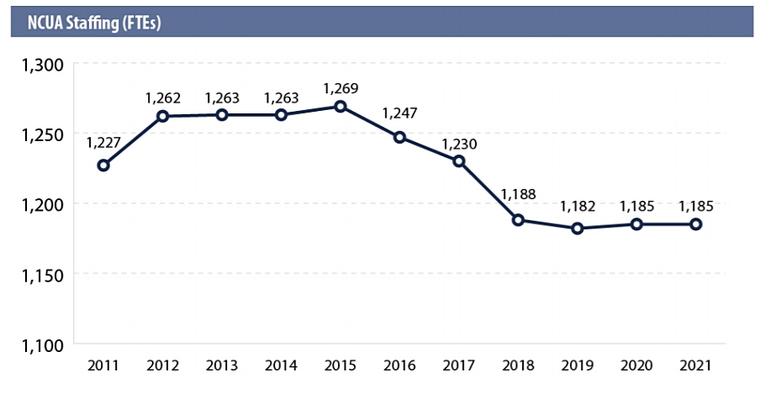
Jones noted staffing for 2020 is projected to increase by three positions compared to 2019, resulting in a new personnel level of 1,185 for the entire agency.
Harper Proposal
What could impact the agency’s head count projections is a proposal from Harper to create a dedicated consumer compliance exam program for large, complex credit unions. Harper briefly addressed his proposal following the trade group comments, asking presenters about their positions on the program.
As CUToday.info has reported, Harper is requesting public comment on his proposal that would affect large, complex CUs but exclude those over $10 billion in assets, since they are already subject to CFPB oversight.
For more details on the NCUA’s proposed budget, go to CUToday.info’s The Gov.