

CHICAGO – A new TransUnion report has found the total percentage of accounts in “financial hardship” status dropped during July for auto loans, credit cards, mortgages and personal loans, marking the first such decrease since the start of the COVID-19 pandemic.
But more than three-quarters of consumer still say they are “concerned” about ability to pay bills.
The report defines accounts in financial hardship by factors such as a deferred payment, forbearance program, frozen account or frozen past due payment.
TransUnion said it found that while fewer accounts are in financial hardship status as of late, credit performance has continued to hold steady and has not shown a material deterioration. The company noted that to gain greater insight into the performance and payment behaviors of consumers during the COVID-19 pandemic, TransUnion has supplemented its quarterly Q2 2020 Industry Insights Report with its Monthly Industry Snapshot Report, highlighting the consumer credit market for July.
“Overall the consumer credit market has been performing quite well despite the obvious challenges brought on by the COVID-19 pandemic,” said Matt Komos, vice president of research and consulting at TransUnion. “It’s a reassuring sign that delinquency levels have remained relatively low – especially as the percentage of consumers in financial hardship status has started to decline. While we still expect to see future delinquencies rise based on macroeconomic factors, it is clear that government stimulus programs and accommodation programs provided by lenders are helping the market withstand these challenges in the near-term.”
Here's a look at what TransUnion found by category:
Accounts in Financial Hardship
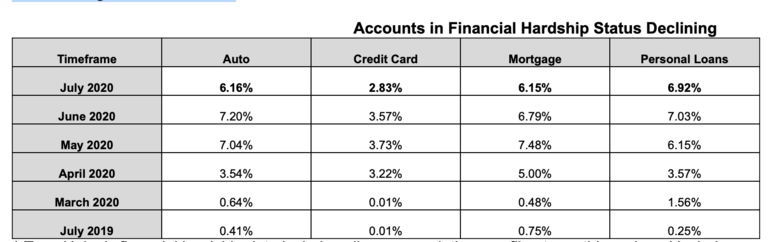
According to TransUnion, the percentage of accounts in financial hardship appeared to hit their peak during the months of May and June – a time when many consumers were feeling the combined impacts of reduced work hours, shelter-in-place orders, unemployment and dwindling stimulus funds.
“The recent reduction in account hardship levels may indicate that the number of consumers in financial distress has leveled off as performance for these products has maintained steady levels,” the company said in its analysis.
TransUnion found serious delinquencies (60 – 90 days past due) showed a month-over-month improvement from June 2020 to July 2020 across most credit products. Credit card, mortgage and personal loans also showed a substantial year-over-year decline in delinquency compared to performance in July 2019.
“The presence of federal programs and those provided by lenders, however, may have alleviated some of the financial hardship borrowers are facing,” the company said.
Delinquencies
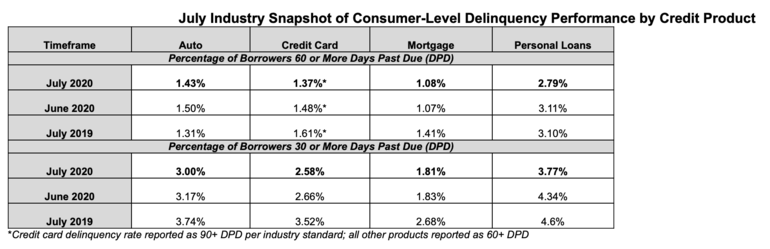
According to TransUnion, another positive sign from the report can be found via the 30-day delinquency metric – typically an early red flag that an account will default and potentially be charged off.
“These delinquency levels have shown signs of improvement in the month of July across auto, credit card, mortgage and personal loans compared to June as well as one year ago,” TransUnion said.
Despite this indication that consumers are not falling behind on payments, consumers are still expressing concern about their ability to pay bills, according to the company, which noted its Financial Hardship Survey from late July found 57% of Americans have been financially impacted by the COVID-19 pandemic.
Of those consumers, 77% said they are concerned about their ability to pay bills and loans, TransUnion said, adding they expect they will not be able to pay their bills or loans in about six weeks and anticipate an average budget shortfall of around $875.
“The level of concern is now at its highest level since TransUnion began tracking this variable in late March,” the company said.
Auto Payments
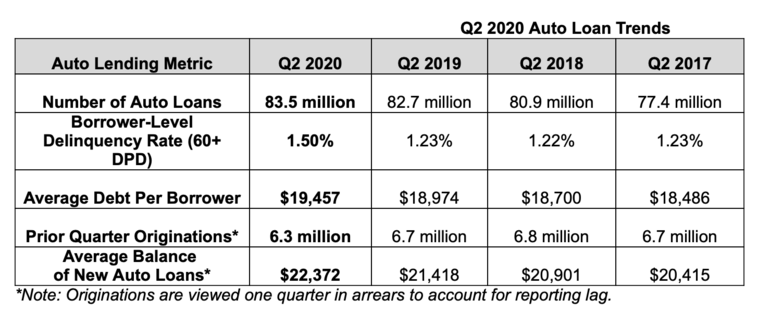
During the second quarter, TransUnion noted lenders began tightening their lending criteria in the auto market as performance started to show initial signs of deterioration. Consumer level delinquencies (60+ DPD) reached 1.50% in Q2 2020, an increase of 27 basis points (bps) from Q2 2019 and the largest such increase from the previous 11 quarters, the company said.
“While overall delinquencies saw an uptick, most lender types including banks, captives and credit unions have experienced a downward monthly trend in delinquency since the pandemic began,” TransUnion said in releasing the findings. “Conversely, independent auto lenders have been experiencing a monthly increase in 60+ DPD. This recent deterioration in performance, along with economic stressors presented by the COVID-19 pandemic, has resulted in lender pullback across all risk tiers, but has been primarily driven by subprime and near prime.”
Overall originations declined -5.8% year-over-year for a total of 6.3 million new loans.
The Analysis
“Traditionally auto loans have been a payment consumers make even in times of economic distress as a vehicle is the main source of transportation and the lifeblood for many consumers in their daily lives,” said Satyan Merchant, senior vice president and automotive business leader at TransUnion. “While there has been some recent deterioration in terms of auto performance, this may be the result of consumers having waited longer to enroll in forbearance or deferral programs for this product. Lenders are likely to continue monitoring delinquency levels – especially as accommodations expire or stimulus benefits run out – to determine future risk mitigation strategies across the portfolio.”
Credit Cards
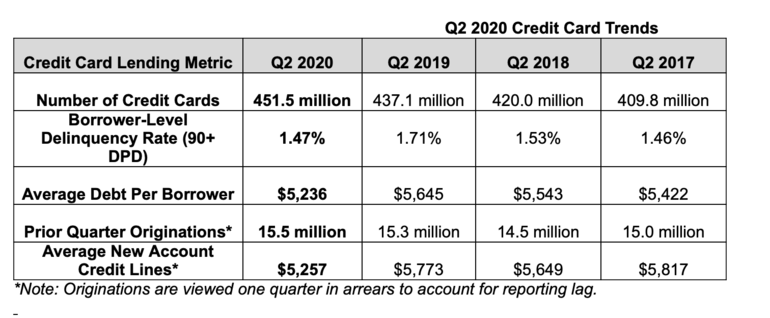
To address growing market uncertainties, TransUnion noted card issuers have tightened credit over the past quarter with total credit lines on new accounts declining -8.3% year-over-year to $78 billion, the first decrease observed since Q1 2018. The average credit line issued to new accounts decreased -9% year over year to $5,257, and a decline was seen across all risk tiers, the company noted, adding consumers continue to pay down card balances, with the average debt per borrower decreasing from $5,645 in Q2 2019 to $5,236 in Q2 2020.
These payments, as well as an increase of hardship accommodations, have resulted in steady performance for the sector, improving to 1.47% (90+ DPD), TransUnion said.
The Analysis
“Following several quarters of hyper growth, the COVID-19 crisis has driven a significant slowdown in origination activity and a decrease in credit lines as lenders look to hedge risk,” said Paul Siegfried, senior vice president and credit card business leader at TransUnion. “The additional liquidity afforded by deferral programs and government aid – combined with lower spend and larger payments – has allowed consumers to reduce card balances in the near-term and has largely kept delinquencies in check. However with many of these programs set to expire at the end of the third quarter, we expect this will have an impact on future performance.”
Personal Loans
The growth exhibited by the personal loan market over the prior several quarters slowed in Q2 2020, the first full quarter of COVID-19 impacts, according to TransUnion.
The company’s data show total personal loan balances reached $156 billion, a 5.3% year-over-year increase and the slowest rate of growth since Q4 2012.
“This is a strong indication of COVID-related pullback, particularly in below-prime tiers. Personal loan performance has not shown any material deterioration as overall consumer level delinquency (60+ DPD) in Q2 2020 decreased slightly to 3.08%,” it said. “This is accounted for by consumers taking advantage of forbearance initiatives as well as the recent mix shift toward lower risk consumers.”
Originations in Q1 2020 grew by 3.8% year-over-year, a significant reduction compared to the 8.2% growth in Q1 2019. Most of the growth was concentrated in prime and above risk tiers as lenders started tightening underwriting standards in the second half of March, TransUnion added.
The Analysis
“COVID-19 significantly impacted the personal loan market as total balances and the number of consumers carrying a balance saw decreases this past quarter,” Liz Pagel, senior vice president and consumer lending business leader at TransUnion. “This was driven by a combination of lenders tightening underwriting standards and a decrease in consumer demand driven by stimulus checks and stay-at-home orders driving down consumer spending. We expect lenders to cautiously ramp up origination volumes in Q3 with a continued focus on lower risk consumers. And as consumers start to roll off forbearance programs over the coming months we expect lenders to keep an eye on future delinquency levels.”