MADISON, Wis.–America’s credit unions added 428,000 new members during December, bringing the 2018 membership growth to 5.1 million new members, the biggest annual increase in credit union history and four times the pace set a decade earlier, according to a new year-end analysis.
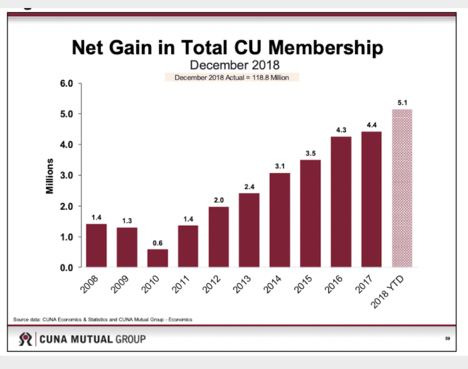
CUNA Mutual’s newly released Trends Report, which includes data through December of 2018 that is provided by CUNA, said total credit union membership hit 118.8 million at year-end 2018, which represents 36.2% of the total U.S. population, and is up from 34.8% of the population at year-end 2017, the Trends Report states.
But does other good news perhaps a prelude to not-so-great news to come? The Trends Report found the credit union aggregate loan-to-asset ratio hit 72.5% by year end, but its analysis added, “Alas, the last two recessions have been preceded by credit union loan-to-asset ratios climbing above 69%. Is this correlation or causation? In any event, this richer mix of assets should help boost credit union yield-on-asset ratios from the 3.8%.”
In addition, the nation’s 5,625 credit unions outperformed the 5,044 community banks in the “credit arena” in 2018, according to the Trends Report, which found community bank total loan balances rose only 4.5% in the year during that period, below the 9.1% gain for credit unions. Community bank “loans to individuals” rose only 4.7% during the 12 month period, Community bank real estate loans rose 6.7%, versus 8.1% for credit unions, CUNA Mutual said.
The ROA at community banks, however, was significantly above credit unions’ 0.96%, due to higher net interest margins of 3.68% versus 3.1% for credit unions, the Trends Report found. Asset growth was slower at community banks, rising 4.6% during the last 12 months versus 5.4% for all credit unions.
Here’s a look at how credit unions performed by category during December, according to the Trends Report:
Total Credit Union Lending
Credit union loan balances rose 0.6% in December, slightly below the 0.8% pace reported in December 2017, according to the Trends Report. Driving overall loan growth was strong growth in credit card loans (2.1%), unsecured personal loans (1.2%) and fixed-rate mortgages (1.3%), CUNA Mutual said, adding the muted December credit card growth was caused by the continuing windfall from lower gasoline prices.
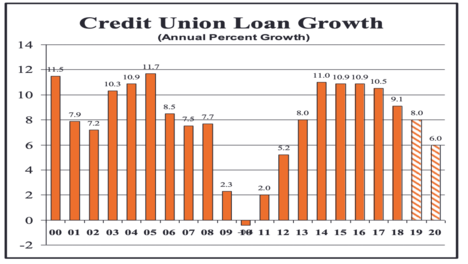
“Credit union loan balances rose 9.1% in 2018, down from the 10.5% reported in 2017 due to a slowdown in all loan categories except adjustable-rate first mortgages,” the CUNA Mutual analysis stated. “Expect loan growth to decelerate to 8% in 2019, slightly above 7.9% long run average. Rising household formations of 1.7 million and continued job creation will keep home and auto sales at their long run averages.”
Credit Union Consumer Installment Credit (CUCIC)
Credit union consumer installment credit balances (auto, credit card and other unsecured loans) rose 0.6% in December, faster than the 1% pace set in December 2017, the Trends Report said. During 2018 credit union consumer installment credit grew 11.6%, faster than the total market excluding credit unions, which grew only 3.5%. The added that if guaranteed student loans are removed, then consumer credit increased only 1% for non-credit-union lenders. Household debt burdens, as measured by household debt as a percent of disposable household income, fell to 98% in the third quarter of 2018, the lowest rate since the third quarter of 2001, according to the Federal Reserve’s Flow of Funds report.
Vehicle Loans
Credit union new auto loan balances rose 1.2% in December, similar to the 1.3% pace set in December 2017, and rose 11.9% for the full year, CUNA Mutual stated. On a seasonally-adjusted annualized basis, new auto loan balances rose 11.2% in December, which is below the 11.7% pace reported in December 2017, according to the report.
“Expect auto sales to slow to 16.7 million units in 2019, which is still above the 16.5 million sales rate that economists believe is the inherent long run demand,” the report forecasts

Real Estate Secured Lending – First Mortgages and Other Real Estate
Credit union real estate loan balances grew 8.1% in 2018, the slowest pace since 2014, according to the Trends Report. “Second mortgage loan balances reported strong growth in 2018 at 10.7% after eight years of falling or low balance growth due to members rolling second mortgages into refinanced first mortgages,” the report states. By year-end, fixed-rate first mortgages made up 28.7% of all loans, up from 22.6% in December of 2007 at the beginning of the Great Recession, the report added
“Credit unions are making headway in serving their members’ mortgage needs. Currently 2.5% of members have a first mortgage loan at their credit union, up from 1.9% in 2009,” according to CUNA Mutual. “First mortgage credit quality improved in 2018, with delinquency rates falling to 0.53%, down from 0.57% in 2017 and 0.63% in 2016.”

Surplus Funds (Cash + Investments)
In December, 2018, credit union liquidity fell to the lowest level in over 40 years, the report notes, as credit union surplus funds as a percent of assets declined to 23.3% in December, down from 26.2% one year earlier, due to loan growth outpacing savings growth, according to the Trends Report. Credit unions are decreasing the liquidity of their surplus funds. In December, 47% of surplus funds had a maturity of less than one year, down from 47.6% one year earlier, the report notes.
Meanwhile, during 2018 credit union savings balances rose $63.7 billion, down from $70.7 billion in 2017. “These ‘sources of funds’ helped fund the $89.5 billion increase in credit union loan balances in 2018,” the analysis observes. “The resulting $25.6 billion loan funding deficit was made up with a $22.5 billion reduction in investments and $3.1 billion of the total $12.5 billion increase in capital.”
The analysis further found loans rose to 72.2% of assets in December, up from 69.7% one year earlier, which was the highest level since July 1980.
“With loan and asset balances expected to increase 8% and 7.5%, respectively, in 2019, the credit union aggregate loan-to-asset ratio will reach 72.5% by the end of this year,” CUNA Mutual’s economists stated. “Alas, the last two recessions have been preceded by credit union loan-to-asset ratios climbing above 69%. Is this correlation or causation? In any event, this richer mix of assets should help boost credit union yield-on-asset ratios from the 3.8% set in 2018 to the 3.95% expected this year.”
Savings and Assets
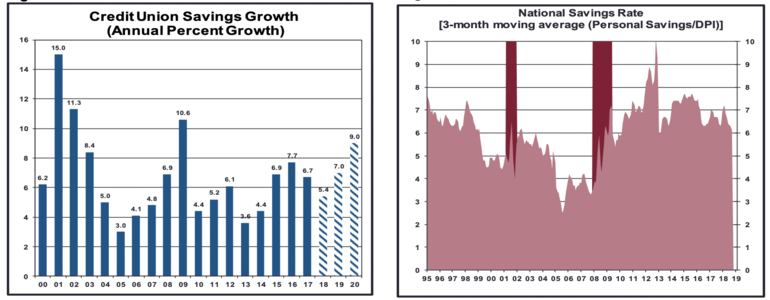
Credit union savings balances fell 0.1% in December due to the surge in deposits in November when the month ended on a payroll Friday, the Trends Report said. Savings balances typically decline 0.14% in December due to recurring seasonal factors such as holiday spending. Savings balances rose 5.4% for all of 2018, slower than the 6.7% pace set in 2017.
“Expect faster savings growth in 2019 of around 7% due to low gasoline prices, falling loan and spending growth rates and increased volatility in the stock market, which will create an incentive for members to choose the safety of insured deposit products to store part of their wealth,” the Trends Report predicts.
Capital and Other Key Measures
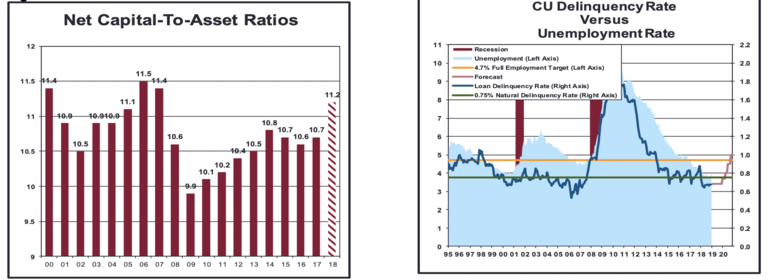
The credit union industry’s net capital-to-asset ratio ended 2017 at 11.2%, up from the 10.7% reported at year-end 2017, as capital growth outpaced asset growth, the CUNA Mutual analysis shows.The capital ratio is expected to fall to 11.1% in 2019 as the expected pace of capital growth (7%) is expected to fall slightly below the expected pace of asset growth (7.5%), it added.
The credit union loan delinquency rate (loans two or more months delinquent as a percent of total loans outstanding) remained at 0.67% in December from November, and down from the 0.88% reported one year earlier, CUNA Mutual said.
“With the labor market beyond “full employment” it appears the delinquency rate has dropped below its long run ‘natural’ rate of 0.75%,” the analysis stated.
Credit Unions and Members
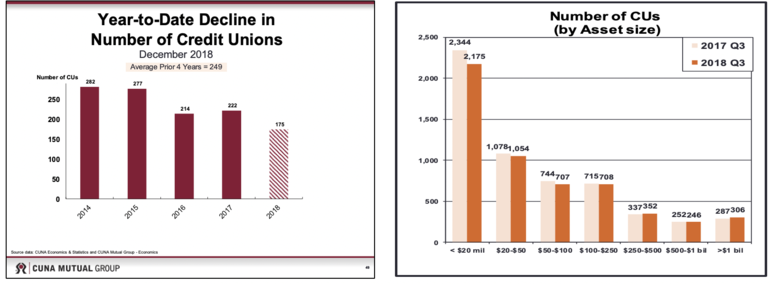
As of December 2018, CUNA estimates 5,625 credit unions are in operation, down 175 from December 2017. CUNA Mutual noted NCUA’s Insurance Report of Activity showed 53 mergers were approved in the fourth quarter with an average asset size of $29 million for the merging credit union and $947 million for the continuing credit union. This is up from the 50 mergers reported in the fourth quarter of 2017 with an average merging asset size of $23 million. The number of credit unions with assets less than $20 million fell by 169 over the last year to approximately 2,175, which is 38% of all credit unions.
There are now approximately 306 credit unions in the U.S. with assets greater than $1 billion according to NCUA call report data, CUNA Mutual added.
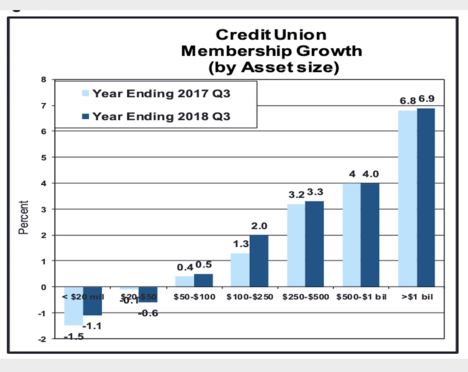
Large credit unions reported the fastest annual growth, while credit unions with less than $50 million in assets reported falling memberships.