

ST. LOUIS–A tight U.S. labor market has helped most vulnerable workers recover to pre-pandemic employment levels, and improving efficiencies in the job matching process can help them keep those gains, according to a new study released by the St. Louis Fed.

The study, authored by William M. Rodgers III, vice president and director of the St. Louis Fed's Institute for Economic Equity, and Alice L. Kassens, the John S. Shannon Professor of Economics at Roanoke College and a research fellow at the St. Louis Fed's Institute for Economic Equity, is based on an analysis of the Beveridge curve, and reveals how the COVID-19 public health crisis, relief and recovery assistance, the Great Resignation and other structural factors changed the job matching process between employers and candidates.
According to the St. Louis Fed, the pandemic shifted the Beveridge curve—which represents the relationship between the unemployment rate and the job openings rate—outward with the rapid increase in unemployment, followed by increasing job vacancies even as the unemployment rate returned to pre-pandemic levels.
The analysis states the predicted Beveridge curve for the overall labor market nearly returned to its pre-pandemic level, which was a strong labor market.
‘Positive Development’
“More important, this is a positive development since it indicates that, even after controlling for personal, household and geographic characteristics, job matches are happening faster, acting to lower unemployment,” the two researchers wrote. “Surprisingly, the Beveridge curves of many vulnerable groups who faced structural barriers to participation prior to the pandemic (e.g., noncollege-educated people, people of color, and young adults living in core urban areas and not enrolled in school) have also returned closer to their pre-pandemic positions. Women with children are the exception: Their Beveridge curve has not returned to its pre-pandemic position.”
Potential Pathways for Labor Market
The researchers noted the pressing question now is how will these vulnerable groups fare amid weaker economic activity, especially as rates rise.
“Though lowering inflation will improve the economy’s health and stability in the long run, the job prospects of these vulnerable groups are more sensitive to slower macroeconomic growth and downturns,” the report states. “A key to helping workers become more resilient to changes in the labor market hinges on removing the structural barriers that reduce the efficiency of the job matching process.”
Potential Paths
Given the uncertainty surrounding the economy, what are the possible paths for the labor market?
According to the analysis, the paths include:
- That the overall unemployment rate will not increase substantially as the job openings rate falls. Under this scenario, the number of job openings could fall from its extremely high level over the next few months to a lower (but still strong) level and have a relatively limited effect on hiring and unemployment.
- That ways will be found to ensure that a decline in the vacancy rate does not lead to a substantial increase in the unemployment rate. “How? There would have to be a considerable improvement in the job-matching process,” the researchers said. “The rigidities or structural barriers to work that existed prior to the pandemic or emerged as a result of the pandemic need to be reduced. Such barriers include inadequate child care for working mothers, weak job search networks, poor transportation and discrimination.”
Requirements for a More Resilient Labor Force
According to the analysis, a more resilient labor force depends on whether the Beveridge curves of workers viewed as “marginal” or “vulnerable” shift to their pre-pandemic positions: fewer job openings while maintaining low unemployment.
“The good news is that the regression-adjusted curves of young adults; noncollege-educated adults; and young noncollege-educated adults from core urban, suburban and rural areas have returned to their pre-pandemic Beveridge curves,” the researchers said. “This position could change because they have the greatest sensitivity to changes in job openings. The Institute will be monitoring their unemployment rates over the next few months.
The Exceptions
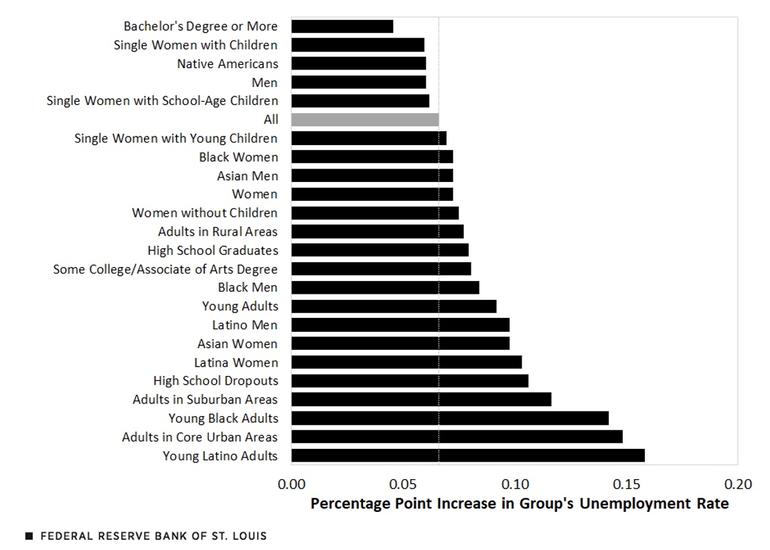
“However, the Beveridge curves of white, Black and Latina women have not fully returned to their pre-pandemic positions. Single mothers are particularly exposed to structural issues, as shown in the two figures below,” the analysis continued. “For example, even as state mandates lifted and children returned to school, an exposure could send the child back home. The uncertainty associated with the quarantine requirement poses a challenge to single mothers with few resources to watch the child while they are at work. Along with the vulnerable groups listed above, the labor market experiences of these women over the next few months are critical to how buoyant the overall labor market can remain.”
The Very Best in CU Reporting. For You. For Free. Or Your Money Back
Don’t forget to check your Spam/Junk email folder if you haven’t been receiving your free, popular and daily CUToday.info news headlines.
And if you haven’t yet signed up for the new email solution on which CUToday.info has partnered with ResponseGenius, you can do so here. Signing up requires less than one minute of your time.
CUToday.info has received very positive response from readers following the move to an improved provider of the daily headlines, but many also noted they did need to go to their Spam/Junk folder and mark it as safe.
The new email solution has not only improved every reader’s delivery experience, but it also features a fresh, new format that is easy to read, especially on mobile devices.
Please note and/or make your IT department or email administrator aware the emails will be coming from the domains CUTodayinfo.com and CUTodayinfoReply.com.