

WASHINGTON–The three major credit bureaus have changed how they respond to consumer complaints and are more frequently providing “tailored responses,” according to a new annual report from the CFPB that also offers recommendations for more improvements.
According to the Bureau, the report details improvements and deficiencies in the nationwide consumer reporting companies’ responses to consumer complaints transmitted by the CFPB.
“TransUnion, Equifax, and Experian routinely top the list of complaints submitted by consumers,” CFPB Director Rohit Chopra said in a statement. “We will be exploring new rules to ensure that they are following the law, rather than cutting corners to fuel their profit model.”
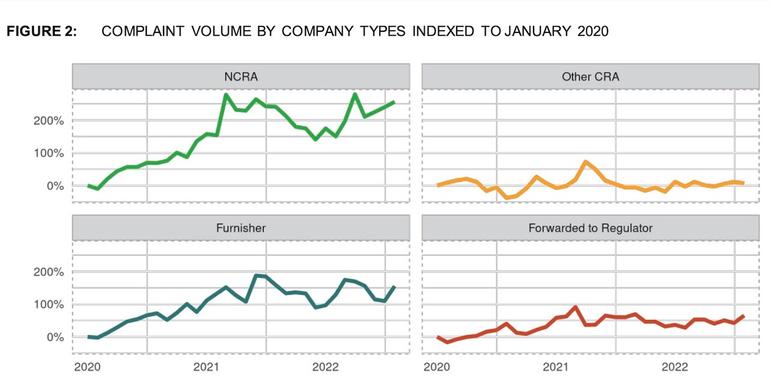
The Bureau said the report is based on the 488,000 consumer complaints the CFPB transmitted to Equifax, Experian, and TransUnion from October 2021 through September 2022. It follows last year’s report that detailed “failures” by the nationwide companies when responding to consumer complaints submitted to the CFPB.
The Findings
According to the Bureau, Equifax, Experian, and TransUnion have since acted to remedy some of the issues identified in last year’s report. Specifically, the CFPB said it found Equifax, Experian, and TransUnion have:
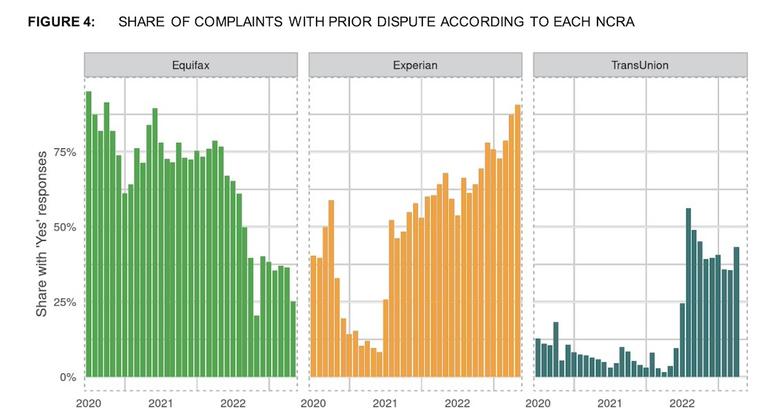
- Changed how they respond to complaints. “Equifax, Experian, and TransUnion use of problematic response types described in last year’s report has declined. Most complaints now receive more substantive responses.”
- Provided more tailored complaint responses. “Across all three companies, most responses now describe the outcomes of consumers’ complaints. In September 2022, the nationwide companies provided a tailored response to more than 50% of complaints that were closed with an explanation or relief.”
- Reported greater rates of relief in response to complaints. “In 2022, TransUnion reported providing relief in most complaints. Experian reported providing relief in nearly half of complaints. Equifax reported that it did not provide relief, but its written complaint responses suggest that its rates of relief are comparable to the other two companies.”
Additional Issues
The CFPB reported it has also highlighted other consumer reporting problems and has reminded consumer reporting companies of their obligations to consumers under the Fair Credit Reporting Act.
“For example, an earlier report revealed how the nationwide consumer reporting companies had often allowed their processes to be used to coerce individuals to pay medical bills they may not even owe,” the Bureau said.
The CFPB noted it further issued “straightforward guidance” on permissible purposes for accessing consumer reports, identifying and eliminating obviously false and junk data, and resolving consumer disputes. The Bureau noted it also has taken action against consumer reporting companies when they have broken the law, as well as affirmed the ability of states to police credit reporting markets.
The Recommendations
The CFPB said it expects the three nationwide consumer reporting companies to continue improving how they serve consumers. To that end, the CFPB is recommending that Equifax, Experian, and TransUnion:
- Consider consumer burden when implementing automated processes. “When companies consider introducing automated processes that will affect their customers, particularly those that relate to a legal right, they should consider consumer burden, especially whether a change will require consumers to do more work to exercise their legal rights.”
- Recognize that technology is also improving for consumers. “Advances in communications technologies mean consumers do not necessarily need to write complaints on their own. Instead, communications technologies may ease the writing burden. Such innovations, including ones that can generate letters for consumers, may create similar-sounding complaints that are, in fact, from unique individuals with independent concerns. The assumption that similar-sounding letters are from third parties will increasingly be wrong.”
- Consider how to transition the market from control and surveillance to consumer participation. “One potential reason there are so many reported inaccuracies in consumer reporting data is that consumers are several degrees removed from their own data. Enabling increased consumer participation on the data side of consumer reporting has the potential to create a fairer market with added benefits for consumers, consumer reporting companies, and lenders.”
The full report can be found here.