

NEW YORK – The Federal Reserve Bank of New York has issued a report on the Phase I results of Project Cedar, the inaugural project of its New York Innovation Center (NYIC), saying it has uncovered three key findings.
Project Cedar is a multiphase research effort to develop a technical framework for a theoretical wholesale central bank digital currency (wCBDC) in the Federal Reserve context through exploration of fundamental design choices and modular technical features, the New York Fed stated.
According to the New York Fed, Phase I of the Project Cedar experiment examined the potential application of distributed ledger technology, specifically blockchain, to enhance the functioning of cross-border payments.
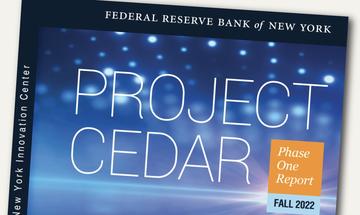
“The 12-week experiment included the development of a wholesale CBDC prototype and revealed that wholesale cross-border digital currency transactions supported by blockchain technology can deliver fast and safe payments,” the New York Fed said.
A Summary
The report summarizes the problem space, hypothesis, design and results of the experiment conducted in Phase I, which focused on a wholesale cross-border payments use case, the New York Fed explained.
"Safe and efficient cross-border payments are critical to the functioning of the global economy," said Per von Zelowitz, director of the New York Innovation Center. "Project Cedar Phase I revealed promising applications of blockchain technology in modernizing critical payments infrastructure, and our inaugural experiment provides a strategic launch pad for further research and development regarding the future of money and payments from the U.S. perspective."
In Project Cedar Phase I, the experiment simulated a foreign exchange (FX) spot trade and introduced a wholesale central bank digital currency prototype to test whether using blockchain technology could improve speed, cost, and access to cross-border wholesale payments.
“FX spot trades are among the most common wholesale cross-border transactions, as they are often required to support broader transactions, such as for international trade or foreign asset investment,” the New York Fed said. “While these payment systems function well, there is opportunity for improvement around settlement. Currently, it takes two days for most FX spot trades to settle. During this period, payment senders and recipients are exposed to settlement, counterparty, and credit risk which, among other things, can hinder an institution's ability to readily convert its assets into cash.”
Three Key Findings
The New York Fed said the experiment revealed three key findings that showed cross-border payments supported by blockchain technology can deliver faster, and safer payments:
- Faster Payments: In the test environment, transactions on the blockchain enabled distributed ledger system settled under 15 seconds on average
- Atomic Settlement: The simulated ledger network enabled atomic settlement, meaning both sides of the simulated transactions were settled either simultaneously or not at all. This greatly reduces the various forementioned risks that counterparties incur in the current state environment
- Safer and Accessible Transactions: The distributed ledger system design enabled payments on a 24/7/365 basis and supported objectives related to interoperability by enabling transactions across homogeneous ledgers networks representing a variety of financial institutions, including central and private sector banks
The Very Best in CU Reporting. Every Morning. At a Price Every CFO Will Love
Don’t forget to check your Spam/Junk email folder if you haven’t been receiving your free, popular and daily CUToday.info news headlines.
And if you haven’t yet signed up for the new email solution on which CUToday.info has partnered with ResponseGenius, you can do so here. Signing up requires less than one minute of your time.
CUToday.info has received very positive response from readers following the move to an improved provider of the daily headlines, but many also noted they did need to go to their Spam/Junk folder and mark it as safe.
The new email solution has not only improved every reader’s delivery experience, but it also features a fresh, new format that is easy to read, especially on mobile devices.
Please note and/or make your IT department or email administrator aware the emails will be coming from the domains CUTodayinfo.com and CUTodayinfoReply.com.