

ALEXANDRIA, Va.–Prior to casting his dissenting vote against delaying NCUA’s risk-based capital rules any further, NCUA Board Member Todd Harper conducted a vigorous hour-long questioning of NCUA staff, raising prior statements made by those staff members that seemed to run counter to their new positions, probed for why a rule that applies to a tiny number of CUs is being pushed back again, and questioned why NCUA is trailing other regulators in taking action by nearly a decade.
As CUToday.info reported, the board has voted 2-1 to delay until Jan. 1, 2022 a risk-based capital standard that was to go into effect Jan. 1, 2019 (after being pushed back from Jan. 1, 2018). The RBC proposal was first put forward in 2014, and formally passed by the NCUA board in 2015. NCUA Chairman Rodney Hood and Board Member J. Mark McWatters voted in favor of the delay.
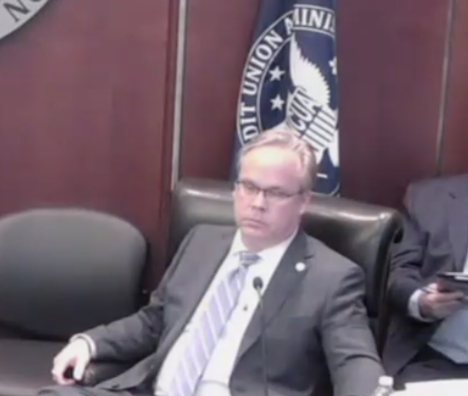
NCUA Board Member Todd Harper during meeting.
Great Skepticism
In his comments, Harper said he viewed any further delay with “great skepticism.”
“I appreciate the views of my colleagues on this matter, but we may have to agree to disagree,” said Harper. “The supervisory efforts should focus on the institutions and activities posing the greatest risk... As such, I believe that all financial institutions backed by federal share or deposit insurance should hold capital commensurate with the risk on their balance sheets…Additionally putting safeguards like the revised, final risk based capital rule in place before the next recession or financial crisis occurs is good public policy. Afterall, it's better to repair a roof before it rains than to patch it while it rains. With the recent inversion of the yield curve we know a recession is coming. We just don't know when and how severe.
“Moreover, the recent losses at several federally insured credit unions, the taxi medallion lenders, highlights why we have to implement, not further delay this regulation,” Harper continued. “These failed credit unions held significant concentrations of taxi medallion loans on their books, as much as 90% in one instance. Altogether, an NCUA Inspector General's Loss Review (found) an estimated loss of $765.5 million. Let me say that again: $765.5 million.”
Saying he wanted to apologize in advance for the time he planned to take questioning NCUA staff, primarily director of Examination and Insurance Larry Fazio, Harper said he was doing so because delaying risk-based capital standards will have “consequences for the entire credit union system.”
Questions Asked
Below is a look at some of the questions posed by Harper and the responses from Fazio.
Harper: When did the FDIC implement its rule?
Fazio: It finalized it in 2013.
Harper: When did the federal reserve implement its capital rule?
Fazio: I think this was the same time.
Harper: It was 2014. When did the Office of Comptroller implement theirs?
Fazio: Also the same thing, 2014.
Harper: So what this proposed rule, which kicks the can down the road to two more years, suggests it will take federally insured credit unions seven or eight years longer than banks and thrifts took to implement theirs. Now let's turn to the requirement from the federal credit union act related to capital standards. Am I correct in noting that section 216 of the Act requires the NCUA board to adopt a system of prompt corrective action to restore the net worth of federally insured credit unions that become inadequately capitalized? Second does the act require the adoption of a prompt corrective action system that is both consistent with section 216 of the Federal Credit Union Act and comparable to the prompt corrective action prescribed by the Act?
NCUA Staff Attorney John Brolin: Yes, sir, that's correct.
Harper: Let's compare the coverage for banks and thrifts to federally insured credit unions. How many (CUs) are exempt from the risk-based capital rule that's currently scheduled to take effect on January 1st, 2020.
Fazio: Approximately 90%. A little under 5,000…
Harper: How many FDIC-insured banks and thrifts are exempt from its rule?
Fazio: None.
Harper: Thank you. Regardless of how small they are?
Fazio: Correct. They do not have the statutory requirement.
Harper: And what percentage of FDIC banks and thrifts is that?
Fazio: 100%.
Harper: How many from the Federal Reserve are exempt from its risk-based capital rule?
Fazio: Same answer.
Harper: And what percentage is that?
Fazio: Zero.
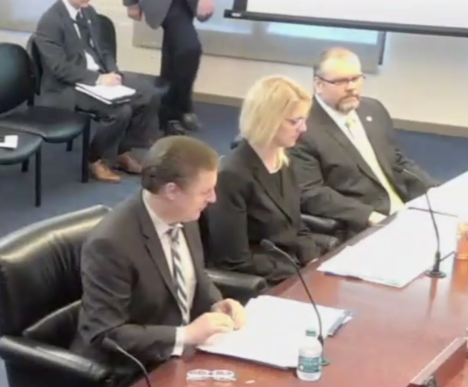
NCUA staff responding to questions from board.
Harper: How many are exempt from the Comptroller’s rule?
Fazio: Zero.
Harper: Turning to NCUA’s risk-based capital rules. How old is the rule that credit unions must follow?
Fazio: It's origins date back to 2001. There are a couple of modifications along the way in terms of a few technical changes.
Harper: Let's move on. Of the more than 5,300 credit unions, how many are classified as under-capitalized under the current risk-based rules?
Fazio: Three.
Harper: Under the risk-based net worth rule, how many are critically under-capitalized?
Fazio: Three are significantly undercapitalized, three are undercapitalized.
Harper: If only a single complex credit union fails the standard, can we conclude the current risk based system for credit unions is broken?
Fazio: I wouldn't say it's broken.
Harper: Since the Great Recession, has NCUA made any corresponding changes to its risk based capital rule that have actually gone into effect?
Fazio: No.
Harper: If the banking regulators increased the capital requirements for banks and thrifts and we have not maintained comparability as required under the law, isn't that effectively a decrease in the capital standards for the federally insured credit unions? If the banking regulators generally increased their capital requirements and we have not maintained comparability a required by the law, isn't that effectively a decrease in the quality of capital standards for federal rally insured credit unions, vis-a-vis the banks?
Fazio: If you accept the premise that it's comparable, then they raised theirs and we haven't.
Harper: Credit unions subject to RBC will have had a total of more than four years to prepare. Staff with Examination and Insurance told the NCUA board (more than a year ago), ‘We continue to believe a one-year delay is sufficient. It will provide credit unions with an additional year to implement the 2015 rule. That is more than sufficient time.’ I am asking you now, why that is not enough? Technically, this only impacts 257 complex credit unions, and it only really effects the four whose PCA categories would drop. We are ready to go, why are we hitting pause?
Fazio: We have to have the compliance systems in place and credit unions will have to adjust their operations.
Harper: Former Board Member (Rick) Metsger said at the time we were considering the extension, ‘Credit unions will now have six years since inception of the rule to raise capital or reduce risk on their balance sheets, and all the available data show complex CUs have reduced risk on their balance sheets. They have 18% capital on an RBC basis. That’s 800 basis points more than necessary to be well capitalized? Was he wrong?
Fazio: No.
Harper: Board Member Metsger also said, ‘This is a proposal. We have an existing rule set to take effect in January 2019. I know we have systems to capture the new data. Could we possibly do this in six months? And you said, ‘It’s possible.’ If you stated more than a year ago that it was possible to implement in six months, why do we now need three years to implement? What has changed? Are complex credit union in such terrible shape they need two more years? There are 545 complex CUs that would be in this universe, and this is only really binding on 257, most of which are well-capitalized under either standard. Five are adequately capitalized, and none are undercapitalized. Collectively, they represent 99% of assets of credit unions. Do they need two years to prepare? Has net worth increased or decreased since the rule was adopted?
Fazio: Its’ grown to 11.14%.
Harper: Has the risk ratio of complex credit unions increased over last year?
Fazio: It has increased by 20 basis points.
Harper: Are we really saying we could afford nearly $1 billion (in potential losses) to the Share Insurance Fund over the next two years, but we can’t ask the extreme outliers, the credit unions in the bottom half of the bottom 1% (to comply)? Do we need a full decade to holistically review capital standards?
Fazio: That’s a policy choice. We didn’t actually propose anything until 2014, and in 2015 it was finalized? How long it takes to put into effect and do some additional changes is a policy for the board to make.
Harper: How many of the 5,300 CUs do you expect to ever utilize the new subordination or secondary capital rules we are working on?
Fazio: I don’t want to speculate.
Harper: You think a lot
Fazio: Probably not a lot. Just some.
Harper: Is there even a single one among those credit unions that would be undercapitalized if we allow the rule to take effect on Jan. 1, 2020?
Fazio: No.
Closing Statement
In closing, Harper offered this statement: “If banks didn’t get their RBC rules delayed, I have to ask myself why should credit unions? It’s often said those who forget the pastare doomed to repeat it. In terms of this RBC effort, we are forgetting the past repeatedly, like the characters in Groundhog Day. After a decade of work, it is time for us to move ahead. To protect taxpayers, we should no longer wait.
“The proposed rule is binding on a single credit union…I think we should move ahead. As those CUs expand their relatively risky behaviors, they should have capital commensurate with risk, rather than having it after the fact, as we did during Great Recession. I am not prepared to support something the credit union system doesn’t need, isn’t in the public interest, and as the recent losses from taxi medallion lending CUs proves, is not in the interests of federally insured credit unions. The risk-based capital rule brings us under BASEL, and provides comparability with other federal regulators as required by Federal Credit Union Membership Access Act.
“In my view an additional two-year delay makes NCUA a day late in meeting the expectations of credit unions, and a dollar short the next time a credit union fails.”