MADISON, Wis.—There will be fewer than 3,000 credit unions in the U.S. in just 20 years, according to a new projection.
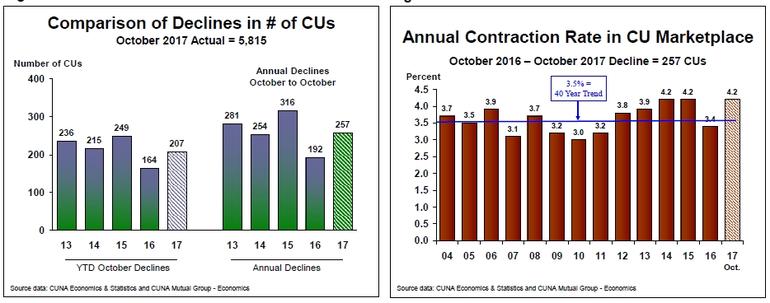
CUNA Mutual’s latest Trends Report–while reporting overall industry numbers that are strong–is forecasting the current 5,815 credit unions will decline significantly by 2038.
“If we apply this exponential ‘decay’ rate to the current number of credit unions, 5,815, we should expect another 203 credit unions to exit the financial system in 2018,” the Report suggests. “If we forecast out a little further, according to the laws of exponential decay, there will only be 2,955 credit unions in 20 years, half as many as there are today. Fortunately, credit union assets follow an average annual exponential growth of 7%. This means the time it takes for credit union assets to double (currently $1.389 trillion) is only 10 years.”
Separately, looking at numbers in the shorter term, the Trends Report data for CU performance during October show loan balances in October grew at a 10.2% seasonally-adjusted annualized pace, with CUNA Mutual economists predicting a slowdown in CU loan growth next year.
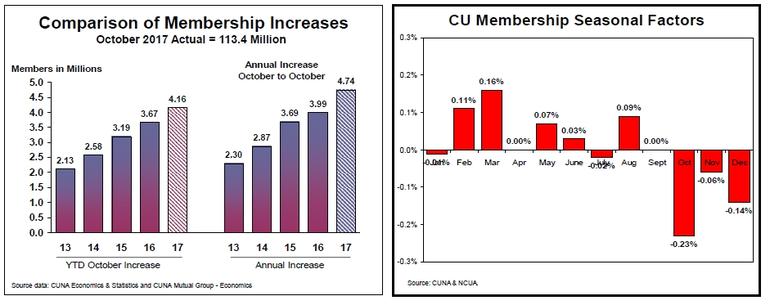
Credit union memberships grew a modest 215,000 in October, although the pace was faster than one year earlier.
Here’s a look at how credit unions performed by category:
Total Credit Union Lending
Credit union loan balances rose 0.9% in October, faster than the 0.7% pace reported in October 2016. Driving overall loan growth was strong growth in home equity loans (2.2%), adjustable rate first mortgages (1.6%) and new auto loans (1.4%).
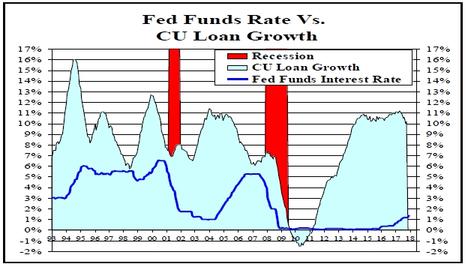
“How will rising short-term interest rates in 2018 affect credit union loan growth?” the Report asks, before answering, “Higher Fed Funds interest rates will have a slight downward pull on overall loan growth next year as credit card, auto and mortgage interest rates increase. We expect loan growth to slow to 9.5% in 2018 from 10.5% in 2017; however, this is still above the long run average of 7.8%.”
Credit Union Consumer Installment Credit (CUCIC)
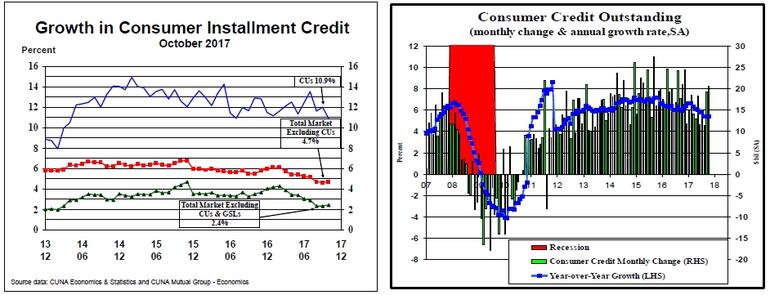
Credit union consumer installment credit balances (auto, credit card and other unsecured loans) rose a modest 0.8% in October, slower than the 1.7% pace set in October 2016, due to deceleration in unsecured personal and credit card lending, according to the latest Trends Report. During the last 12 months, credit union consumer installment credit grew 10.9%, which is more than twice as fast as the rest of the market. Outstanding consumer credit rose $20.5 billion for all lenders in October, according to the Federal Reserve, and above the $16.1 billion average monthly growth reported during the last 12 months. The rise in the Fed Funds interest rate will increase credit card interest rates in the near term and, to a lesser extent, auto loan rates. This will boost credit union yield on assets and net income in 2018, CUNA Mutual Group said.
Vehicle Loans
Credit union new auto loan balances rose 1.4% in October, faster than the 1.0% pace set in October 2016, and increased 16.5% during the last year, the Trends Report noted. On a seasonally-adjusted annualized basis, new auto loan balances rose 12.1% in October, down from the 17.4% pace reported in October 2016.
“Strong consumer fundamentals are driving auto loan growth: an improving labor market, low interest rates, rising wage growth, expanding driving-age population, improving construction activity, low oil prices and better household balance sheets. The number of new auto loans as a% of members in offering credit unions – the penetration rate – rose to 5.6%, up from 4.2% in 2012,” the report shared.
Vehicle sales fell to 18.1 million units in October, on a seasonally-adjusted annualized sales rate, from the 18.6 million reported in September. This sales rate was 2.8% above the 17.9-million pace set in October 2016 due to hurricane replacement car sales. Expect auto sales to remain at the 17.5 million pace in 2018 and then decline to 17 million in 2019. This should keep credit union new-auto lending growing at a double-digit pace for the next year, CUNA Mutual Group stated.
Real Estate Secured Lending – 1st Mortgages and Other Real Estate
Credit union real estate lending was firing on all four cylinders during the first 10 months of 2017 due to the improving economy and credit unions increasing their market share of the mortgage origination market. Adjustable-rate first mortgage loan balances grew a strong 1.6% in October, similar to the 1.9% pace set in October 2016. Fixed-rate mortgage loan balances rose 0.2% in October, above the 0.5% decline recorded in October 2016. Expect purchase mortgage lending to increase around 6-7% in 2018 due to rising incomes, higher consumer confidence and strong job growth, the Trends Report is projecting.
The Trends Report added, however, that credit unions can expect refinance mortgage lending to drop 25-30% as long-term interest rates rise from around 4% today for a 30-year mortgage to 4.75% in 2018. Thus, total mortgage lending is expected to decline by 5-6% in 2018, the report stated.
Home equity lending balances surged in October, rising 2.2%, similar to the 2.6% reported in October 2016. Seasonal factors typically add 0.6%age points to the underlying monthly trend growth rate in October, making it the second fastest growing month for home equity loans. Home equity loan balances will remain strong due to rising home prices, the improving job market, high consumer confidence, consumers releasing pent up demand for durable goods and low interest rates, CUNA Mutual Group is predicting.
Surplus Funds (Cash + Investments)
Credit union surplus funds fell in October by $9.7 billion due to a $8.2-billion surge in loan growth and $5 -billion drop in deposits. Borrowing rose $7.2 billion to help fund loans and deposit runoff, according to the Trends Report.
The report further noted that credit union surplus funds as a% of assets fell to 26.0% in October, from 26.7% in September to reach $361.5 billion. “This is the lowest liquidity position since October 2007, two months before the onset of the Great Recession,” according to the Trends Report.
Savings and Assets
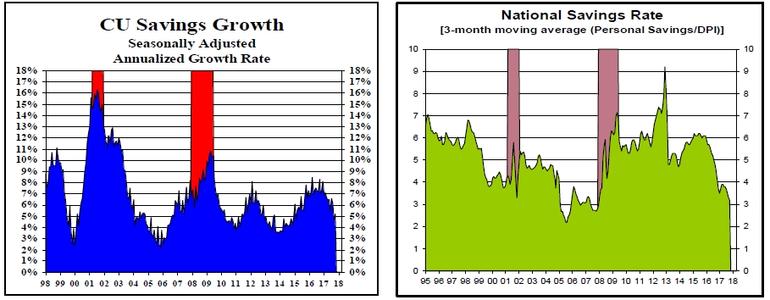
Credit union savings balances fell in October (-0.4%) as the deposit surge in September, due to September ending on a payroll Friday and having five Fridays, reversed itself, the Trends Report analysis states. Savings balances grew at a 5.2% seasonally-adjusted annualized growth rate in October, below the 7% reported one year earlier. Credit unions are experiencing a slowdown in deposit growth as the national savings rates (personal savings as a% of disposable personal income) fell to a cyclical low of 3.2%, the lowest since December 2007, the month which kicked off the Great Recession.
“With consumer confidence at the highest level in 17 years, Americans are in the mood to spend and not necessarily save due to expectations of faster income growth in 2018,” CUNA Mutual Group said.
Capital and Other Key Measures
The credit union system has become significantly more productive over the last 17 years, the data show.
“Back in the year 2000, it took on average 0.38 full-time credit union employees to manage every $1 million in assets. Today that ratio stands at 0.21, a 45% improvement in productivity, or 2.8% increase in productivity per year,” according to the Trends Report. “Today there are 294,000 full-time employees working at credit unions managing $1,390,000 million in assets. The number of employees working at credit unions today would have been 528,000, (0.38 x 1,390,000) if credit union employees had the same level of productivity they did back in 2000. The net result is 234,988, (528,000 – 294,000); jobs were not filled due to improvements in human and physical capital. Smaller asset-size credit unions reported bigger improvements in productivity ratios over the last 16 years; however, larger credit unions are still more productive due to their economies of scale.”
Credit union capital balances grew 6.9% in October, slightly below the 7% average set over the last twenty years, according to the Trends Report.
Credit Unions and Members
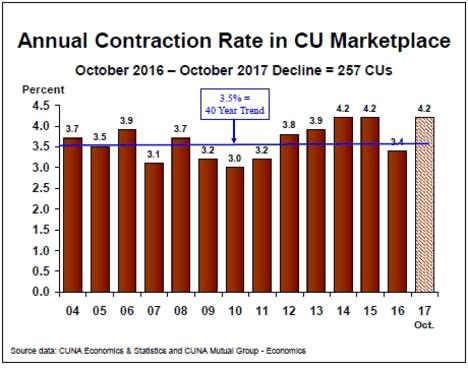
As of October 2016, CUNA estimates 5,815 credit unions were in operation, down 257 from October 2016. Year-to-date the number of credit unions fell by 207, significantly more than the 164 reported in the first ten months of 2016. NCUA’s Insurance Report of Activity showed 16 mergers were approved in October with an average asset size of $18.5 million. This is down from the 11 mergers reported in October 2016 with an average asset size of $7.9 million, the Trends Report shows.
Credit union consolidation and concentration is expected to continue at its long-run pace in 2018. Since 1980, the number of credit unions has declined by roughly 3.5% each year.
“If we apply this exponential ‘decay’ rate to the current number of credit unions, 5,815, we should expect another 203 credit unions to exit the financial system in 2018,” the Report found. “If we forecast out a little further, according to the laws of exponential decay, there will only be 2,955 credit unions in 20 years, half as many as there are today. Fortunately, credit union assets follow an average annual exponential growth of 7%. This means the time it takes for credit union assets to double (currently $1.389 trillion) is only 10 years.”
Credit union memberships grew a modest 215,000 in October, or 0.19%, but faster than the 132,000 new members, or 0.12%, added in October 2016, the Trends Report stated. Year-to-date credit unions added 4.16 million new members, faster than the 3.67 million members added during the similar period in 2016. October’s seasonal factors typically shave off 0.23%age points from the underlying trend membership growth rate.
Total credit union memberships reached 113.4 million in October, 4.7% more than October 2016 and the fastest pace in more than 25 years. Expect membership growth to slow slightly in 2018 as loan growth slows slightly, CUNA Mutual Group said.
A full copy of the Trends Report can be found in CUToday.info’s The Vault here.