MADISON, Wis.–Credit unions should expect an ongoing decline in mortgage originations as rates rise, but also should expect to continue to benefit from increasing economies of scale, as CUs have become “significantly more productive over the past 21 years,” according to a new forecast from CUNA Mutual Group.
The forecast was included in the company’s latest Trends Report, which examines CU data through October of this year. Included in the new Report is a prediction that the number of CUs will drop by half to approximately 2,521 in 20 years, although assets will continue to see "exponential" growth.
Here’s a look at how credit unions performed by category, according to CUNA Mutual’s analysis:
Total Lending
Credit union loan balances rose 1% in October, above the 0.2% increase reported in October 2020. Loan categories that increased the fastest were unsecured personal (2.8%), home equity (1.4%), fixed-rate first mortgage (1%) and used-auto lending (0.6%). New auto loan balances declined 0.7%, the only loan category that reported a negative growth rate, CUNA Mutual said.
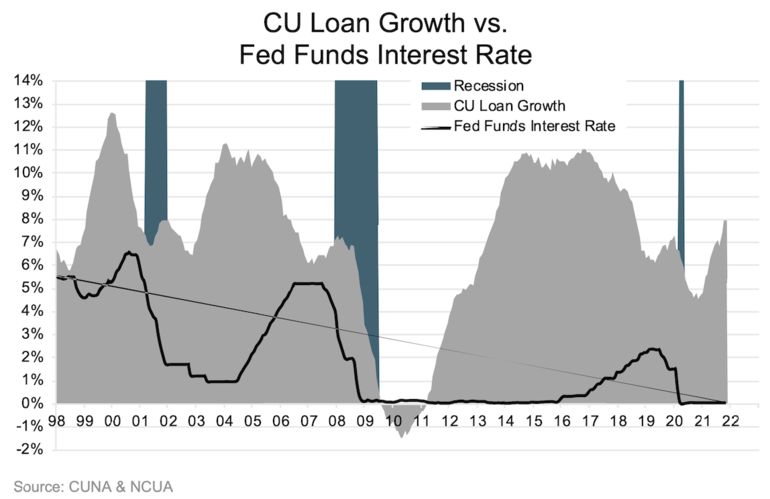
“Short-term interest rates have been close to zero since the spring of 2020. So how do falling short- term interest rates affect credit union loan growth?” the Trends Report analysis asked. “The figure below shows the relationship between credit union annualized loan growth numbers and the Fed Funds interest rate for the past 24 years. Periods of low Fed Funds interest rates, (2002-2003 and 2009-2015) have a boosting effect on overall credit union loan growth, albeit with a 2-year lag. This is, of course, the goal of looser monetary policy, which is to accelerate the rate of credit creation from below-trend growth to something closer to normal. Credit union loan balances grow on average 7.2% per year over the long run, and credit union loan balances are rising at a 7.9% seasonally adjusted annual rate today.”
CUNA Mutual’s Steven Rick noted the Federal Reserve is expected to raise the Fed Funds interest rate three times in 2022 to slow credit creation, aggregate demand and reduce inflationary pressures.
Consumer Installment Credit
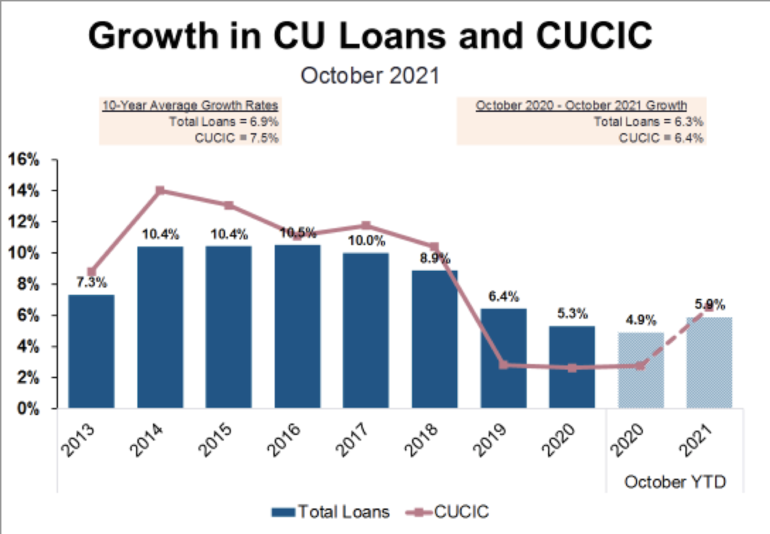
According to the Trends Report, Credit union consumer installment credit balances (auto, credit card and other unsecured loans) reported 0.4% in October, the same 0.4% increase set in October 2020, due to an acceleration of 2.8% in the “unsecured personal loan” category. Credit card balances rose 1.1% in October, above the 0.0% growth reported last October, the report added.
Year-to-date, credit union consumer installment credit grew 6.5%, which is twice as fast as the 3.2% reported during the same period in 2020. This has pulled overall loan growth to 5.9% so far this year, the Trends Report stated.
For all lenders, outstanding consumer credit rose by $17 billion in October, according to the Federal Reserve, which is significantly lower than the $28 billion reported in September, but above the $15 billion average growth reported during the years 2015-2019.
“The continued growth in the stock of consumer credit demonstrates a willingness by consumers to spend despite the ups and downs of the pandemic economy,” the analysis added.
Vehicle Loans
A credit union staple, CU auto loan balances, have been declining.
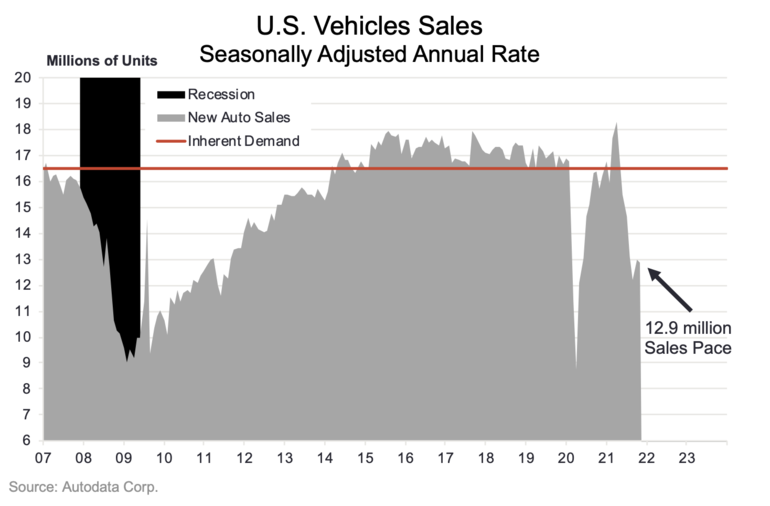
The Trends Report found credit union new auto loan balances fell 0.7% in October, slower than the 0.7% rise set in October 2020, and decreased 2.1% during the last year. On a seasonally-adjusted annualized basis, new auto loan balances fell 4.7% in October, even lower than the -2.6% pace reported in October 2020.
“Multiple factors are driving the slowdown in new auto loan growth: limited inventories of new cars, COVID-19 pandemic/economic uncertainty, the mortgage refinance boom and more aggressive marketing by banks,” the Trends Report analysis stated. “The number of new-auto loans as a percent of members in offering credit unions – the penetration rate – rose to 6.7% in the third quarter, up from 6.3% last year and 5.0% in 2015.”
Real Estate Information
Credit union fixed-rate mortgage lending was “firing on all four cylinders during the last 12 months due to mortgage interest rates averaging 2.94% in 2021, down from the 3.93% average in 2019, the year before the onset of the COVID-19 pandemic,” according to the Trends Report.
Fixed-rate first mortgage loan balances grew a strong 14.2% over the last year, similar to the 14.3% pace set in 2020. Second mortgage loan balances fell 3.5% over the last year but rose 3% during October.
“Expect mortgage originations to decrease 25% in 2021 due to rising interest rates and fewer opportunities for mortgage refinances,” the Trends Report is forecasting. “With the Federal Reserve expected to end its quantitative easing program in March 2022, we expect 30-year mortgage interest rates to rise 3.5% by the 2nd half of 2022.”
The Report added that the contract interest rate on a 30-year fixed-rate conventional home mortgage rose to 3.07% in October, from 2.90% in September, and above the 2.83% reported in October 2020. The 24-basis point rise in mortgage interest rates during the last year was due to an 80-basis point rise in the 10-year Treasury interest rate and a 56-basis point drop in the credit risk spread.

Savings & Assets
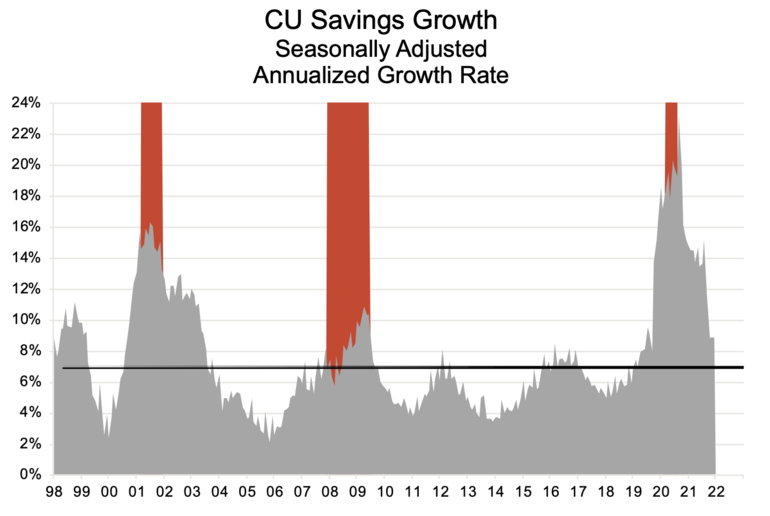
Credit union savings balances rose in October by 1.0%, less than the 1.7% rise in October 2020. The Trends Report noted that savings balances grew at an 8.8% seasonally-adjusted annualized growth rate in October, below the 19.7% reported one year earlier but above the 7% long-run average.
“Credit unions are experiencing relatively strong deposit growth due to strong member income growth. Personal income is up 5.9% over the last year as the labor market tightens and wage pressures build,” the Trends Report stated. “The personal savings rate (personal savings as a percent of disposable personal income) fell to 7.3% in October, from 8.2% in September, but is back to the 7.3% reported in October 2019 before the COVID-19 pandemic.”
The Report added that the growth in savings balances, record-high stock prices and record-high home prices has boosted household balance sheets and net worth. “We expect credit union deposit growth to slow in 2022 to 5%, below the 7% long-run average, as members begin to spend again on travel, leisure and hospitality,” according to the CUNA Mutual forecast.
Capital & Other Key Measures
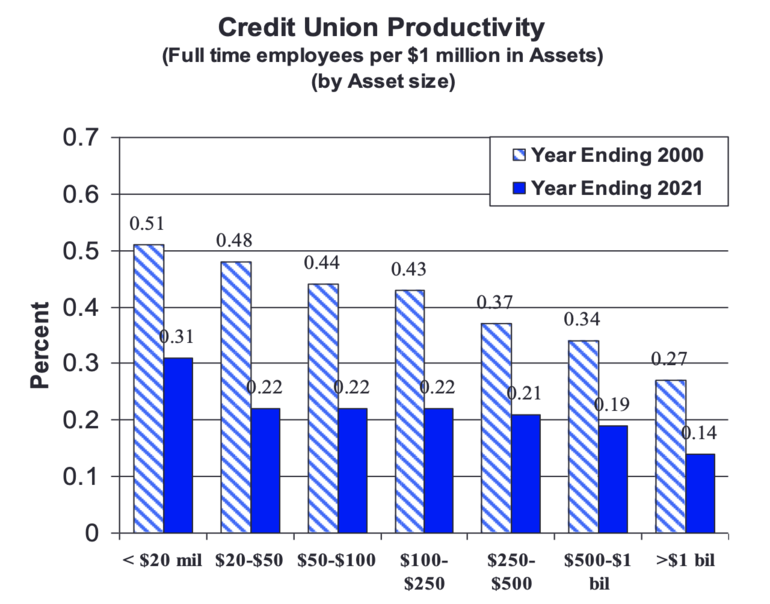
“The credit union system has become significantly more productive over the last 21 years,” the Trends Report pointed out. “Back in the year 2000, it took on average 0.38 full-time credit union employees to manage every $1 million in assets. Today that ratio stands at 0.16, a 58% improvement in productivity overall or 2.9% increase in productivity per year.”
According to the analysis, today some 313,922 full-time employees are working at credit unions managing $2.041 trillion in assets.
“The number of employees working at credit unions today would have been 775,580 (0.38 x 2,041,000) if credit union employees had the same level of productivity that they did back in 2000,” the CUNA Mutual analysis states. “The net result is that 461,658 (775,580 – 313,922) employees were not needed due to improvements in human and physical capital. Smaller asset size credit unions reported bigger improvements in productivity ratios over the last 21 years; however, larger credit unions are still more productive due to their economies of scale.”
Credit Unions and Members
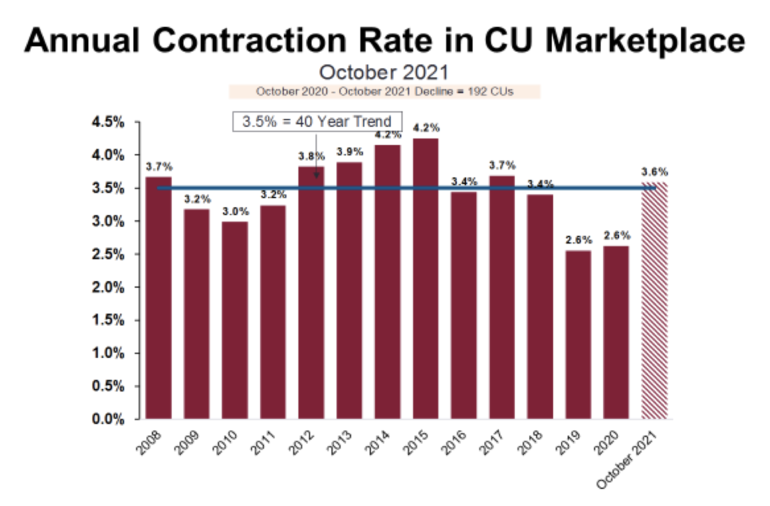
As of October 2021, the Trends Report cited CUNA estimates indicating there were 5,163 credit unions in operation, down 192 from October 2020. Year-to-date the number of credit unions fell by 154, significantly more than the 105-decline reported in the first ten months of 2020.
“We expect a surge in credit union mergers in the 2022-2024 period, like what we experienced the years following the Great Recession as many credit unions look to offer more financial services to their members through mergers,” the Trends Report forecast.
Meanwhile, credit union consolidation and concentration are expected to continue above their long-run pace over the next few years.
“Since 1980, the number of credit unions has declined by roughly 3.5% each year,” the Report analysis states. “If we apply this exponential ‘decay’ rate to the current number of credit unions, 5,163, we should expect another 181 credit unions to exit the financial system in 2022. If we forecast out a little further, according to the laws of exponential decay, there will only be 2,531 credit unions in 20 years, half as many as there are today. Fortunately, credit union assets follow an average annual exponential growth of 7%. This means the time that it takes for credit union assets to double (currently $2.1 trillion) is only 10 years.”