

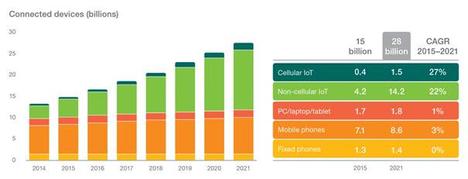
STOCKHOLM, Sweden—A new report reveals that the Internet of Things is set to overtake mobile phones as the largest category of connected device by 2018.
According to the latest edition of the Ericsson Mobility Report, between 2015 and 2021, the number of IoT connected devices is expected to grow 23% annually, of which cellular IoT is forecast to have the highest growth rate. Of the 28 billion total devices that will be connected by 2021, close to 16 billion will be IoT devices.
Ericsson said Western Europe will lead the way in adding IoT connections—the number of IoT devices in this market is projected to grow 400% by 2021.
“This will principally be driven by regulatory requirements, for example for intelligent utility meters, and a growing demand for connected cars including the EU e-call directive to be implemented in 2018,” Ericsson said.
"IoT is now accelerating as device costs fall and innovative applications emerge,” said Rima Qureshi, senior vice president and chief strategy officer for Ericsson. “From 2020, commercial deployment of 5G networks will provide additional capabilities that are critical for IoT, such as network slicing and the capacity to connect exponentially more devices than is possible today."
Smartphone subscriptions continue to increase and are forecast to surpass those for basic phones in Q3 this year. By 2021, smartphone subscriptions will almost double from 3.4 billion to 6.3 billion. Also revealed in the report, there are now five billion mobile subscribers - unique users - in the world today, which is testament to the phenomenal growth of mobile technology in a relatively short period of time, Ericsson said.
Detailed in the report is a dramatic shift in teen viewing habits: use of cellular data for smartphone video grew 127% in just 15 months (2014-15). Over a period of four years (2011-15) there has been a 50% drop in the time teens spend watching TV/video on a TV screen, and in contrast an 85% increase in those viewing TV/video on a smartphone. This, and the fact that the upcoming generation of mobile users are the heaviest consumers of data for smartphone video streaming (Wi-Fi and cellular combined), makes them the most important group for cellular operators to monitor, Ericsson said.
In 2016, a long-anticipated milestone is being passed with commercial LTE networks supporting downlink peak data speeds of 1 Gbps, Ericsson explained.
“Devices that support 1 Gbps are expected in the second half of 2016, initially in markets such as Japan, U.S., South Korea and China, but rapidly spreading to other regions. Mobile users will enjoy extremely fast time to content thanks to this enhanced technology, which will enable up to two-thirds faster download speeds compared with the fastest technology available today, the company said.
Addition report highlights:
A global growth story: Mobile broadband subscriptions will grow fourfold in the Middle East and Africa between 2015 and 2021; mobile data traffic in India will grow fifteen times by 2021; and despite being the most mature market, mobile traffic in North America will grow 50% in 2016 alone.
Data traffic continues unabated growth: Global mobile data traffic grew 60% between Q1 2015 and Q1 2016, due to rising numbers of smartphone subscriptions and increasing data consumption per subscriber. By the end of 2021, around 90% of mobile data traffic will be from smartphones.
LTE subscriptions grew at a high rate during Q1 2016: There were 150 million new subscriptions during the quarter - driven by demand for improved user experience and faster networks - reaching a total of 1.2 billion worldwide. LTE peak data speeds of 1 Gbps are anticipated to be commercially available in 2016.