

WASHINGTON—The confidence of homebuyers in their ability to purchase a home remained unchanged—and that means low—in August, according to Fannie Mae’s latest Home Purchase Sentiment Index (HPSI).
Three of the HPSI’s six components increased month over month, most notably the component measuring perceived home-selling conditions. In August, 66% of consumers reported that it’s a good time to sell a home, compared to only 18% who said it was a good time to buy a home.
Additionally, in the wake of the significant rise in rates over the last 18 months, just 18% expect mortgage rates to go down in the next 12 months. Overall, the full index is up 4.9 points year over year, Fannie Mae said.
“Mortgage rates once again breached the % mark in August, hitting a 22-year high and doing no favors for consumer sentiment,” said Doug Duncan, Fannie Mae senior vice president and chief economist. “Consumers remain pessimistic toward the housing market in general and homebuying conditions in particular. The overall HPSI is maintaining the low-level plateau set a few months back, and we don’t see much upside to the index in the near future, barring significant improvements to home affordability, which we also don’t expect.
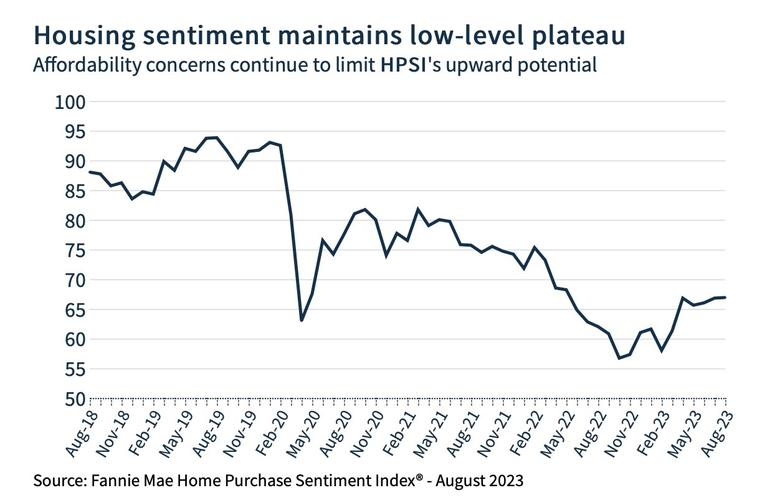
Pessimism Among Renters, Buyers
“While renters are slightly more pessimistic than homeowners, for two years now a large majority of both groups have told us that it’s a bad time to buy a home, and they’ve continuously cited affordability concerns as the primary reason,” Duncan continued. “If mortgage rates remain elevated, many existing homeowners will likely continue to hold on to their current historically low mortgage rates, suppressing existing home listings and providing support for home prices – assuming mortgage demand maintains resilience despite the higher rate environment. Considering that existing home sales have traditionally represented approximately 85-90% of total home sales, even substantial quantities of new home production are unlikely to produce the inventory needed to meaningfully improve affordability.”
‘Tale of Two Markets’
Duncan added that from a historical perspective, the current housing market is unusual, as demonstrated in part by the HPSI and its recent plateauing.
“Given the significant home price appreciation and rapid rise in mortgage rates, it is very much a tale of two markets, at least from a consumer perspective,” he said. “Of course, a third perspective exists among homebuilders, who are currently thriving amid the surge in demand for new home construction, a function of the unusual dynamics at play in the existing home space between would-be sellers and would-be buyers, as well as changing labor market dynamics owing to the ongoing prevalence of remote work.
“In the past, first-time homebuyers typically sought to purchase existing homes, which were generally more affordable than new homes. They then invested sweat equity before moving further up the housing ladder, often in response to an expanding family or another significant life event,” Duncan stated.
He went on to add, “However, Baby Boomers’ desire to age in place and the impact of the ‘lock-in effect,’ in which existing homeowners are disincentivized from listing their homes for sale because their existing mortgage rate is well below current market rates, across demographic groups – but particularly among Gen Xers – has thrown a wrench into this historical cycle, making it more difficult for would-be homebuyers to find affordable existing home purchase options. This is driving demand toward newly constructed homes, which, again, has been great news for homebuilders and the larger economy, at least to this point.”
Home Purchase Sentiment Index Highlights
- Good/Bad Time to Buy: “The percentage of respondents who say it is a good time to buy a home remained unchanged at 18%, while the percentage who say it is a bad time to buy remained unchanged at 82%. As a result, the net share of those who say it is a good time to buy remained unchanged month over month.”
- Good/Bad Time to Sell. “The percentage of respondents who say it is a good time to sell a home increased from 64% to 66%, while the percentage who say it’s a bad time to sell decreased from 36% to 34%. As a result, the net share of those who say it is a good time to sell increased five percentage points month over month.”
- Home Price Expectations. “The percentage of respondents who say home prices will go up in the next 12 months remained unchanged at 41%, while the percentage who say home prices will go down increased from 24% to 26%. The share who think home prices will stay the same decreased from 34% to 33%. As a result, the net share of those who say home prices will go up in the next 12 months decreased two percentage points month over month.”
- Mortgage Rate Expectations. “The percentage of respondents who say mortgage rates will go down in the next 12 months increased from 16% to 18%, while the percentage who expect mortgage rates to go up increased from 45% to 46%. The share who think mortgage rates will stay the same decreased from 38% to 34%. As a result, the net share of those who say mortgage rates will go down over the next 12 months increased one percentage point month over month.”
- Job Loss Concern. “The percentage of respondents who say they are not concerned about losing their job in the next 12 months decreased from 80% to 78%, while the percentage who say they are concerned increased from 20% to 22%. As a result, the net share of those who say they are not concerned about losing their job decreased five percentage points month over month.”
- Household Income: “The percentage of respondents who say their household income is significantly higher than it was 12 months ago increased from 19% to 22%, while the percentage who say their household income is significantly lower increased from 10% to 12%. The percentage who say their household income is about the same decreased from 71% to 65%. As a result, the net share of those who say their household income is significantly higher than it was 12 months ago increased one percentage point month over month.”
Are You Being Gouged for Bank-Like Subscription Fees for Old News? Here’s a CU-Like Way to Fix That
The biggest, best and freshest news reporting in credit unions remains free! Each morning CUToday.info delivers its daily Fresh Today news update offering the latest headlines and breaking news right to your email, with the easy-to-read headlines format allowing you to click on the stories that interest you most in order to learn more. So stop paying those bank-fee-like subscription prices from other so-called “news”” publications!
If you haven’t yet signed up for the new email solution on which CUToday.info has partnered with ResponseGenius, you can do so here. Signing up requires less than one minute of your time—and it’s free!
Please note that after signing up you may need to go to your Spam/Junk folder and mark the morning headlines email as safe. CUToday.info does not provide its list of readers and emails to outside parties, and we will not be contacting you to sell you an extended warranty or sending you any links so you may cash in on an inheritance you didn’t know was coming.
And did we mention it’s free?