MADISON, Wis.–Memberships in credit unions surged a record 573,000 during August, and were up 3.7 million over the 12 months ending the same month, according to the newest Trends Report released by CUNA Mutual Group.
A big driver of that growth, says CUNA Mutual in its analysis: An “unintended consequence of the Durbin Amendment of the Dodd-Frank Act (which) capped the fees large banks can charge merchants to process debit card transactions (21 cents plus 0.05% of the total charged). To make up for this lost revenue, banks increased their monthly fees for having a debit card or a checking account.”
An improving economy and demand for credit is also sending more people to join credit unions.
Other findings in the Trends Report from August, which is based on data gathered by CUNA:
Total Lending
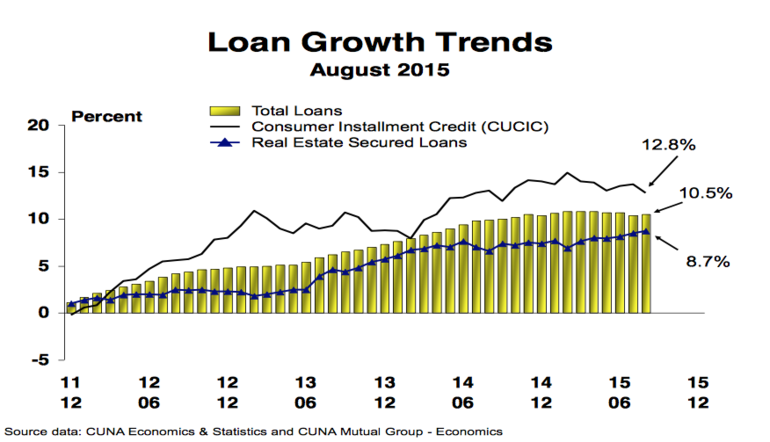
Credit union loan balances rose 1.2% in August, faster than the 1.1% pace reported in August 2014. During the last 12 months credit union loan balances increased 10.5%, a slight decline from the 10.8% year-over-year pace set in March. The pace of consumer-installment-credit growth has slowed recently to 12.8% but still more than double the pace of all other lenders. This has brought the credit union share of the total consumer installment credit market to 9.5%, up from 9.0% in August 2014.
Moreover, said CUNA Mutual, CUs are no longer “punching below their weight” on first mortgages, with CUs now holding 8.5% of the first mortgage origination market.
Credit Union Consumer Installment Credit
Credit union consumer-installment-credit loan balances (auto, credit card and other unsecured loans) rose only 0.9% in August, slower than the 1.7% pace set in August 2014. During the last 12 months, credit union consumer installment credit grew 12.8%, slower than the 14.9% year-over-year pace set in February, CUNA Mutual reported.
Vehicle Loans
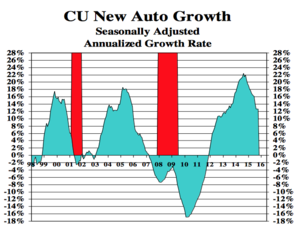
Credit union new auto loan balances rose 1.4% in August, below the 2.2% pace set in August 2014. Currently new-auto loan balances are rising at a 12.7% seasonally-adjusted annualized growth rate, “which is down from the record, and frankly unsustainable, 22.4% pace set in August 2014,” CUNA Mutual said in the Trends Report.
Real Estate-Secured Lending
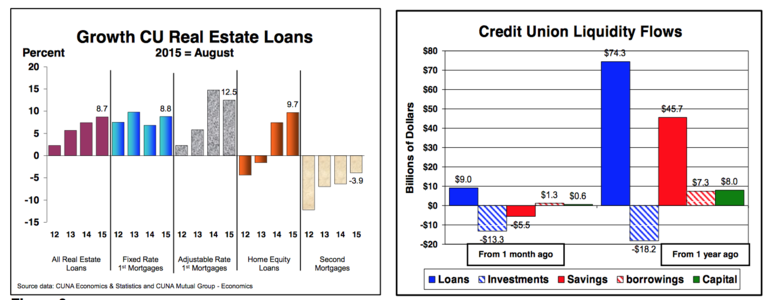
Credit union fixed-rate first mortgage loan balances grew 0.1% in August, the same slow pace reported in August 2014, but a year-over-year growth comparison shows fixed-rate mortgage balances rose 8.8% above the 5.4% reported in the year ending in August 2014. Adjustable-rate first mortgage loan balances grew faster than fixed-rate loans, increasing 12.5% during the last year, slightly less than the 15.1% reported in the year ending in August 2014. Credit unions now hold $316.8 billion of first mortgages on their books, 69% of which are of the fixed-rate variety.
Home equity lending posted another strong month in August, increasing 1.5%, compared to only 0.9% in August 2014. Rising home prices and improved consumer confidence levels encouraged many credit union members to tap into their home equity to finance the purchase of durable goods. Durable goods spending rose a strong 1.2% in August, according to the Bureau of Economic Analysis, as consumers reduced some of their pent-up demand for furniture, appliances and motor vehicles. Moreover, consumers are spending less on gasoline and other energy goods than they were a year earlier, this is loosening budget constraints and therefore freeing up cash for other purchases.
The contract interest rate on a 30-year, fixed-rate conventional home mortgage fell to 3.91% in August, from 4.05% in July, and below the 4.12% reported in August 2014. “We expect the 30-year mortgage interest rate to increase 15 basis points each quarter during the next year, reaching 4.5% by year-end 2016. We don’t expect the interest rate rise to have a significant negative impact on housing demand, however, due to the still historically low level of interest rates in 2016,” CUNA Mutual said.
Home prices rose 1.2% in August from July, according to the Core Logic Home Price Index, and 6.9% year-over-year. The index is now 39% above the low point in March 2011, and only 5% below the peak set in April 2006. Home prices are rising due to increasing demand running into a limited supply of homes for sale. The inventory-to-sales ratio for existing single family and condo/co-op homes was at 4.5 months in August, the lowest since 2005. Demand for homes is expected to increase in 2016 due to a rising number of household formations and the tightening labor market boosting wage growth and in-turn consumer confidence. Furthermore, access to mortgage credit will increase as financial institutions seek to boost revenue.
Surplus Funds
Credit union surplus funds fell $13.3 billion, or -3.5%, in August to help fund strong loan demand ($9.0 billion) and deposit outflows ($-5.5 billion). “To make-up the loan funding shortfall, capital growth contributed $0.6 billion and increased borrowings another $1.3 billion,” CUNA Mutual said. “Credit union surplus funds as a percent of assets fell to 30.7% in August, down from 33.9% in August 2014, as credit unions partly funded $74.3 billion in new loans with $18.2 billion of cash and investments. “
CUNA Mutual noted that the shift in the mix of credit union assets toward higher yield loans and away from lower yielding investments has not pushed-up credit union asset yields.
Savings and Assets
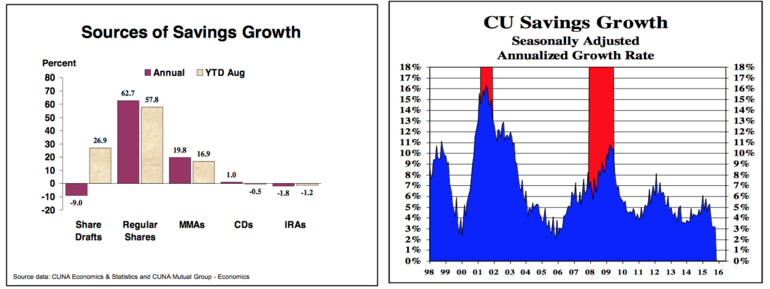
Credit union savings balances fell 0.5% in August, lower than the 0.7% gain in balances reported in August 2014, as the excess funds reported in July, due to the month ending on a Friday payday, exited as members paid their monthly expenses. Over the last year, regular share accounts accounted for 62.7% of all savings balance growth, while money markets accounts contributed 19.8% (Figure 8).
Capital and Other Key Measures
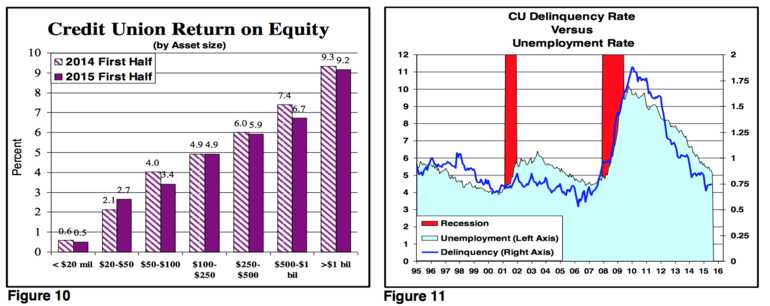
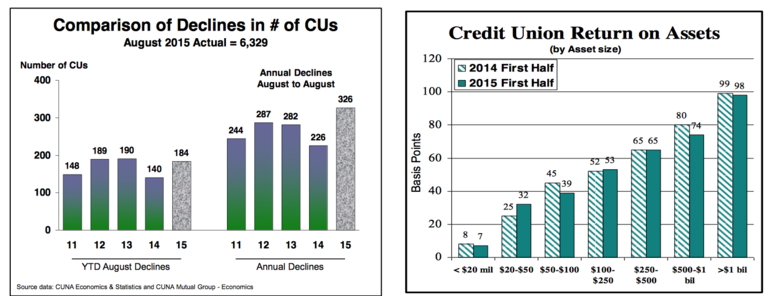
The industry’s weighted average return-on-equity ratio fell to 7.3% in the first half of 2015, from 7.4% in the first half of 2014 due to a rising capital-to-asset ratio over the last year but a constant on return-on-asset ratio, said CUNA Mutual. “Return-on-equity ratios are highly correlated to asset size with billion dollar credit unions averaging 9.2% return on equity while smaller credit unions reported significantly less,” the company noted in its analysis.
The loan delinquency rate (loans two or more months delinquent as a percent of total loans outstanding) fell to 0.74% in August 2015, down from 0.84% in August 2014.
Number of Credit Unions
As of August 2015, CUNA estimates 6,329 credit unions were in operation, down 326 from August 2014. Year-to-date the number of credit unions fell by 184, which is significantly above the 140 decline reported in the first eight months of 2014. NCUA’s Insurance Report of Activity showed 16 mergers were approved in August with an average asset size of $14 million, down from the 25 mergers reported in August 2014 with an average asset size of $9 million.