

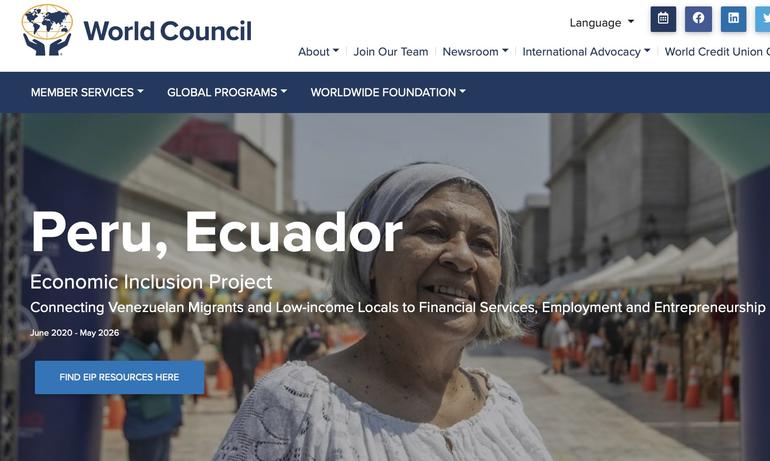
MADISON, Wis.—Ten representatives from credit unions in the United States have spent two weeks in South America studying the USAID/World Council of Credit Unions (WOCCU) Economic Inclusion Program (EIP) and how it connects Venezuelan migrants in Ecuador and Peru to financial inclusion through credit unions.
The trip was coordinated by the Worldwide Foundation for Credit Unions (WFCU) and the Global Bridges program.
Funded by USAID and implemented by WOCCU, the Foundation described the EIP program is an “ambitious and innovative approach aimed at providing economic opportunities and financial services to assist both Venezuelan migrants and refugees and their host communities in the target cities of Lima, Peru, and Quito and Guayaquil, Ecuador, and several rural areas of each country as well.”
Week One
According to the foundation, during the first week of the study tour, one U.S. representative from Virginia Credit Union (VACU) connected with Peru’s EIP program and visited the Peruvian credit union system through meetings with the National Federation of Credit Unions (FENACREP), regulators, and EIP partners.
In Peru, the VACU representative learned that credit unions can provide services in rural areas by establishing rural and mobile agents, the foundation said.
“Members of credit cooperatives go from being independent people to being agents of political change. This makes credit unions achieve financial inclusion,” Juan Carlos Urgiles, general manager of Jardin Azuayo, a credit cooperative based in Paute, Ecuador, said in a statement.
Week Two
During the second week of the study tour, the foundation said 10 Americans toured Ecuador, meeting with several national organizations, including the Financial Policy and Regulation Board and the Superintendence of the Popular and Solidary Economy, for an engaging learning experience.
“Through an open dialogue, participants learned how EIP expands financial inclusion, implements innovation and serves migrant populations through financial education, employment and entrepreneurship training and gender-based inclusion,” the foundation said.
Plan Offers a Guide
Added Oscar Guzman, chief of party for EIP, “Victims of gender violence can only achieve economic independence by receiving psychological stability, linked to an economic stability plan known as ‘plan de vida’ and financial services. This plan guides them to leave the circle of violence and achieve economic autonomy through livelihood activities (entrepreneurship and employment)."
The Ecuador and Peru Study Tour was made possible through the sponsorship from Virginia Credit Union.