

WASHINGTON–A new report from the Tax Foundation claims the elimination of the credit union tax exemption would “support sound tax policy” and suggests CUs no longer resemble the institutions granted that exemption in the 1934 Federal Credit Union Act.

The Tax Foundation’s paper uses the credit union tax exemption as a case study for how corporate loopholes could be reformed.
According to the analysis, the exemption is a “narrow benefit provided to a single subindustry that results in an inefficient allocation of resources and a tax advantage over banks that offer similar financial services.”
The Tax Foundation, a think tank that describes itself as created to "monitor the tax and spending policies of government agencies,” explained tax expenditures are provisions in the tax code that deviate from a “normal income tax structure” and which generally favor a specific industry or activity.
“Eliminating such provisions could help broaden the tax base, and thus raise more revenue while improving the structure of the tax code,” the new paper states. “But diagnosing which tax expenditures are unsound policies that should be eliminated, as opposed to a structural element of the tax code worth retaining, is not always straightforward.”
An Historical Reference
As its example, the paper cites the credit union tax exemption, and it turns to history for what has happened with other tax exemptions to suggest the same should happen to the exemption for CUs.
“A policy change that occurred in 1951 also provides insight into the basis for granting credit unions an exemption from federal income taxes. In 1951, Congress revoked the tax-exempt status of certain types of financial institutions, including mutual savings banks. Like credit unions, mutual savings banks are member-owned and established to serve members of modest means, encourage thrift, and provide safe and convenient facilities to care for savings,” the paper states. “Yet in 1951, Congress found mutual savings banks to be in active competition with commercial banks and so their tax exemption was revoked. At the time, the exemption for credit unions was retained, but an Internal Revenue Service (IRS) report from that period stated that if Congress felt in 1951 that credit unions had ‘resembled taxable financial institutions,’ it ‘seems probable’ that Congress would have removed their tax-exempt status as well.
‘Resemble Other Financial Institutions’
“Evidence indicates that many credit unions now resemble other financial institutions that are subject to the corporate income tax, suggesting the tax subsidy for credit unions is nonneutral,” the analysis continues. “And other changes in the marketplace mean that lower- and middle-income consumers now have plentiful access to credit.
“Credit unions’ distinguishing characteristics and restrictions have been loosened over time, meaning that credit unions often compete directly with banks for the same customers. For example, the field of membership, or common bond requirements, have been relaxed to the extent that several news articles report that there are credit unions where ‘anyone can join.’ Further, in 2017, new rules took effect that loosened restrictions on business and commercial lending, paving the way for more credit unions to increase business lending activities in competition with banks.”
The Tax Foundation paper cites earlier research that it says, “raises the question of whether even the amount of the subsidy passed through to customers through prices fulfills the intended role of credit unions because many credit union customers are not low-income or disadvantaged.”
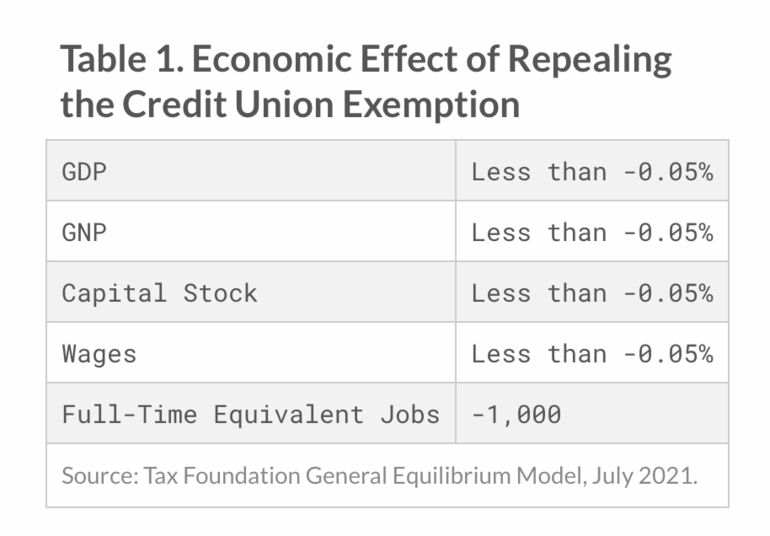
The paper also cites a Treasury estimate that the CU tax exemption will come at a cost to federal coffers of $24.56 billion from 2021-2030.
Narrow ‘Preference’
“While eliminating loopholes is a common turn of phrase when discussing business taxation, determining what constitutes a loophole is not necessarily an easy task. Lawmakers should carefully analyze tax expenditures before eliminating them, being sure to retain provisions that are broadly available and reduce the tax penalty on saving and investment,” the paper concludes. “Some provisions, however, such as the exemption for credit union income, clearly distort economic activity by narrowly targeting tax preferences on one industry. Tax expenditures like the credit union exemption could be reformed, and the resulting revenue used to further improve the corporate tax base or pay for new spending.”
The Tax Foundation report comes at the same time the Independent Community Bankers of America have launched a new national campaign targeting the credit union tax exemption.