

ST. PETERSBURG, Fla.— The consequence of tariffs on consumer spending could have a profound impact on 2025 payment results, with mixed thoughts on timing, Velera reported.
“Price increases could begin to materialize in the coming weeks, while others could take a few months depending on supply chain constraints,” the CUSO stated in its latest edition of the Velera Payments Index, which marks the five-year anniversary of the report.
“What began in 2020 as a weekly consumer transaction insights report in the early days of the pandemic has transitioned into four years of the monthly Payments Index,” Velera said. “As consumer spending patterns continue to shift, we remain dedicated to providing relevant and actionable updates.”
Beginning with this April edition, the Payments Index will retain its monthly cadence, but will introduce a new quarterly format: a “base” edition followed by two months of Deep Dive reports, Velera said.
“Velera is excited to launch the next evolution of our Payments Index, one of the credit union industry’s best resources for timely data and insights on payment transactions. The evolution of this monthly report has been extraordinary; since its origin as a weekly transaction tracker throughout the first year of the pandemic, the Payments Index has emerged as one of Velera’s key pieces of thought leadership, offering actionable data, insightful trend analysis and prescriptive content for credit unions,” said Chuck Fagan, president and CEO at Velera. “I would also like to recognize Velera’s outstanding marketing and communications and Advisors Plus teams for their ongoing collaborative efforts in bringing these insights to life for our credit unions and our industry. We look forward to the continued evolution of the Payments Index and helping credit unions make strategic, data-informed decisions to fuel growth.”
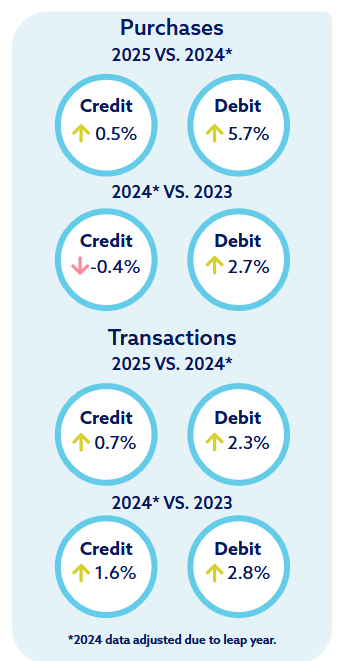
Key takeaways (March data) include:
- While year-over-year growth remains positive in debit discretionary activity, results have softened from the start of the year, which could be a preemptive measure by Payments Index consumers in advance of high inflationary prices.
- Growth rates softened for debit in March and moderated for credit. Debit purchases were up 4.0% and credit purchases were up 2.0%. Debit transactions were up 2.3% and credit transactions were up 2.1%. The Goods sector was the top contributor to growth in debit purchases, followed by Money Services, with these two sectors accounted for just over 70% of the year-over-year increase. For credit purchases, the Services sector was the largest contributor to growth for March. Within Services, insurance sales/premiums were the top merchant category, up 8.8% compared to March 2024.
- Leaving the swipes and dips behind, contactless “tap-and-go” transactions now make up over half of all Card Present transactions on contactless cards. Digital wallets also continue to grow in popularity, with 9.9% of all debit transactions (CP & CNP) taking place via a digital wallet and 5.6% of all credit transactions (CP & CNP) via a digital wallet for March 2025.
- The 12-month CPI through March decreased by 2.4%, down 0.1% from February. The Energy index declined 2.4%, with most of the reductions coming from gasoline, which was down 6.3%. Core inflation, which excludes food and energy, is now at 2.8%, up 0.1% for March.
- Overall credit card delinquencies for March 2025 were 2.31%, down 0.11% year over year. After peaking in January 2024 at 2.67%, growth in the delinquency rate has softened each month since the peak with an average reduction of 0.11% for each month of 2025.
The full report is available for download here.