

WASHINGTON–How NCUA is responding to the issue of climate change was the subject of a surprising amount of discussion during a Senate Banking Committee hearing here. That included asking the current chairman, whose term has expired, if he would hold off on any climate change-related regulations until a successor is nominated.
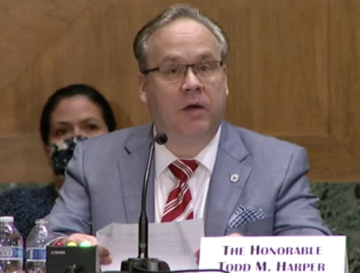
Todd Harper testifies before Senate Banking Committee.
The discussion was largely reflective of the different positions of Democrats and Republicans when it comes to climate change and the role of government.
In his submitted testimony to the committee ahead of the hearing, which also featured representatives from the OCC and FDIC, Todd Harper said “financial regulators, like the NCUA, have a responsibility to foster resiliency to all material risks to financial institutions, including those related to climate change. By measuring, monitoring, and mitigating such risks, the NCUA can fulfill its core obligations of maintaining the safety and soundness of credit unions, protecting consumers, and safeguarding the Share Insurance Fund.”
At the microeconomic level, Harper stated that over time, climate change will affect the value of collateral like homes and commercial properties, especially in areas affected by extreme weather.
“Additionally, a credit union’s field of membership may be tied to communities or activities that may be dramatically affected by climate change, like farming or fossil fuels,” the testimony stated. “Credit unions serving such populations must consider adjusting their fields of membership or altering their lending portfolios to remain resilient over the long term.”
Stepping Outside Role?
Sen. Pat Toomey (R-PA) pressed not just Harper but his fellow regulators over whether they are stepping outside their roles as independent agencies.
“As the pandemic recedes, I am concerned the Biden Administration is using banking regulation to achieve social goals not related to banking,” said Toomey. “Such a shift would erode the longstanding objective of having independent agencies. The Executive Order on climate risk seems to use financial regulation to further drive action on climate policy.”
Toomey said if the actual purpose of the various agencies’ actions were to assess risk, then it would stand to reason that “actual analysis would occur before a policy response.”
Toomey said actions being taken presupposes there is, in fact, climate-related risk not being accounted for by regulators, and that regulators are being pressured to enact “backdoor environmental policy.”
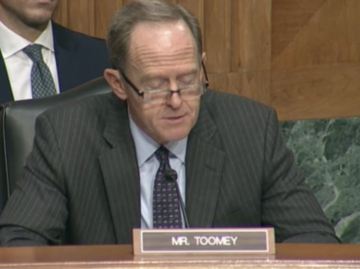
Citing Harper’s submitted testimony that credit unions may need to consider adjusting their fields of membership or adjusting lending portfolios due to climate change, Toomey said it doesn’t appear to be the result of “actual analysis.”
One Farmer’s Concern
Sen. Jon Tester (D-MT), who is a third-generation farmer from Montana, said that when it comes to extreme weather events, it’s been an “interesting year,” with little rain in the west, too much rain in the east, and three-million acres burned so far, and the fire season is just beginning.
“I would hope people would look at these extreme weather events as they are happening more regularly,” said Tester. “It’s just improper not to look at them. We are going to have our 44th harvest and this going to be our worst harvest by far. By far. If it gets any worse I won’t take the combine out of the shed.”
Term’s Up, So…
Sen. Thom Tills (R-NC), noting Harper’s term as NCUA chairman has officially expired and he is serving in a holdover capacity, asked Harper if he would commit to withholding any significant regulations, such as climate change, until a successor is named.
“I view this as a board issue,” said Harper, stating that members of the current board have voted together approximately 90% of the time.
Harper is the lone Democrat on the NCUA board, and while the chairman controls the agenda, it is likely Republican appointees Rodney Hood and Kyle Hauptman would vote against climate change-related regulations.
“I am not looking to move quicky on any regulation here,” said Harper. “I believe first step would be a request for information.”
Effects on CUs
Sen. Catherine Cortez Masto (D-NV) asked Harper concentration risk might be affected by climate change.
“We look at where a credit union’s loans are,” said Harper. “And one of the areas we look at is maybe (it has made loans on) homes in a flood zone or an area prone to wildfires. Is the credit union taking steps to ensure insurance is in place?”
Harper pointed to the town in which he grew up where there was a refinery approximately two miles away. He asked what happens over time as that refinery changes its product line? Does the credit union that serves its employees need to change its field of membership?
Similarly, he said, he also lived close to a producer of corn starch. What happens to that company and its workers if there are crop shortages? Those are the types of risks he said credit unions will need to assess as the climate changes.