

MIAMI BEACH, Fla.–Why do consumers make the decisions they do? And why are some practices within the credit union so difficult to change? The answer to both questions is “habits,” according to one person, and habits can be changed if understood.
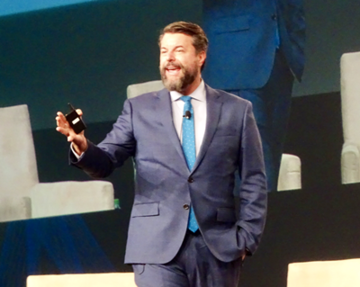
Charles Duhigg speaks at THINK 19
Charles Duhigg, a Pulitzer Prize winning reporter and the author of two books, “Power of Habit” and “Smarter Faster Better,” told CO-OP’s THINK Conference here the research shows nearly half of a person’s daily activities is based on habit.
“Every habit is actually three things: a cue, which is an automatic trigger for a behavior to start; a routine, which is the behavior itself, and a reward,” said Duhigg. “Every single habit in your life has a cue and a reward, and if we can figure those out we can change how you behave, almost without you knowing about it or having to think too hard about it. When people understand the habits, we empower them to change behavior.”
Duhigg said if an individual or organizational can change what’s known as a “keystone habit,” it becomes a chain reaction that changes or develops other habits, as well.
To illustrate his points, Duhigg shared three anecdotes as examples of his three themes, which were how habits work, how habits emerge, and how habits change.
How Habits Work
Duhigg shared the story of the development of Procter & Gamble’s Febreze product, which the company was confident was going to be a blockbuster but initially bombed. It was able to turn the performance around by changing the messaging to position Febreze as a reward for cleaning. In six months of emphasizing the reward, the product went from $200 million in sales to $1 billion annually.
“They figured out the reward customers really wanted, instead of the one they came up with dreaming something up in marketing,” said Duhigg. “Often, we come up with a reward for changing members’ behavior that makes perfect sense to us, but it’s not the reward wanted by the person whose behavior we’re trying to change, because it doesn’t make sense to them.”
Duhigg urged credit unions to think about how they reward members, and whether the credit union is giving members the kinds of rewards they give themselves. “Studies show people aren’t good at telling us the rewards they want, but are good at showing us.”
How Habits Emerge
How do habits emerge in the first place in lives and workplaces? Often, habits come from rational places even if they lead to irrational—or tragic—results.
To answer the question, Duhigg shared the story of the London Underground and the King’s Cross Station. For employees of the Underground, there was an unwritten rule that you “Do your own job.”
“The underground had organization habits, also known as silos,” said Duhigg.
What happened at King’s Cross station was one rider alerted a ticket-taker to a burning smell, and the ticket-taker found a burning tissue and put it out. Later, another rider raises concern over smell of smoke, and even though there is a fire station a half-block away, an Underground police officer notified the Underground’s dispatch office, not the fire department. When the fire department finally arrived, people panicked at their presence plus the smell of smoke, which made it difficult for the fire department to enter the station.
“Twenty-seven minutes after the burning tissue, no one ever called dispatch and said delay the trains, and three trains arrived at the same time, pushing oxygen into the station. And that acted like a bellows for a fire beneath the escalator, igniting it helping it reach the flashover point,” he said.Thirty-two people would die in the fire.
‘Anyone Could Have Pulled Fire Alarm’
“The time that elapsed from time of warning to time of loss of life was almost a full hour,” said Duhigg. “A period during which anyone could have pulled a fire alarm or evacuated the station or called dispatch and told them to stop sending trains. But the organizational habit was, ‘Do you own job, not someone else’s job. It’s not your job to look for fires, it’s to take tickets.’”
The subsequent investigation, said Duhigg, found every single habit of the Underground “all made perfect sense.” “What we know is bad habits exist for good reasons. If you want to create change in your organizations, it’s not enough to say, ‘We’re doing this a dumb way, we’ve got to change.’ A critical first step is to figure out who is being rewarded for the dumb way. You must then find a way to reward that person in a different way. Unless you know who is benefitting from them, you can’t uproot the bad habit and get it to shift.”
How Habits Change
Starbucks had a problem; its average employee was 19 years old, and 19 year olds sometimes do dumb things, such as bringing anger to work and instead of writing a customer’s name on a cup, writing “Bitch,” as one employee did. For much of Starbucks’ early history, it was a localized issue. Then social media emerged, said Duhigg.
“Starbucks recognized the problem is often due to something outside of work and they have a willpower lapse, and the result is terrible,” said Duhigg.
He noted studies have found willpower is the single greatest predictor of future success—“and researchers have found you can teach willpower, and the way you teach it is to make it a habit.”
Starbucks changed its training to change habits by introducing L.A.T.T.E., which stands for Listen to the customer; Acknowledge the problem/situation; Take action and solve the problem; Thank the customer, and Explain what you did.
“The reward is the smiling customer at the end of this,” said Duhigg, noting not only did customer satisfaction increase after L.A.T.T.E. was implemented, so did employee satisfaction.
Changing Lives
“Explaining to people how their habits work can change their lives,” said Duhigg. “It’s most true when we are at those moments when we are scared. And it’s never more true than when it comes to money. People who come into their credit unions are coming to you for guidance, to buy homes, to pay medical bills. These are the moments when you are most flexible and malleable about changing who you are. When a company comes to you and says let us help you change your habits and how you reward yourself, those are the people who change lives.”
Duhigg said what Starbucks realized is it is really teaching life skills, such as how to control a situation, how to be in charge.
“They are giving the employees the ability to feel in control and not scared. What we know is that when it comes to changing habits, the most powerful rewards are those that contain emotions.”