

MIAMI BEACH, Fla.–Having reached a fork in the road, which way should CUs turn? What are the hard lessons learned by one CU? How can a CU survive the digital revolution?
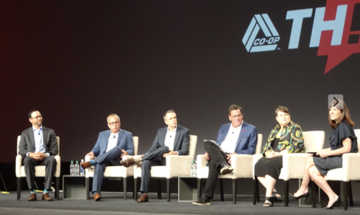
Panel discusses CU issues during THINK meeting
Those questions and others were examined during CO-OP’s THINK 19 meeting here. Participating as panelists were Nikhil Lele of EY; Chuck Purvis, CEO of Coastal Credit Union; Dean Michaels, chief strategy officer with CO-OP; Ben Morales of Washington State Employees CU, and Dr. Stephanie L. Woerner, research scientist with the MIT Sloan School of Management.
The session was moderated by Jean Chatzky. Here is a look at some of the issues discussed:
Chatzky: Financial institutions are at a fork in the road between selling products or solving problems. Do you have to make a decision?
Woerner: I think you have to make a decision. If you are selling products, then you will be selling on price.
Purvis: Sometimes you need a crisis to motivate you to change. In our organization, for our first 30 years we were an IBM credit union and that was pretty easy. For the next 20 we expanded and became a low-income credit union. And then the financial crisis came and we weren’t prepared and we got in trouble. Members were in trouble.
We spent the better part of four years recovering, and that forced us to rethink what we were about. We had lost our story. The story is the brand and we didn’t have a brand by the time we recovered. Two words really reshaped the organization: “We Care.” It has shaped everything we do. Our business model starts with employees. A lot of CEOs go to work every day thinking members are their number-one priority. I go to work every day thinking our employees are my priority. If they are not engaged, members will not be engaged.
The third leg is the better job we do for members and helping them as individuals. The more people they tell, the more people who join, and our financials get even better.
The fourth leg is we’re now able to take some of our financial success and put it into the community. We have now financed 60 Habitat houses.
Chatzky: If digital transformation is the next wave, how can we ride it rather than be pulled down by it?
Lele: For us digital transformation is just one part of the story. Effectively, digital transformation meets a brand new reality, which is a completely different reality. It’s at the intersection of those two things where we see a fundamental reframing of the industry taking place.
What that means is products are a zero-sum game for any FI that sells them. They’re transactional, they’re about stealing share, they are about a scarce resource–the consumer’s attention. The pivot is to more life event thinking. It changes how you serve the consumer. It’s no longer about banks competing with banks and credit unions competing with credit unions. It’s about all types of retailers; any institution now has access to virtually any product. It’s about how you think about the needs of the consumer through very complex life events and it spans an entire set of complex needs.
Today, the way the industry is set up and the way you serve those needs is very fragmented. We’re seeing FIs rising to become three things: Financial navigators that help consumers make wise decisions. Two, financial concierges that help them access the services they need beyond the financial product. And finally, financial therapy.
What our research has shown is that no matter what decision a consumer is making, in the context of a life event there is a very strong mix of both positive and negative emotion in the consumer’s mind. It’s about emotional, rationale, and convenience.
Chatzky: How do we use technology to put us in the middle of these stressful life situations to be that therapist or concierge?
Michaels: I think about it a little bit less from a technology perspective and a little bit more around the business model and are you solving problems. When I think about where credit unions fit, to me, and the data show it’s a rough fight, it’s around ecosystem and the tech to support that ecosystem. I think that’s the opportunity for credit unions. And that means data and using that data to know members, how they have transacted, and using that information to provide an answer for something they haven’t really thought of. The other part is around making all of your solutions seamlessly operate together.
Chatzky: Tell us about QCash?
Morales: Today, WSECU delivers 30,000 fully funded personal loans in about six clicks in 60 seconds. Our journey began 15 years ago when a teller observed members coming in and getting money orders to pay predatory lenders. Once we understood what was happening, we decided to do something about it and solve that problem. We spent years iterating on the solution and how to help make product relevant and help members save money. What we learned was the transition to mobile made us realize other problems needed to be solved.
Like USAA, we understand life happens. Today, we are continuing to see different use-cases evolve. It’s about how can we be there for the member when they need credit, not when they want it.
If you think about it, credit unions have the most feature-rich data out there. We don’t do credit score-based lending, we assess the data and have been able to predict their payback pretty successfully.