

MIAMI BEACH, Fla.–The big questions before credit unions are these: How do we serve each individual? How do we bring the credit union to the member, rather than have the member come to the credit union?
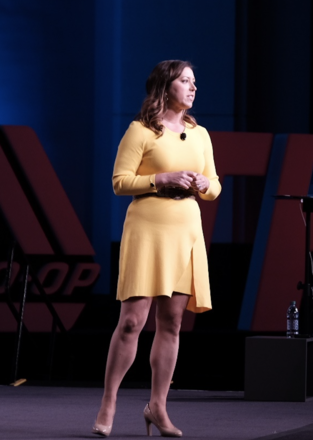
Samantha Paxson addresses THINK 19 meeting
That was a theme touched on during remarks by Samantha Paxson, chief experience officer with CO-OP Financial Services, during the opening of the THINK 19 Conference here.
Paxson argued that the transition to a digital environment and digital delivery actually enhances credit unions’ ability to serve the individual in a micro, personal way that was previously unavailable.
“Our focus this year is on opportunity,” said Paxson. “We can’t get caught up in that risky/scary mindset. We’ve seen that levels of customer satisfaction with banks has gone up and the level of satisfaction with credit unions has gone down; it’s a dead heat on consumer satisfaction. I say let’s embrace that script. Let’s embrace this moment of disruption. Let’s adopt a new business model in this new digital economy. Let’s build better, more active relationships with members to build the industry.”
Time to Be ‘Energized’
Saying it’s time to be “energized,” Paxson said credit unions should be leveraging their cooperative structure, adding that at CO-OP its focus is to “embed the cooperative spirit in everything we do.”
Credit unions likely have no chance but to band together to compete, observed Paxson, pointing to data showing during 2018 global fintech funding rose to $111.7 billion, up 120% from 2017, according to KMPG.
Google, Apple, Facebook and Amazon are redefining consumer expectations and are “moving into our space,” added Paxson, which she said only adds to the necessity to act together as credit unions.
And that leaves credit unions to take advantage of the one thing they have those fintechs do not.
‘A Trustworthy Place’
“People need us. We are still about people helping people. People need a trustworthy provider that can aggregate the services they need in one place,” said Paxson. “We have more mojo than we think we have. This is the digital relationship model. We have the opportunity to build a more relevant and rewarding relationship with each member.
We have to show up in the moments that matter to people at the intersection of life and finance. Where to start? The simple answer is payments.”
Paxson said that with P2P payments there has been a steady chipping away of the checking account as the core of the relationship.
“We need to turn it around and into an advantage using payments,” said Paxson. “At CO-OP, we have found a direct link between payments and top-level engagement and deeper, more sophisticated services with members. We can’t get to payments without teamwork, so again, it’s all about cooperation.”
Intersection of Life and Finance’
Paxson, who called payments the entryway into the intersection of life and finance, called trust the most valuable in the digital economy. “The level of trust defines the level of the relationship,” she said. “Today, that trust is defined by two things: character, which we have in spades, and capability. Members have to believe in our capability to deliver. Action always beats intention. Data helps us protect and help members. Data drives awareness, it helps us drive empathy. It allows us to have the human touch that earns trust.”
Paxson said CO-OP Financial Services is evolving into an ecosystem to give credit unions what’s needed to build and sustain member relationships.
Radical Realignment
“I believe we need a radical realignment,” she said. “We have the pieces, so let’s pull them together, together. Ultimately, we have to serve a segment of one. Credit unions will serve a market of individuals, a market of ‘me.’ How we serve each individual is the question? How do we bring the credit union to the member, rather than have the member come to the credit union?”