

MIAMI BEACH, Fla.–How well do you know your members? Do you know why they interact with you versus another provider?
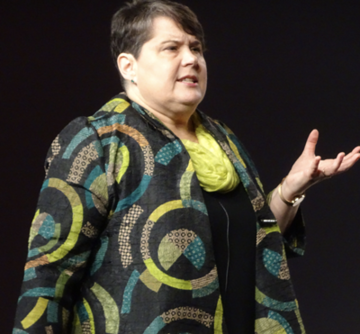
Stephanie L. Woerner talking to THINK Conference
Those questions were posed to credit unions at CO-OP Financial Services’ THINK Conference here by Dr. Stephanie L. Woerner, a research scientist with the MIT School of Management, who challenged credit unions to understand some fundamental concepts before investing in technology to compete in a digital marketplace.
Among the hardest questions of all to answer, according to Woerner: What problems are members trying to solve?
“Digital transformation is not really about the technology,” she said. “You need the technology to help you engage with your customer, and as older organizations you will find you are a particular target for a lot of disruption. You have a solid customer base, you probably have good profits, and you need to be thinking about your customer experience. It’s probably patchy, with places where it is really excellent and places where it is not. So what you need to think about is, it’s not about technology, which is there to enable it; it’s how will you engage your customers as you go through this transformation.”
Three Types of Companies
Woerner said there are three types of companies now changing the market:
- New entrants, such as Uber coming into taxi industry.
- Companies within an industry implementing a new business model, such as Nordstrom’s, which has successfully changed its model to digitally interact with customers.
- Established companies from outside an industry that enter a market, such as Amazon, JPMorgan Chase and Berkshire getting together to work on healthcare.
Two Questions
Woerner said there are two questions every credit union should seek to answer. The first is what is the digital threat and opportunity?
“When we started our research, we thought it would be more about opportunity,” she said. “But with established companies, the threat was more on their mind. Certainly in financial services you have a lot of challenges.”
Woerner said what the emergence of digital has done is made boundaries more porous, changed customer expectations, and forced companies to realize they have to work more with their suppliers and partners, as they can’t provide all the services their customers want.
The Second Question
The second question to be asked is, “How well do you know your customers?”
“Many don’t know,” said Woerner. “Do you know what they buy? More importantly, do you know their motivation is for interacting with you? What problems are they trying to solve?”
4 Business Models
Every credit union must decide into which of four segments it fits in the new digital economy, according to Woerner. Those four segments:
Supplier
A supplier sells its products through intermediaries. This is a company such as Procter and Gamble, where the majority of consumers have already made a decision before entering a store.
In the case of P&G, it has done significant research to find out more about those customers and then become stickier. To that end it redesigned its website with more content aimed at parents, such as how babies/children eat, sleep, learn, etc. “They are able to track that and see what’s really punching customers; buttons.”
OmniChannel
In this model, customers can move seamlessly between channels. In this channel, a company needs to be really good at mobile, said Woerner.
She cited USAA as a very good example of omnichannel, as the company has moved from selling just insurance to a variety of other services all based on life events, for which it offers multiple solutions. “They will tell you here’s what you need to solve a problem.”
Modular Producer
This is a company that offers a plug-and-play solution, and it’s a model that been around for more than 25 years, Woerner said.
As an example, WOERNER pointed to hotel rewards programs, which are all run by the same company that then plugs into each chain’s platforms. “These companies are technology agnostic. You have to think about what it is you are great at and can you serve it with an API? And then you have to be great at innovation.”
Ecosystem Driver
Amazon is a great example of an ecosystem driver, said Woerner. It’s a platform a consumer can go to at any time for a retail-type transaction.
“To be a great ecosystem driver, you have to be the place the customer thinks of when you have a problem to be solved,” said Woerner. “So think about what kind of destination are you? Are you the first place they think of? This is a very difficult business model. You have to be efficient, but at the same time offer a great customer experience. If you don’t have the products, you need to be able to add complementary products and services to your platform.”
Where to Be Great
Woerner recommended credit unions become “great” at:
- Telling and listening to the member story
- Gathering and using great customer data
- Building an evidence-based decision-making culture
- Thinking about multi-product, multi-channel solutions