

PHOENIX–The whole concept of “digital transformation,” which is the core focus of the THINK 18 meeting here, is a misnomer, according to one person, because it implies that “digital” is the biggest and most important part.
Instead, Brian Solis told the THINK 18 meeting, it’s the transformation that’s the key piece, and that begins with the individuals willing to be change agents.
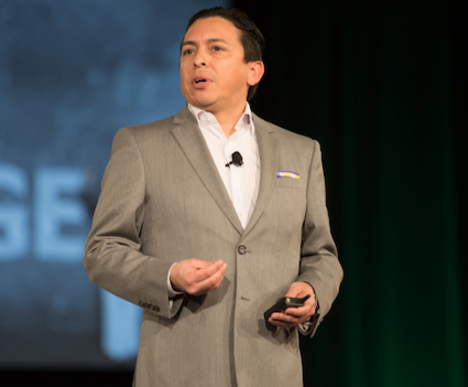
Brian Solis speaking to THINK 18.
In remarks to the CO-OP-sponsored meeting, Solis, who is a principal analyst with Altimeter Group and who describes himself as a digital anthropologist, said he remains a “hopeless optimist, and I would like to believe disruption is a choice.”
“It’s not just about the future of credit unions, it’s about the future of humanity,” he told the meeting. “How can we work if we are stuck in an infrastructure that rewards our behaviors of the past. We are measured by yesterday’s rules, and we are asked to think about the future while in the same confines.”
Research shows that Millennials view their relationship with money and finance completely differently than do those who run credit unions.
“Without purpose and inspiration and humanizing our work and giving it a mission, what’s to say we’re on the right path?” asked Solis.
Every great story of innovation and transformation is personal, said Solis. “You have to believe that you play a role in how the future unfolds. You have to believe the future will happen to you or because of you, and I believe it’s the latter.”
The New Kodak Moment
According to Solis, “The new ‘Kodak moment’ is that moment when you realize that customer behaviors and preferences changed dramatically from your assumptions, and it’s too late to change.”
The Kodak Moment 2.0, said Solis, is missing how people change and what they value.
“The Kodak Moment was so powerful for some of us; they represented memories. That’s what film gave to us. But now I want you to think about digital. Think about all those pictures on your phone that you are never, ever going to see again. They are no longer memories; they are experiences. You share those experiences, and then you move on. The relationship with pictures has completely changed.”
Moving forward and driving change, said Solis, require credit union leaders to think about what is happening and how it is relevant to someone else.
“What I hear consistently is that mindset and expertise is what works against organizations when they aspire to change,” Solis said. “We want to change, but how do we do that. Success for all its glory is one of the greatest enemies of innovation.
Solis said research has found just 7% of organizations have a culture where employees feel they can develop and try and test new ideas rapidly.
A Surprise
Similarly, he said, “I was surprised to find that just 35% of businesses had mapped the customer journey within the last year. That was down from 54% in 2016. Digital transformation is happening without understanding.”
“I have found that companies over-emphasize digital in digital transformation,” said Soli, who defined digital transformation as the “pursuit of native technologies and adaptive business models and processes to create new value for an evolving generation of customers and employees and earn relevance to markets.”
Solis acknowledged that while all that he was really talking about is change, humans don’t like change and it’s difficult.
“You are a data gatherer and story teller. We have to show the world is different than what you are trying to solve for. People aren’t sitting around the table saying ‘Great, we have to change.’ You have to be a champion.”
A New Lens
To do that, said Solis, requires a person to break their routines and processes—including sitting in meetings. “Otherwise, we iterate, we don’t innovate.”
“We are never going to challenge the rules if we don’t feel empowered to do so, aren’t rewarded for doing so, or we can’t. Without challenging the rules, any brainstorming we do will keep us constrained to a center of reference that is anchored to the past. There is a lot we have to learn, but there is even more we have to unlearn.”
What is needed, said Solis, is to view the world through a new lens that isn’t tethered to the past.
“Understanding human dynamics is where innovation begins,” said Solis. “If you’re waiting for someone to tell you what to do, you’re on the wrong side of innovation. A change agent understands what people value and what they want to become, and you connect the dots between where we are today and where we will be tomorrow.”