

PHOENIX–How willing would your credit union be to make unsecured loans to underserved populations following an online application that takes less than two minutes and involves no credit check?
Not very willing, would be the response of most credit unions. But one company that has done just that in emerging markets has used some non-traditional analytics–such as software that reads certain texts–to accurately predict risk profiles and repayments to build success.
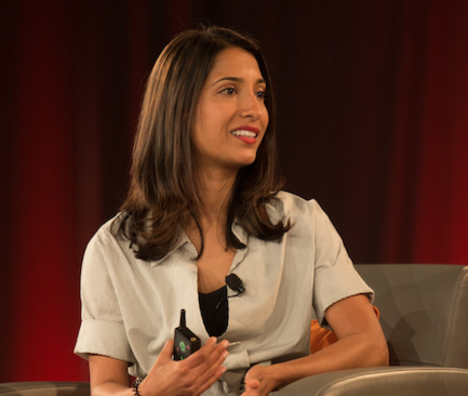
Shivani Siroya speaking to THINK meeting.
The company, Tala, which developed a real-time credit-scoring tool for micro-borrowers, is led by founder and CEO Shivani Siroya, who shared how the company has prospered and offered some lessons for credit unions during CO-OP’s THINK18 Conference here.
According to Siroya, Tala’s mission is “financial access, choice and control for underserved people globally.”
“It’s not enough to provide access to credit or to do credit scoring; it’s about how can we put our customers at the center of it all,” Siroya said. “How can we give them the tools and the identity to be in control of their financial lives?”
Siroya detailed Tala’s experiences during a Q&A that was moderated by Jean Chatzky. Here’s a look at what was discussed:
Chatzky: How does it work?
Siroya:We have started to realize consumers don’t necessarily go into financial institutions every day. About 3.6-billion people in the emerging world access the Internet just by using their smartphones. By designing something like a consumer app they already use, we could be part of the solution. They go to the Google Play store and download our app. We ask them some basic questions, five to eight, to confirm their identifies, and about 85% of customers will get credit in their accounts in under two minutes.
Chatzky: How much credit is extended?
Siroya:It is almost like a digital credit card. Somewhere between a microloan and a loan. The amounts range from $10 to $1,000. For a small business owner in an emerging market, that’s a significant amount of capital.
Chatzky: Why emerging markets?
Siroya:We were already in emerging markets. I worked at the UN Population Fund and knew those markets. As a start-up you also have to think what does the regulatory environment look like and what does the lift look like from a regulatory perspective that you have to take on. The governments in emerging markets are looking for financial inclusion, so the lack of headwinds in those markets has made it easier for us to get in and prove out this hypothesis of working from the customer up. We will eventually get into the U.S. market.
If we look at one of our markets, India, there is a government that has created a national ID system. It makes it so lenders in the market have something they can actually leverage by integrating with their APIs. That means we don’t have to create the whole value chain. We can focus on the customer and helping them.
Chatzky: Why start in Kenya?
Siroya:I find it to be an incredible case study. Kenya was one of the first markets to launch mobile money with M-Pesa. Of the 44-million people in Kenya, 70% of the population has a mobile wallet that they regularly use. When we looked across markets we saw there was this mobile money sophistication in this market. We were able to distribute with a simple back-end API to their application. It also turns out a lot of Kenyans are on Facebook and Twitter, so that’s how we initially launched, with those channels. And as for credit product sophistication, because of M-Pesa, there was already a collateralized savings product in the market, so we were able to come into the market with an unsecured product without having to introduce trust.
Chatzky: Tell us about launch and the spread to other countries?
Siroya:In Kenya, it took us about three months. We really understood the customer and the pain points. We always start with what’s our vision and then work backwards. It caused us to realize a lot of times we’re putting bells and whistles in applications that we don’t need to do. Initially, we didn’t really think anyone would use the product. Think about seeing an ad in your feed that you can get credit. We were shocked that in first week we had 1,000 people try to sign up. It validated the need for a product like this. But what surprised us the most was people told us they thought it was like magic, they liked that they felt trusted. What shifted for us internally is we’re not just a credit and data company, we are a company that has developed a relationship with these customers and we are unlocking trust.
Chatzky: Are you seeing in the repayment of these loans?
Siroya:Most microfinance is about group lending, so they are using social pressure. Our product is unsecured and there are no bureaus. Our overall repayment rate is 92%. Most microfinance lenders are generally at 95%. We have now disbursed a little over $350 million. There are about 1.4 million customers on the platform.
Chatzky: It seems your biggest differentiator is your use of data. Tell us more about that. What data are you looking at and what is most reliable?
Siroya:I break it down into three categories. We’re always first trying to control for fraud; we’re trying to make sure the person applying is the person. We try to make sure the device is actually theirs. We do have the belief that most people are good and if we can control for fraud you should be able to lend to about 95% of the population. And then what you’re using the data for is segmentation and customization of your pricing.
Once we verify the person, the second piece is around capacity. What we want to understand how much should we actually offer you and at what rate and term. What’s really interesting is that in most emerging markets, the way your utility bill or bank statement or employer interacts with you is done via text message. They don’t use email. What we’ve then done is built software that lets us look for very specific receipts. What’s useful is understanding transactions and consistency in paying bills.
The last piece is thinking about behavior and a person’s likelihood to repay us, as well as the long-term relationship we are going to have with the customer.
What we say internally is the data itself isn’t important, it’s about the stories behind the data. This includes the time of day a person makes calls. We have found that if most calls are at night than in the morning, they are more likely to be a good borrower. We found calls are more expensive at night, so this tells us something about someone’s liquidity. In Kenya, that is the case.
Chatzky: How long did it take you to connect the dots?
Siroya:We had to do blind lending at first. We lent to 10,000 customers completely blind. And then once we had that data we had information we needed.
Chatzky: How do you handle privacy issues?
Siroya:It starts with radical trust. That’s our company DNA. For customers to trust you with their data, you have to be really explicit and be transparent. Even before a customer can download the application, we tell them here is exactly what we are collecting and why. We will not use the data for anything other than underwriting purposes. Even after they give us the data, we tell them again. We want to make sure this person understands what they are really signing up for. We also have a data ethics policy.
Chatzky: What is the opportunity for credit unions in working with you?
Siroya: I think one, we can definitely provide our experience in being able to show how underserved customers have navigated a mobile experience and provide best practices. But the most exciting part of being here is our visions are aligned. WE all believe that it’s not about credit, it’s all about the relationship with the customer. We have an aligned value system. We can then talk about how there are certain factors in our models that allow us to instantly score people. It’s most important to have a high repayment rate along with a high rate of acceptance. The other issue is how to align your team and vision to have it focused on that vision.
Chatzky: How do you race to excellence at Tala?
Siroya:It’s first about how you define excellence. For us it’s about radical trust. We must fully embody that core belief people.