

PHOENIX–Credit unions, just like banks, grew up in an industrial age with an industrial model that is now “dead,” according to one person, who offered some ideas on how CUs can get new life.
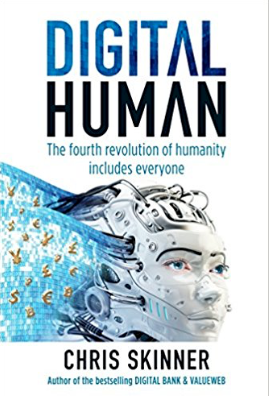
“We are now in a digital age,” said Chris Skinner, a fintech advisor and strategist and author of the book The Digital Human. “A digital age is not rolling out an app; it’s about moving to a new model from the ground up. You are going to have to scrap your existing business. Digitalization now includes every human on earth. Every human on earth is creating digital content. It’s why the world’s most valuable companies today have all the value. These companies don’t do much except connect people who have something with people who need something.”

Chris Skinner speaking to THINK 18 in Phoenix.
The market in which credit unions have competed during that industrial age has changed 180 degrees, said Skinner in remarks to CO-OP’s THINK 18 Conference here.
“What is changing now is that there are thousands of specialist companies that do one thing brilliantly well who are taking over from companies that do thousands of things in an average way,” he said. “People can now use APIs to build the very best bank in the world. It’s difficult when you are in a world accustomed to controlling everything and to being a control freak to open up to others. Most banks are becoming technology companies and most technology companies are moving into banking. There is a hybrid model being built right now.”
The Age-Old Model
For much of their existence, credit unions and banks have really been three companies, according to Skinner: a back office, a middle office, and a front office.
“Today’s digital age demands that you focus on the customer-facing function first, and build backwards,” he said. “The old model was the opposite, all about pushing product through channels to the customer. It was silo-based. We talked about process, products and people. Now we start with the people. In the digital age, the most important piece is the humanity.”
If credit unions want to know where the winners and losers in that digital age will be found, it will be in the analytics, said Skinner, noting just about every device now is “smart” and collecting data. “Code is as important in business as being able to speak English. That’s a massive change.”
The battleground in separating those winners and losers will be in pulling consumer data from fragmented systems to create “customer intimacy,” according to Skinner.
“The institutions that know us best digitally through learning will be the ones that win the most business,” he said. “This is being driven by artificial intelligence and blockchain. These are massive changes for our core systems.”
The Real Challenges
While the talk is focused on technology, Skinner said that’s not really the issue an organization must recognize and evolve.
“The challenge here is not the technology, it’s the structure of how we do things,” he said. “The real future business model of the bank is to be the curator of the apps and APIs and analytics for their customers and members. Stop building things. Curate them.”
Becoming a digital credit union is going to require another hard look in the mirror, as well, observed Skinner, who showed the meeting a photo of the typical board and management team he meets at a financial institution: all older, white men with the same backgrounds.
“Ninety-four percent of leaders of banks are bankers, and only 6% have any technology experience at the biggest banks,” he said. “When you are thinking about digitalization and where you are going to go, stop thinking about the existing banking products you provide. Most of what you do will be gone in 10 years. The future is coming from the ground up. We have to work from the top down, from Industrial era structures. How do we scale down a business to include everyone? IT’s going to be a challenge.”
Other points made by Skinner:
- The future isn’t coming from Europe and America. The future is being envisioned by Africa and Asia.
- China-based Ant Financial is the company in the world with a vision of financial inclusion. It projects that by 2025 two-billion people will be using its Alipay to buy and sell things. “Their vision is by 2025 they will be processing one-million transactions per second. Visa does about 2,000 per second globally.”
- Data is the currency today, not paper.
- The fintechs are going to discover all the regulations banks/CUs already deal with. “Technology companies are going to become highly regulated as they move into other services. If you’re a compliance officer now, you might have an opportunity to join Facebook or Google.”