

PHOENIX–Credit unions may feel threatened by Apple and Amazon, but CUs are also one of the few organizations that have something uniquely in common with those behemoths–indeed, it’s a commonality like “nothing else in the country,” according to one expert on technology and computing.
That was the bright spot for CUs in an insightful presentation that was equally encouraging and frightful regarding what is taking place in the world and whether it will lead to a better future, or a dystopian one.
First, the good news from Jaron Lanier, a Silicon Valley entrepreneur who sold his virtual reality firm to Google, is that credit unions are one of the very few entities in the U.S. with a set of unique traits.

Jaron Lanier speaking to THINK 18 in Phoenix.
“You have a tremendous opportunity,” said Lanier in remarks to CO-OP’s THINK 18 Conference. “How many organizations have passed the 50-million mark, have relationships that have some financial component, and also have a trust component? Precious few. Apple. Amazon. Collectively, the membership here has the potential to completely change the system to the benefit of your own personal members. The value of the relationship you have to individual members is undoubtedly better than anything else you have.”
Lanier noted that Facebook, for instance, paid $19 billion for WhatsApp and that company had no financial relationship with its users.
“I’m not asking you to turn into the next evil thing,” Lanier said. “Someone will probably come along and ask you to do that. Don’t do that. I think what is extraordinary is you not only have the scale, with actual relationships in place, you have a duty to these people and they have trust in you. There is nothing else like that in this country. Do you realize that?”
The Real World
All of this is coming about in the era of Moore’s Law in which computers keep getting more efficient and cheaper. And that has led to the potential for a darker future, according to Lanier.
“My main critique of what’s going on with computation and the human experience is we’ve kind of used it to concentrate money and power in ways that are not sustainable,” he said. “We have this situation where there are certain very large computer resources that are under the control of a small group of people who are involved in some form of behavior modification who are centralizing power and wealth. What I am concerned about is if the concentration of wealth and power goes on too long, it destabilizes the world. I think we’re edging into that again. Look at the list of the world’s richest people. In the old days they were a bit more diverse. All the new ones now are close to one of these big computers.”
Artificial Intelligence–Not What Many Believe
Lanier’s remarks at THINK were part of an afternoon of remarks dedicated to artificial intelligence.
“One of my messages about AI is that the ability of AI to do things is often exaggerated. Very often, it’s kind of set up in a way that makes it look better than it really is. For instance, a smart speaker is set up to be prepared for certain things. It’s not really AI.”
As an example, Lanier cited word recognition programs that initially had lots of resources thrown at it to recognize words. But instead, programmers have turned to “brute force” in which a giant database of word sounds has been created and the technology compares it to similar sounds.
“What you have is kind of an illusion of a person,” said Lanier. “When I observe people talking to a smart speaker, they change themselves to make it work. This is the person changing themselves to make the computer look smart. It’s not a freestanding form of intelligence; it’s more of a theatrical intelligence. The reason to keep this in mind is so we don’t allow AI to snooker us. The principal use of AI today is to manipulate human behavior. This is tech companies keeping models of you and using algorithms to change you in little ways.”
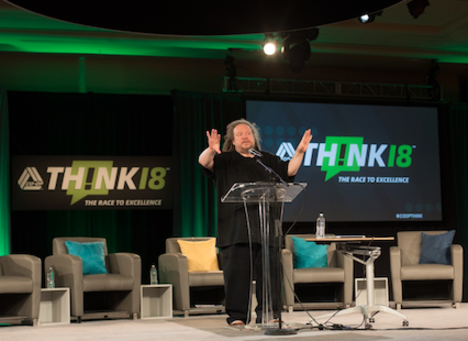
Jaron Lanier at THINK.
Algorithms are “not perfect,” cautioned Lanier.
Engagement, or Addiction?
“If you want to change somebody’s behavior, which the companies do, you don’t get exactly what you want all the time,” he said. “What you get is a sliver beyond random. The thing is if you apply that consistently you begin to have an impact.
“We talk about engagement a lot. I prefer addiction,” he continued. “And instead of advertisers, I prefer paying behavior manipulators. Once you’re captured, it’s not necessarily a good deal for you. Do you know Amazon will charge two different people different amounts for the same thing based on an algorithmic estimate of how much you can afford to pay?
And for those who aren’t bothered by what’s happening, Lanier added, “If you’re shocked by this, you haven’t been paying attention.
New Channels for Credit Unions
As the world changes, Lanier said credit unions are perfectly positioned to change with it, but they need to think in new ways. For instance, he said there could be an opportunity for credit unions in the gig economy.
“It makes people more vulnerable to the contingencies of life. The fact is it reduces the status of people, such as those doing the driving of taxis. That could potentially happen to anyone,” he said. “Or, (credit unions) could create a membership system to make it easy to log in to pay for things (across merchants and platforms). You have created an easy way for them to be paid. If the credit unions of the world created an identity service, people could be paid for providing data. It’s a whole new world of a potential economy in which you are paid for data instead of having it taken from them.”