

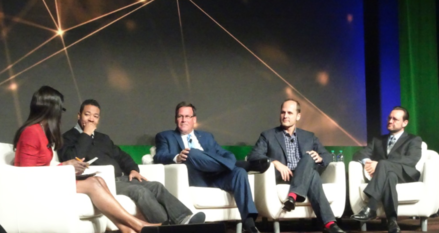
NEW YORK–Two international experts on disruption and innovation and two credit union CEOs talked about those issues, employment issues, what they are doing at their CUs and more during a panel discussion here.
Addressing CO-OP Financial Services’ THINK 17 meeting here were Rowan Gibson, president of Innovation Bridge; Laszlo Block, former SVP with Google; Chuck Purvis, CEO of Coastal Credit Union, and Ronaldo Hardy, CEO of Southwest Louisiana Credit Union.
Here’s how they responded to the questions asked of them:
Q: Talk about innovation and disruption:
Hardy: Other organizations are disruptive because they can see something from the outside. But sometimes, too, you can try to bring innovation to a space without that knowledge and cause yourself more harm than good.
Purvis: It’s interesting how often innovation comes out of mistakes. About 14 years ago we put a new technology into branches and made a big financial investment in tellerless branches, and it was a disaster. Members hated it. Our choice was, do we go backward or do we further innovate and find a better way to do it? It led us down the path to video tellers. We have no tellers in our branches, and that is now taking off in the country. We knew a lot about the subject, but the execution in the first pass wasn’t very good.
Block: It’s a mistake to assume there is one path to innovation. It often happens at the intersection of two fields and there is really cool stuff at the overlap. Few people have expertise in more than one area. So, if you can get together a team of people with diverse perspectives you can do cool stuff.
Gibson: I would like to be a contrarian and challenge that orthodoxy. The more you know about a particular industry, the more blinded you tend to become because you develop patterns of thinking. One of the things I mentioned is the newcomers are the biggest threats because they come into an industry with no preconceptions. If you’re a start-up you think from perspective of the customer.
Q: How can we bring more innovation to hiring people and keeping them inspired?
Gibson: We talk about embedding innovation as an enterprise capability. If that’s the case, then it has to be HR and finance and IT. HR is a function of the company where you can be just as innovative as anywhere else in the company. I read recently about an IT company that was hiring autistic people because they found they are incredibly good at sort of monotonous processes, and where they had been disenfranchised in many opportunities, because this company had a lot of processing types of work.
Block: There is a lot of interesting ways to de-bias the hiring process. There are lots of tiny things we do that we don’t realize. Removing names and information from resumes that removes hints at gender makes a difference. There are lots of opportunities to apply science to offset the bias we have.
Gibson: This idea of talent migration that allows people to migrate to the things that interests them the most, that’s fantastic. We see it at Whirlpool and other companies.
Q: When you hear all this, about the field moving toward behavioral economics, that it needs to come into credit unions, what are your thoughts?
Purvis: We are a mission-driven organization. I have a lunch with all our new employees every month and one to the things I tell them is, ‘We are in the dreams business.’ We make dreams come true when a new college grad comes for a car loan. We are doing a lot of work to ensure our employees are connected to that mission. Half of our employees will not interact with members on a given day, and we have to humanize that connection. Our whole model is about needing highly engaged employees, and if we have that they will provide exceptional service to our 230,000 members, and if we do that well the financial side of the business will take care of itself. We are very transparent. We encourage people to move around. We look for volunteers to lead projects.
Q: When we talk about culture, what are your thoughts about work space and efforts at collaboration?
Hardy: Culture is something that every organization I have been a part of has focused a lot on. We get so caught up on the external brand piece, and we forget about the internal piece and how the two of those need to deliver synergy. They have to marry well and reflect each other. We have worked hard to build in collaboration in the workspace; to me it’s non-negotiable. But we do have to work to build it. At a previous credit union, we would come together in the boardroom and work together. We found when we were working together as an executive team we were able to work better by being in the same room.
Q: Tell us more about your messaging around members as owners.
Purvis: The CEO of a public bank gets paid to take money from customers and give to stockholders. Our business is just the opposite; I get paid to generate financial benefits of our members. Our incentives are to lower loan rates and raise deposit rates. For the last couple of years, we have been tangibly measuring for our members the financial benefits to them versus doing business with a national bank. Our goal is to do that at the individual member level. We have 230,000 members with unique needs; half of our membership lives in low-income census tracts. Half are former IBMers. We are working on an initiative on developing a financial health score. We sent out a survey to help us see how prepared we are to serve with them.
Hardy: I do think we are not doing the best job communicating the membership piece and helping them to understand what that really means to them. We are also not doing the greatest job of helping our members to connect with one another. We were one of the original social networks, but we are not leveraging that so they feel connected to other people in the process.