

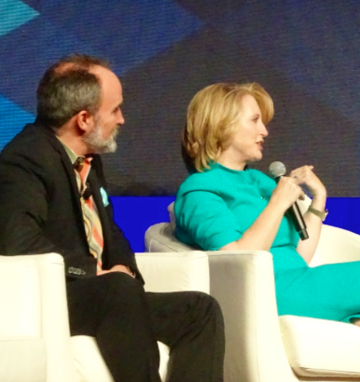
David Rogers (L) and Michelle McKenna-Doyle
NEW YORK–A Columbia Business School teacher and an NFL executive responded to credit union questions during CO-OP Financial Services’ THINK 17 meeting here.
One takeaway: credit union execs were urged to not “fall in love with your brilliant solution; fall in love with solving the problem for your members.”
Here’s a look at what credit unions asked, and how David Rogers of Columbia Business School and Michelle McKenna-Doyle, SVP/CIO with the National Football League, responded.
Q: How do innovation teams work within organizations?
Rogers: The interesting question is where to put these innovation teams? Do we set them up by themselves so they can be super-innovative? Then the challenge is bringing (the innovation) back into the organization. Or is the whole organization involved? Other models include having someone be allowed to work on projects that have sponsorship from other parts of the organization. And another model lets you take a sabbatical and leave your current positon to take a new role, while you backfill the old.
Q: Failure or “failing fast” is one thing when you’re a huge company, but quite another when you’re a not-for-profit credit union. So how does failing fast work in smaller organizations?
Rogers: I think it’s hardest in big organizations, where the culture is more traditional.
McKenna-Doyle: I agree. It was so much harder to change at Disney (where she was formerly in senior management) than at the NFL, which is a huge brand but a small organization.
Rogers: People ask, ‘How do I change that if I’m risk averse.’ A great example is Tata, which is based in India and which has many different units. They had for years a series of innovation prizes. And everybody was putting their best foot forward. One year the CEO said we’re going to have a new prize for best failure. Three or four people applied the first year. What he did as CEO when the award came out, he brought that winner up on stage and talked about why it was a great project and what they had learned from it. Now they have as many companies applying for that as any other reward. With failure, it’s about talking about how you do it and leading to results. Failure and success come out of the same process.
Q: How do you use data to understand where members are?
McKenna-Doyle: This is often where people get tripped up. When data sets are used for operational purposes and you try to extract them for customer interface issues, you really have a problem if you only have operational data. There has to be a translation layer there. It’s very hard and expensive to do. But you can’t do the transformation without doing it.
Rogers: And that’s one thing that doesn’t have a short time frame. There’s no way to do that in just 12 months.
Q: Was there any insight in the research (see separate CUToday.info story) that explained the high level of support from senior management for change, but also that lack of funding was a large barrier to change?
Rogers: How I interpreted that is that almost everyone said the budgets are going up. It could be that the budget was zero and now $10. But I don’t think that’s the answer. I think budgets are always growing, but it’s about how you allocate the budget. How do you invest? It’s very different from how most companies budget. Learning to invest in that way will make that same budget go much further.
Q: So how do we find the projects to seed and then dole out the budget?
Rogers: One way is to ask the degree of importance to the business in the time frame you are in. You don’t want to fund projects, you want to fund problems, and know the order of importance. Then, you want to get multiple different ideas or projects to help solve that problem, and then have them compete for that money. The projects also need to be with the same degree of risk. Some projects are basic ‘improving what you already know.’ And then there are other opportunities that are much more unknown, but it’s investing in the options. Those you want to invest in, but you don’t want to give them the same money as fixing a core problem in the business. Don’t fall in love with your brilliant solution, fall in love with solving the problem for your members.
Q: How do you know when to admit failure?
McKenna-Doyle: I think in a project world, often that’s when you’re about to have a breakthrough. You do have to have some patience. But I think if you find yourself in a discipline of having the right kind of status updates and you start seeing the same issue update after update, my rule of thumb is if I see it five times it’s either cut the project or cut the issue. I think having good governance around project management helps you to make those decisions.”