

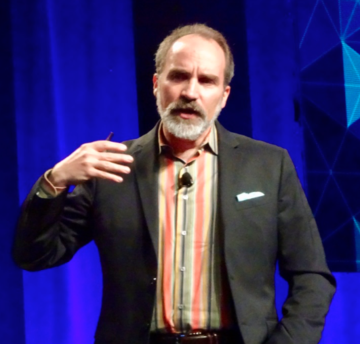
David Rogers
NEW YORK–How does any business started before the Internet evolve and adapt to grow and reach the next stage of profitable growth in the digital economy?
One person offered up a “playbook” credit unions can use to approach that question and find some answers.
David L. Rogers, author of The Digital Transformation Playbook and a teacher at Columbia Business School, told CO-OP’s THINK 17 Conference that if credit unions recognize nothing else about the concept of “digital transformation” it is that it isn’t about technology.
“What I’ve seen coming up more and more is this ‘digital transformation.’ It’s kind of become a buzzword,” said Rogers. “But it’s important to clarify what do we mean by this? It’s said so many times in conferences today. For me the definition is that digital transformation is really a question: How does any business started before the Internet evolve and adapt to grow and reach the next stage of profitable growth in the digital economy?”
That is a very different question than how do you create a great start-up, noted Rogers. Companies that have been around for decades or more have certain advantages, he acknowledged, such as having resources, talent, customers, and relationships. But that comes with baggage, as CU management can be hindered due to operating based on prior experience likely needs to shift.
“If I could boil my entire book down to one sentence it’s this: digital transformation is NOT about technology,” Rogers said. “The key isn’t the technology; it’s actually about changing way you think as an organization. The challenge is that companies, like people, learn from experience. That’s actually a good thing, as you are born with an elastic mind, but as you grow your experiences shape your assumptions. The way you look at opportunities and new experiences is shaped by everything you’ve been through before. Organizations are exactly the same. If that history took place in a radically different environment, a pre-digital environment, and now you are operating in a completely different environment, you need to recognize some of the assumptions you are making.”
The Five Core Domains of Strategy
Rogers said the five core domains of strategy are Customers, Value, Competition, Data, and Innovation. “We need to start thinking differently about each,” he said.
Customers/Members
“We are shifting thinking from treating customers as passive targets and now need to think of them as dynamic networks. The twentieth century was all about mass marketing and economies of scale and meeting the needs of as many people as possible through the media the most people you are trying to sell to are watching,” said Rogers. “Today, marketing is much better understood as thinking about members as part of a network. They aren’t waiting to hear from you. They are as enmeshed in all the platforms and technologies you are. This is partly about realizing consumers are connected in so many ways today.”
Competition
“We’re moving from a world that was symmetric to asymmetric, from competing with companies that looked just like you with products they created themselves…to a broadening of the definition of who is a competitor to a company,” Rogers said.
As an example, Rogers pointed to Toyota as a car brand and the names of its traditional competitors, such as Honda, Ford, GM and Tesla. But other competitors must now be considered, too, such as Uber and Google.
“I don’t think Google wants to become a car manufacturer; the margins are too slim,” said Rogers. “But what happens to Toyota if Google become the Android for cars, or the Windows PC equivalent. What if people say, ‘I don’t care who made the car, as long as it has Google in it.’”
“For you, you need to think of asymmetric competitors. They have a competing value proposition that’s the same, but a different business model. It can lead to different dynamics, and how you manage your relationships with them is very different.”
Data
Data, said Rogers, must move from silos to being a strategic asset.
“We’ve always had data as a business. But what’s changing is the way we use it and it’s important to the business. It’s shifting from being part of the operational strategy to a strategic asset and allows you to add more value for your members. It allows you to grow.”
As an example, he cited Caesars Entertainment, which manages multiple casinos and hotels. He said the company has been pursuing a real focus on customer loyalty, which it used to do through a loyalty program on which someone earned points that they learned about after they left the property. But what’s happened now, he said, is that the company is managing and analyzing customer data about what they are doing during their stays in minutes and seconds, and as a result it changes the game.
“It’s used to shape the customer’s experience. When a customer goes to the tables and is losing money, if you swiped a card at the table, Caesars sees it happen. They don’t want you to say ‘Oh, my luck ran out at Caesars, I’m going to Bellagio.’ Instead, they will send a message in real time to staff members on the floor with name of customer, and they will give the staff member a budget and tell them to do something special for the customer, like a steak dinner or show tickets. Not only can they do this, they can also measure the results and see if you are more likely to come back in the next 12 months, for instance.”
Innovation
“Traditionally, the model of managing innovation risk is about top-down decision making,” said Rogers. “(The old model was) the placing of a big strategic bet by the smartest, most informed people. The new model started in Silicon Valley with companies with lots of ideas but no money. But they were doing so in a market where you could innovate and launch a product every day practically for free. Now it’s not about a few big bets, it’s about lots of small bets where you don’t try to figure out what the customer might do in advance.”
Value
Rogers said every credit union needs to ask itself “Why do we exist?”
“What’s happening today is that market needs and customer needs are changing so fast that value propositions are no longer defined by industry, they are defined by your customer,” according to Rogers. “You have to look at every new technology not for how it affects the business, but instead, how it might this affect your next business.”