NEW YORK–A new survey reveals shifting attitudes among employers and employees related to productivity gains and working from home.
PwC reported its second survey into attitudes about remote work finds U.S. executives and employees converging around a post-pandemic future with a lot more flexibility, yet few are prepared to completely abandon the office space, according to the company.
“As a result, by design or default, most companies are heading toward a hybrid workplace where a large number of office employees rotate in and out of offices configured for shared spaces,” PwC said. “This model embraces the flexibility that most employees (and some employers) crave after working from home for months. It’s also a complicated way to organize the work week and is likely to transform a company’s culture, employee engagement, the way the work gets done and how office space is used.”
The survey, which was conducted ahead of the mass rollout of the COVID-19 vaccine, included 133 executives and 1,200 office workers in November and December 2020.
The Key Findings
Among the key findings, according to PwC, which also provided the analysis below:
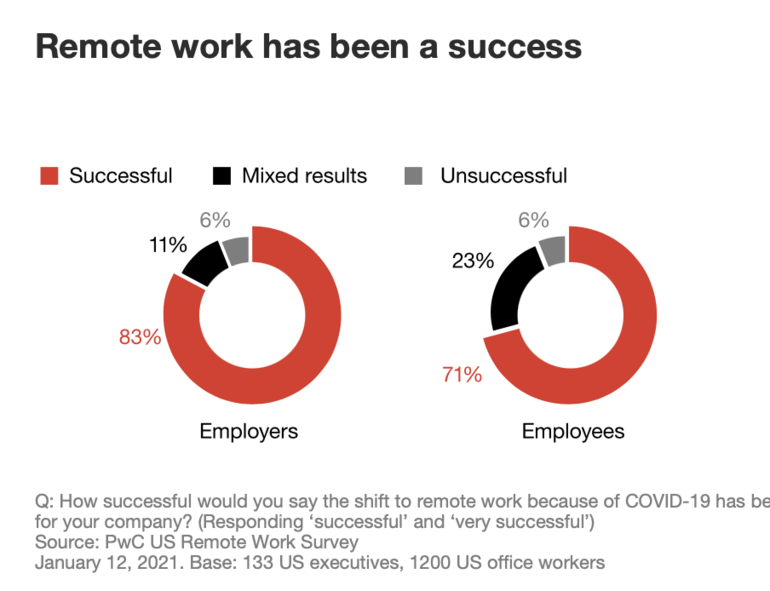
- Remote work has been an overwhelming success for both employees and employers. The shift in positive attitudes toward remote work is evident: 83% of employers now say the shift to remote work has been successful for their company, compared to 73% in the company’s June 2020 survey.
- The office is here to stay, but its role is set to change. “Less than one in five executives say they want to return to the office as it was pre-pandemic. The rest are grappling with how widely to extend remote work options, with just 13% of executives prepared to let go of the office for good. Meanwhile, 87% of employees say the office is important for collaborating with team members and building relationships — their top-rated needs for the office.
- Employees want to return to the office more slowly than employers expect. By July 2021, 75% of executives anticipate that at least half of office employees will be working in the office. In comparison, 61% of employees expect to spend half their time in the office by July.
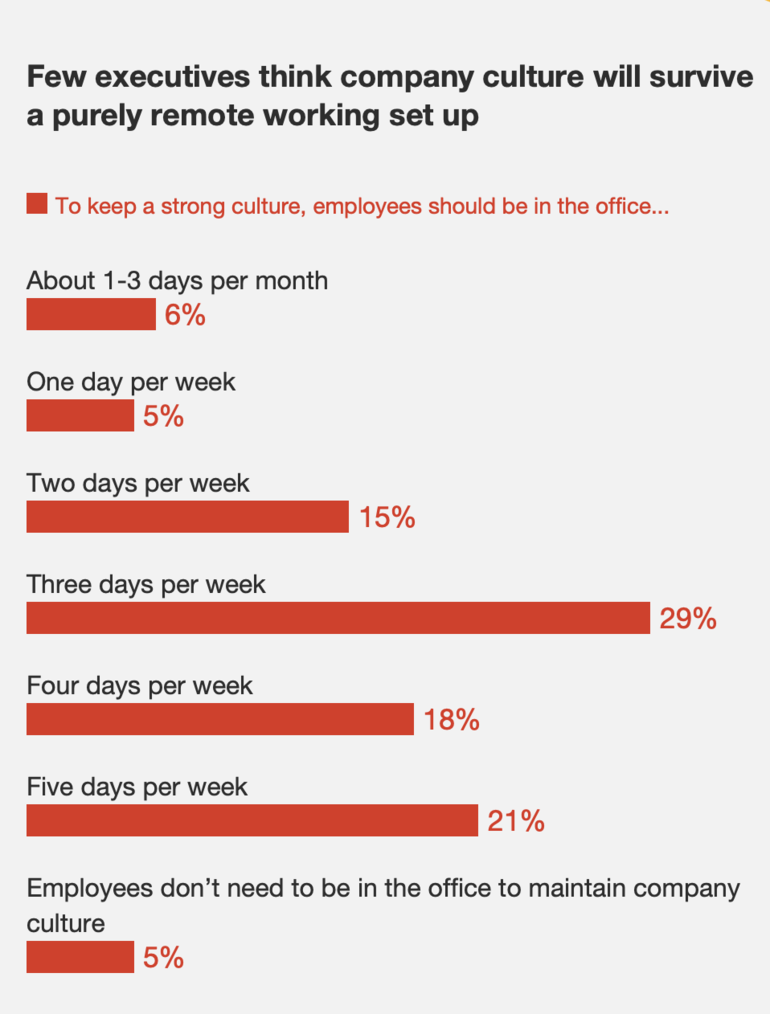
- There’s no consensus on the optimal balance of work days at home vs. in the office. Over half of employees (55%) would prefer to be remote at least three days a week once pandemic concerns recede — little changed from the 59% who said the same in June. For their part, while most executives expect options for remote work, they are also worried about the effects: 68% say a typical employee should be in the office at least three days a week to maintain a distinct company culture.
- Least experienced workers need the office the most. Respondents with the least amount of professional experience (0-5 years) are more likely to want to be in the office more often. Thirty percent of them prefer being remote no more than one day a week vs. just 20% of all respondents. The least experienced workers are also more likely to feel less productive while working remotely (34% vs. 23%). They’re more likely to value meeting with managers or company training programs than their more experienced colleagues.
- Real estate portfolios are in transition. Most (87%) executives expect to make changes to their real estate strategy over the next 12 months. These plans include consolidating office space in premier locations and/or opening more satellite locations. Over the next three years, while some executives expect to reduce office space, 56% expect to need more. These mixed findings show that some companies are planning to reinvest the remote work dividend in new ways in order to create a special experience in the office.
Much Can Change
“Though almost all companies surveyed expect to be back on their premises and able to support 50% capacity by the end of 2021, much can change,” noted PwC. “Companies are making their own plans about if and when to go back to the office — and by what proportion. There is no set template.”
Among the other findings:
- At the same time, the pandemic is accelerating an outward migration of knowledge workers from New York and California to less-expensive locales. Raleigh, N.C., and Austin, Texas, the top real estate markets at the start of 2021, are among the boomtowns attracting more than their share of young workers. Several recent high-profile corporate relocation announcements suggest that some employers are inclined to follow this migration.
- “Given the trends accelerated by the pandemic, executive leaders need to quickly articulate what their office is meant to accomplish,” PwC said. “That clarity will enable them to reimagine how and where their work gets done, how much office space they need and how to support employees to be effective in any work environment.”
- Remote work productivity is not just a fleeting crisis phenomenon. Findings from this second survey should help dispel concerns among the skeptics that work-from-home (WFH) is less effective. Instead, this data should draw attention to specific actions companies can take to help their workforce perform effectively in any environment. A majority of employees surveyed say their companies have been successful in finding ways to make WFH more productive. Allowing the flexibility needed to manage family matters is rated highest: 79% of employees say it’s been a success.
The full survey can be found here.