

WASHINGTON— Consumers want fintech firms that offer bank-like services to follow the same rules as traditional banks, according to a new survey conducted by Morning Consult on behalf of the American Bankers Association.
The survey found overwhelming support for applying the same consumer-protection standards to companies offering services such as checking accounts, savings accounts and loans. Fully 84% of respondents agreed that businesses providing bank-like services should be held to the same regulatory standards as banks.
Consumers also said regulatory consistency matters when deciding where to keep their money. By a 71% to 9% margin, respondents said they care whether the company handling their finances is subject to the same legal and regulatory requirements as banks.
At the same time, the survey found Americans urging caution as policymakers consider new rules for digital assets such as stablecoins and cryptocurrencies. By a 6-to-1 margin (62% to 10%), respondents said Congress and regulators should avoid steps that could undermine the existing financial system, particularly community banks that support local economic activity.
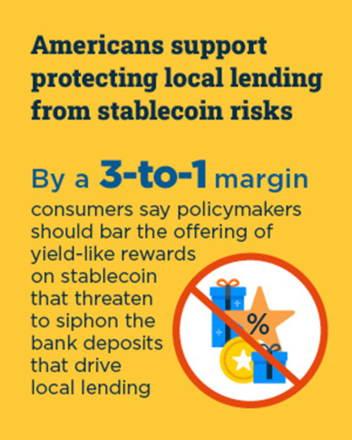
Respondents also expressed concern that stablecoins could pull deposits away from traditional institutions. By roughly 3-to-1 (42% to 15%), consumers said Congress should prohibit stablecoin issuers from offering interest or rewards if doing so could reduce funds available for bank lending in communities.
Despite the attention surrounding digital assets, adoption remains limited. The survey found 90% of consumers do not currently own stablecoins, 80% have never owned one, and only 17% said they are likely to buy, hold or use stablecoins within the next year.
“Consumers are clear: Any fintech or crypto company offering bank like products should be held to the same rigorous standards that apply to banks,” said Rob Nichols. “At the same time, Americans urge caution as Congress considers the first-ever rules for digital assets like stablecoin.”
The survey also examined views on credit cards, finding most consumers see the market as competitive and valuable for managing finances. About 69% said the credit card marketplace is highly competitive, while 73% said access to credit cards is important for managing household finances. Fraud protection ranked as the most valuable benefit, followed by rewards, emergency access to credit and convenience.
Consumers also expressed skepticism toward proposals that would impose government price controls on credit cards. Roughly 65% said a one-size-fits-all interest-rate cap ignores the fact that consumers have different financial circumstances, and a similar share said they would oppose a cap if it resulted in higher annual fees. Many also voiced concern that such policies could reduce credit access or lead to account closures and lower credit limits.