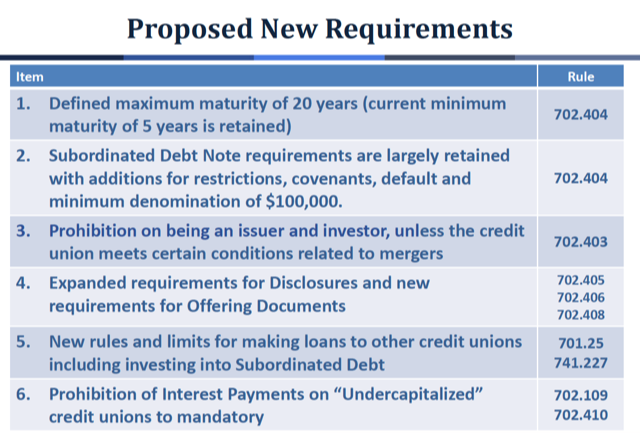
ALEXANDRIA, Va.–The NCUA board has put out for comment a proposal to amend its rules on subordinated debt that would double the number of complex credit unions eligible to issue such debt.
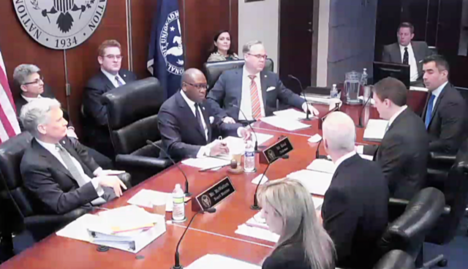
The proposal is sufficiently complex that the board has put it out for 120-day comment.
Included are NCUA’s rules in 12 CFR parts 701, 702, 709, and 741. Most significant to the proposal, NCUA said in materials submitted to the board, is the addition of a new subpart in part 702 – Subpart D – Subordinated Debt, Grandfathered Secondary Capital, and Regulatory Capital. NCUA is projecting it will need to spend an additional $1 million annually to secure in-house and external legal counsel to deal with the rule and the expanded number of applications that are expected.
The proposal has been in the works and under discussion for approximately six years, with board member J. Mark McWatters championing the issue during his term on the board, including as chairman. Given strong positions around credit unions and subordinated debt, McWatters said he anticipates a “rigorous” comment period.
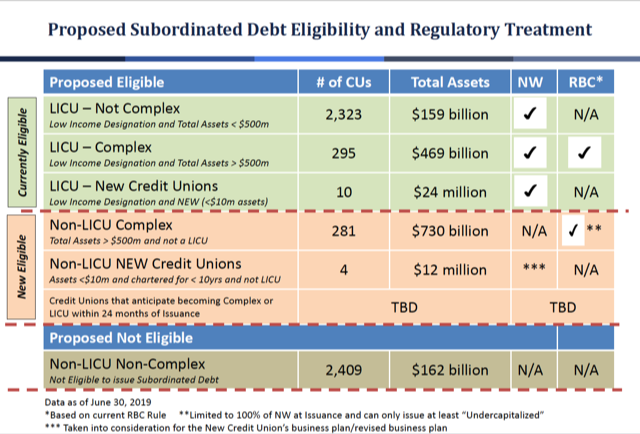
The proposed rule would permit low-income designated credit unions (LICUs), complex credit unions, and new credit unions to issue subordinated debt for purposes of regulatory capital treatment. Approximately half of all federally insured credit unions already qualify for a low-income designation. NCUA staff said the proposed changes would not affect a LICU’s ability to include such instruments in its net worth.
Other Provisions
NCUA staff said the proposal would also grandfather any secondary capital issued before the effective date of a final subordinated debt rule, and would preserve the regulatory capital treatment of grandfathered secondary capital for 20 years after the effective date of a final subordinated debt rule.
Other proposed changes include: a new section addressing limits on loans to other credit unions; an expansion of the borrowing rule to clarify that federal credit unions (FCUs) can borrow from any source; revisions to the RBC Rule and the payout priorities in an involuntary liquidation rule to account for subordinated debt and grandfathered secondary capital; and cohering changes to part 741 to account for the other changes proposed in this rule that apply to federally insured, state-chartered credit unions (FISCUs).
Presenting the proposal to the NCUA board were Larry Fazio, director of the Office of Examination and Insurance; Tom Fay, manager of capital markets in the Office of Examination and Insurance; Julie Decker, risk officer with the same office, and Justin M. Anderson, senior staff attorney.
Four Key Objectives
According to NCUA staff, there are four key objectives in the proposal:
- Incorporate lessons learned from the current secondary capital rule, commenter feedback on the 2017 ANPR, and input from outside counsel
- Provide responsible regulatory relief by authorizing new and complex credit unions to issue subordinated debt
- Make other improvements and provide additional flexibility for LICU use of secondary capital
- Reorganize applicable sections of the NCUA’s regulations in a logical, clear and transparent manner
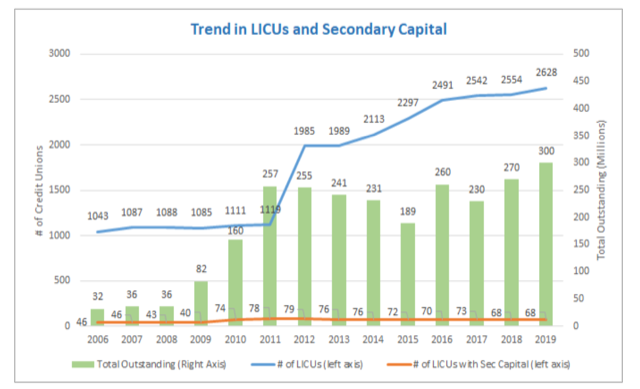
Fazio said he does not anticipate a big uptick in the number of CUs using secondary capital, but an increase in the dollar amount should the proposal ultimately be approved.
Agency staff stressed the proposal includes no new requirements, and the goal is to provide greater clarity and disclosures, including for investors.
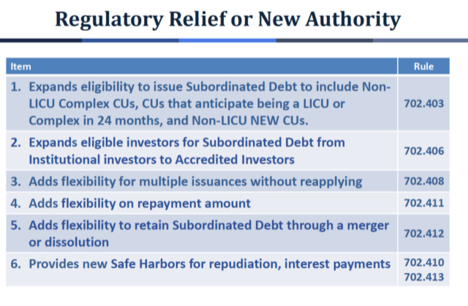
According to NCUA staff, the regulatory relief or new authority being proposed can be seen in the chart at right.
The newly eligible credit unions include 281 CUs representing $730-billion in assets defined as non-LICU complex CUs, and four CUs representing $12 million in assets defined as non-LICU new credit unions (see chart at right).
Some 2,400 non-LICU, non-complex credit unions will not be eligible to issue subordinated debt.
NCUA staff said they expect to add two legal staff and retain outside legal counsel with expertise at a cost of approximately $1 million annually should the proposal become a rule.
Fazio said staff is projecting between 20 and 40 new applications per year under the proposal, and while that is not a significant shift in number, where the shift will occur is from LICUs to complex CUs seeking to issue subordinated debt.
The final proposal can be found here.
Board Member Comments
NCUA Chairman Rodney Hood noted many LICUs have a strong record of using subordinated debt to protect against future losses, and said giving 285 more credit unions greater flexibility to augment capital planning and operations is a good move.
He added the agency has taken steps to protect the NCUSIF under the proposal.
In speaking to the agency staff on hand, Hood asked whether subordinated debt would be used to acquire banks (an issue dealt with separately during the NCUA Board meeting).
“It’s a good question,” agency staff responded. “The credit union is required to provide us with a plan. We don’t essentially mandate what a credit union does with its capital, but even with our proposed plan it would be binding constraint. They could lever up, but there are some backstops in the proposal.”
Harper’s Comments
Harper told the meeting in his view “capital is king,” and that he is pleased to see clarifications that would protect taxpayers and credit unions.
“Overall, the comprehensive, proposed rule strikes a good balance,” said Harper.
Harper stressed it must remain clear subordinated debt is not federally insured.
McWatters’ Statement
NCUA Board Member McWatters referred to the various financial crises he has witnessed during his career, often due to an overconcentration or risk.
“Regardless of the over concentration of financial resources and the resulting asset bubbles, the adverse economic consequences arising from these events would have been substantially mitigated if the relevant financial institutions had held sufficient levels of regulatory liquidity and capital,” said McWatters. “As bedrock philosophy, prudent regulators operate with the following two fundamental mantras: more liquidity is better than less liquidity and more capital is better than less capital.”
McWatters’ full statement can be found here.
CUNA Statement
Following the NCUA board vote, CUNA issued a statement saying, "“We appreciate the NCUA continuing to keep a critical eye on how stringent regulatory compliance standards affect credit unions’ ability to serve their members. We look forward to reviewing today’s proposal, and will engage with the NCUA on how to ensure that credit unions can remain the best financial partner for consumers across the country.”
NASCUS Response
NASCUS President and CEO Lucy Ito issued a statement saying, "We are pleased that the NCUA Board is considering a subordinated debt rule. NASCUS has long held that subordinated debt should be a tool for well-managed credit unions to meet risk-based capital requirements and as an additional line of defense to protect the National Share Insurance Fund. We appreciate Board Member McWatters’ continued efforts to bring subordinated debt to the NCUA board table and we applaud Chairman Hood and Board Member Harper’s support for an extended comment period of 120 days, which will allow state supervisory agencies and all stakeholders the opportunity to thoroughly examine the lengthy and complex proposed rule."
NAFCU Response
“NAFCU has long supported the ability for all credit unions to issue some form of alternative capital as this will provide them with increased flexibility to make loans in their local communities,” said NAFCU Executive Vice President of Government Affairs and General Counsel Carrie Hunt. “We will be reaching out to our members for their detailed feedback on this proposal, and note that we support the goal of providing another tool in the toolbox that credit unions could use to help mitigate the impacts of the risk-based capital rules, offer more products and services to their members, and foster a vibrant economy.”