HOBOKEN, N.J.– A college education can include numerous courses related to risk and rewards, but what about the risk and rewards from choosing a college or university itself?
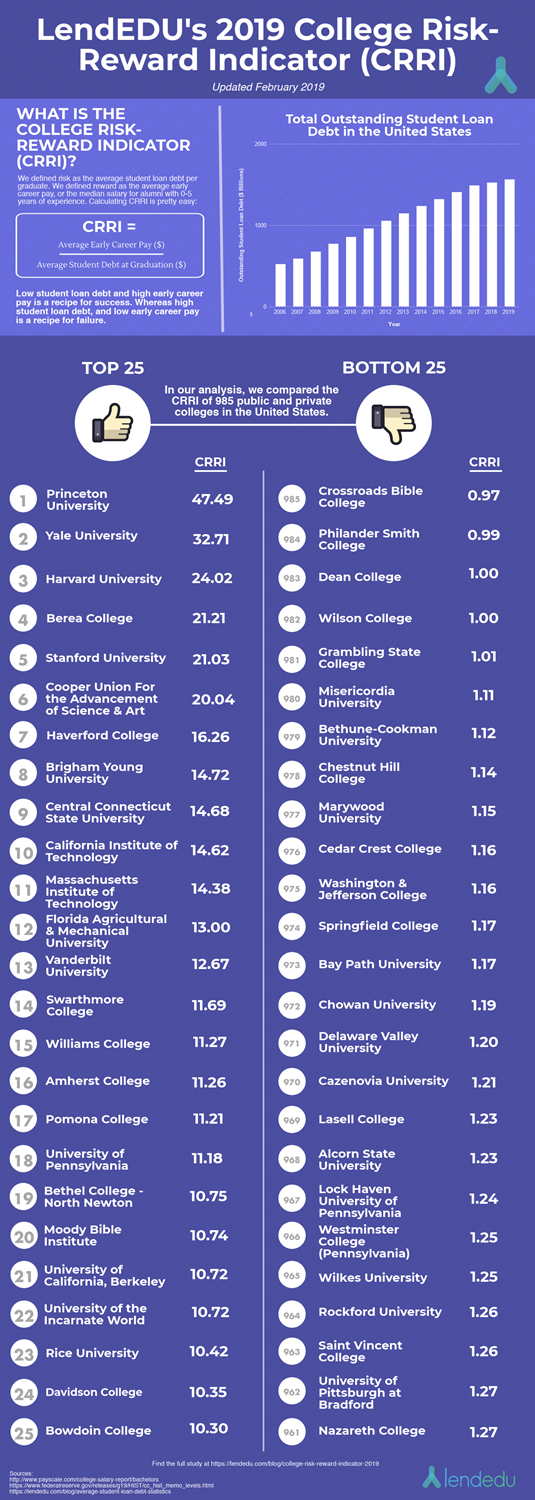
To help students figure out whether certain colleges may be a good investment for them, LendEDU has released its annual College Risk-Reward Indicator (CRRI) Study. The study analyzes nearly 1,000 four-year not-for-profit colleges and universities in terms of average debt per graduate and average early career pay for graduates.
The purpose of CRRI is to gauge the risks of attending a university in terms of expected debt against the expected earnings for graduates.
A Look at the Costs
According to LendEDU’s most up-to-date cost of college statistics, attending the average four-year private institution in the United States will run you $50,900 per year.
Even a public college or university will typically cost $40,940 annually for out-of-state students. Staying in-state to receive a diploma from a public university costs roughly $25,290 per year, LendEDU noted.
While some students and their families have the means to pay for the costs of college with savings, scholarships, or grants alone, LendEDU said its most recent data show 58% of college graduates leave their school with some amount of student loan debt.
“On average, that amount is $28,288 per borrower. When accounting for students that did not need student loans, the average debt per graduate drops to $16,320,” LendEDU said.
How Risk-Reward Indicator Works
For the College Risk-Reward Indicator, LendEDU said it defined the risk of attending a respective four-year college or university as the average student loan debt per graduate at that institution. The reward of attending that same four-year college or university is the average early career pay for graduates of that respective school. Average early career pay for graduates can also be defined as the median salary for alumni with 0-5 years of work experience, the company said.
To calculate the CRRI for each school, the following formula was used, according to LendEDU. CRRI = Average Early Pay / Average Student Loan Debt at Graduation
Why It Matters
Why should all this matter? According to LendEDU, “The biggest key when it comes to being financially prosperous as a young college graduate is having a low student loan debt balance and a high early career pay. Contrarily, high levels of debt and low pay is a recipe for financial hardship.”
LendEDU said its 2019 CRRI Report analyzed 985 private and public four-year colleges and universities in the United States. Schools that recorded the highest CRRI values (Princeton – 47.49) should be considered as the best risk-adjusted choices for undergraduate students. On the other hand, institutions with the lowest CRRI values (Crossroads Bible College – 0.97) should be considered the worst risk-adjusted choices for prospective students.
The chart shows some of the best and worst bargains. For more info.