

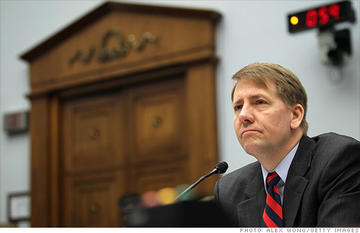
Richard Cordray
WASHINGTON–Language used in the opinion issued by the by the U.S. District Court of Appeals here in its ruling against the CFPB will likely be relished by many in the financial services industry.
In the case of PHH v. CFPB, the court found the CFPB’s structure to be unconstitutional because it is headed by a single director—Richard Cordray—rather than a multi-member board. Credit unions have for several years been calling for Congress to make the change and install a five-person board.
At issue was a June 2015 decision by CFPB Director Richard Cordray to use his authority to add a $103-million fine on top of the original $6.4 million penalty from Administrative Law Judge Cameron Elliot against PHH for violations of the Real Estate Settlement Procedures Act every time it accepted a kickback payment on or before July 21, 2008. Cordray’s decision went far beyond Elliot’s ruling, which had limited PHH’s violations to kickbacks that were connected with loans that closed on or after July 21, 2008.
PHH challenged not just Cordray’s decision related to RESPA violations, but the very constitutionality of the agency that was created in 2011 as part of the Dodd Frank Act.
The three justices of the United States Court of Appeals for the District of Columbia Circuit ruled that the CFPB’s current structure allows the director to wield far too much power, more than any other agency in the government.
“Because the Director alone heads the agency without Presidential supervision, and in light of the CFPB’s broad authority over the U.S. economy, the Director enjoys significantly more unilateral power than any single member of any other independent agency,” the court said in its opinion. “By ‘unilateral power,’ we mean power that is not checked by the President or by other colleagues. Indeed, other than the President, the Director of the CFPB is the single most powerful official in the entire United States Government, at least when measured in terms of unilateral power. That is not an overstatement. What about the Speaker of the House, you might ask? The Speaker can pass legislation only if 218 Members agree. The Senate Majority Leader? The Leader needs 60 Senators to invoke cloture, and needs a majority of Senators (usually 51 Senators or 50 plus the Vice President) to approve a law or nomination. The Chief Justice? The Chief Justice must obtain four other Justices’ votes for his or her position to prevail. The Chair of the Federal Reserve? The Chair needs the approval of a majority of the Federal Reserve Board. The Secretary of Defense? The Secretary is supervised and directed by the President. On any decision, the Secretary must do as the President says. So too with the Secretary of State, and the Secretary of the Treasury, and the Attorney General.”
In short, the court stated, the director of the CFPB is the “single most powerful official in the entire U.S. Government, other than the President” in terms of unilateral power.
“It is the Director’s view of consumer protection law that prevails over all others,” the court continued in its opinion. “In essence, the Director is the President of Consumer Finance. The concentration of massive, unchecked power in a single Director marks a departure from settled historical practice and makes the CFPB unique among traditional independent agencies.”
The court acknowledged that other governmental departments, such as the Department of Justice and the Department of the Treasury, are led by a single director, but said the difference is those agencies are “executive agencies” operating within the Executive Branch chain of command under the supervision and direction of the President, and those agency heads are removable at will by the President.
The court went on to say, “As an independent agency with just a single Director, the CFPB represents a sharp break from historical practice, lacks the critical internal check on arbitrary decision-making, and poses a far greater threat to individual liberty than does a multi-member independent agency. All of that raises grave constitutional doubts about the CFPB’s single-Director structure.”
As CUToday.info reported here, the ruling means the CFPB now will operate as an executive agency and the President will have the power to supervise and direct the Director of the CFPB, and may remove the Director at will at any time.
In its lawsuit PHH had asked for both the CFPB and the Dodd-Frank Act to be abolished, but the court did not go that far.
“With the for-because provision severed, the President now will have the power to remove the Director at will, and to supervise and direct the Director,” the court writes.
“The CFPB therefore will continue to operate and to perform its many duties, but will do so as an executive agency akin to other executive agencies headed by a single person, such as the Department of Justice and the Department of the Treasury,” the court continues.
The court further said it did not approve of Cordray retroactively applying the law to previous violations. It made that argument in the opinion this way: “Put aside all the legalese for a moment. Imagine that a police officer tells a pedestrian that the pedestrian can lawfully cross the street at a certain place. The pedestrian carefully and precisely follows the officer’s direction. After the pedestrian arrives at the other side of the street, however, the officer hands the pedestrian a $1,000 jaywalking ticket. No one would seriously contend that the officer had acted fairly or in a manner consistent with basic due process in that situation. Yet that’s precisely this case. Here, the CFPB is arguing that it has the authority to order PHH to pay $109 million even though PHH acted in reliance upon numerous government pronouncements authorizing precisely the conduct in which PHH engaged.”